Ke Liu , Zhaolun Ma , Mingjing Deng , Tongtong Ma , Shengying Li , Qingsheng Qi , Longyang Dian
{"title":"Photo-induced solvent-enabled catalyst-/additive-free selective C(α)–C(β) bond cleavage of β-O-4 ketone lignin model compounds at room temperature†","authors":"Ke Liu , Zhaolun Ma , Mingjing Deng , Tongtong Ma , Shengying Li , Qingsheng Qi , Longyang Dian","doi":"10.1039/d4gc05578k","DOIUrl":null,"url":null,"abstract":"<div><div>In this work, an efficient catalyst-/additive-free selective C–C bond cleavage of β-O-4 ketone lignin model compounds was carried out to form the corresponding carboxylic acids and phenyl formates under the irradiation of light at room temperature in an air atmosphere, providing an efficient approach to the selective carbon–carbon bond cleavage reaction without using any photo catalysts. Results of mechanistic control experiments indicated that the <em>in situ</em> generation of radicals of dichloroethane (DCE) in the presence of visible light is essential to realize the selective C(α)–C(β) bond cleavage reaction.</div></div>","PeriodicalId":78,"journal":{"name":"Green Chemistry","volume":"27 10","pages":"Pages 2689-2695"},"PeriodicalIF":9.2000,"publicationDate":"2025-02-05","publicationTypes":"Journal Article","fieldsOfStudy":null,"isOpenAccess":false,"openAccessPdf":"","citationCount":"0","resultStr":null,"platform":"Semanticscholar","paperid":null,"PeriodicalName":"Green Chemistry","FirstCategoryId":"92","ListUrlMain":"https://www.sciencedirect.com/org/science/article/pii/S1463926225000950","RegionNum":1,"RegionCategory":"化学","ArticlePicture":[],"TitleCN":null,"AbstractTextCN":null,"PMCID":null,"EPubDate":"","PubModel":"","JCR":"Q1","JCRName":"CHEMISTRY, MULTIDISCIPLINARY","Score":null,"Total":0}
引用次数: 0
Abstract
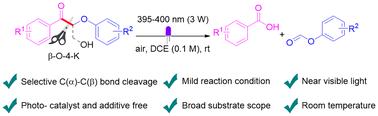
In this work, an efficient catalyst-/additive-free selective C–C bond cleavage of β-O-4 ketone lignin model compounds was carried out to form the corresponding carboxylic acids and phenyl formates under the irradiation of light at room temperature in an air atmosphere, providing an efficient approach to the selective carbon–carbon bond cleavage reaction without using any photo catalysts. Results of mechanistic control experiments indicated that the in situ generation of radicals of dichloroethane (DCE) in the presence of visible light is essential to realize the selective C(α)–C(β) bond cleavage reaction.
期刊介绍:
Green Chemistry is a journal that provides a unique forum for the publication of innovative research on the development of alternative green and sustainable technologies. The scope of Green Chemistry is based on the definition proposed by Anastas and Warner (Green Chemistry: Theory and Practice, P T Anastas and J C Warner, Oxford University Press, Oxford, 1998), which defines green chemistry as the utilisation of a set of principles that reduces or eliminates the use or generation of hazardous substances in the design, manufacture and application of chemical products. Green Chemistry aims to reduce the environmental impact of the chemical enterprise by developing a technology base that is inherently non-toxic to living things and the environment. The journal welcomes submissions on all aspects of research relating to this endeavor and publishes original and significant cutting-edge research that is likely to be of wide general appeal. For a work to be published, it must present a significant advance in green chemistry, including a comparison with existing methods and a demonstration of advantages over those methods.



 京公网安备 11010802042870号
京ICP备2023020795号-1
京公网安备 11010802042870号
京ICP备2023020795号-1

 分享
分享
 求助内容:
求助内容: 应助结果提醒方式:
 扫码关注我们
