Wei Wu , Mantao Chen , Chunyuan Feng , Waner Li , Tingting Zhang , Chao Zeng , Bo Wang , Lixiang Zhong , Chunhui Dai
{"title":"Metal-free polymer photocatalysts for efficient gas-phase reduction of atmospheric CO2 and simultaneous H2O2 production†","authors":"Wei Wu , Mantao Chen , Chunyuan Feng , Waner Li , Tingting Zhang , Chao Zeng , Bo Wang , Lixiang Zhong , Chunhui Dai","doi":"10.1039/d4gc05674d","DOIUrl":null,"url":null,"abstract":"<div><div>Solar-driven reduction of CO<sub>2</sub> into hydrocarbon fuels along with the concurrent production of H<sub>2</sub>O<sub>2</sub> using semiconductor photocatalysts represents a promising strategy for alleviating global carbon emissions while simultaneously producing useful chemicals. Herein, a series of benzobisthiazole-bridged conjugated microporous polymers are designed, and efficient CO and H<sub>2</sub>O<sub>2</sub> coproduction is achieved for the first time <em>via</em> the direct photoreduction of atmospheric CO<sub>2</sub> with saturated water vapor. The abundant N and S atoms in the porous frameworks provide the polymers with high CO<sub>2</sub>/N<sub>2</sub> selectivities of 51–67 at 298 K as well as accessible catalytic sites for activating CO<sub>2</sub> and H<sub>2</sub>O molecules under light irradiation. Moreover, TPT-BBT bearing a 2,4,6-triphenyl-1,3,5-triazine unit demonstrates the smallest exciton binding energy and enhanced photoinduced charge transfer among the three polymers. Therefore, upon exposure to simulated solar light (100 mW cm<sup>−2</sup>), metal-free TPT-BBT displays superior CO and H<sub>2</sub>O<sub>2</sub> yields of up to 361.2 and 552.7 μmol h<sup>−1</sup> g<sup>−1</sup>, respectively, which are substantially higher than those of most photocatalysts reported thus far under similar conditions. These results offer new insights into the design of high-performance polymer photocatalysts for simultaneous gas-phase CO<sub>2</sub> reduction and H<sub>2</sub>O<sub>2</sub> production under mild conditions.</div></div>","PeriodicalId":78,"journal":{"name":"Green Chemistry","volume":"27 10","pages":"Pages 2766-2775"},"PeriodicalIF":9.2000,"publicationDate":"2025-02-05","publicationTypes":"Journal Article","fieldsOfStudy":null,"isOpenAccess":false,"openAccessPdf":"","citationCount":"0","resultStr":null,"platform":"Semanticscholar","paperid":null,"PeriodicalName":"Green Chemistry","FirstCategoryId":"92","ListUrlMain":"https://www.sciencedirect.com/org/science/article/pii/S1463926225001049","RegionNum":1,"RegionCategory":"化学","ArticlePicture":[],"TitleCN":null,"AbstractTextCN":null,"PMCID":null,"EPubDate":"","PubModel":"","JCR":"Q1","JCRName":"CHEMISTRY, MULTIDISCIPLINARY","Score":null,"Total":0}
引用次数: 0
Abstract
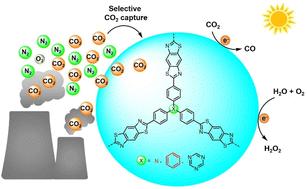
Solar-driven reduction of CO2 into hydrocarbon fuels along with the concurrent production of H2O2 using semiconductor photocatalysts represents a promising strategy for alleviating global carbon emissions while simultaneously producing useful chemicals. Herein, a series of benzobisthiazole-bridged conjugated microporous polymers are designed, and efficient CO and H2O2 coproduction is achieved for the first time via the direct photoreduction of atmospheric CO2 with saturated water vapor. The abundant N and S atoms in the porous frameworks provide the polymers with high CO2/N2 selectivities of 51–67 at 298 K as well as accessible catalytic sites for activating CO2 and H2O molecules under light irradiation. Moreover, TPT-BBT bearing a 2,4,6-triphenyl-1,3,5-triazine unit demonstrates the smallest exciton binding energy and enhanced photoinduced charge transfer among the three polymers. Therefore, upon exposure to simulated solar light (100 mW cm−2), metal-free TPT-BBT displays superior CO and H2O2 yields of up to 361.2 and 552.7 μmol h−1 g−1, respectively, which are substantially higher than those of most photocatalysts reported thus far under similar conditions. These results offer new insights into the design of high-performance polymer photocatalysts for simultaneous gas-phase CO2 reduction and H2O2 production under mild conditions.
期刊介绍:
Green Chemistry is a journal that provides a unique forum for the publication of innovative research on the development of alternative green and sustainable technologies. The scope of Green Chemistry is based on the definition proposed by Anastas and Warner (Green Chemistry: Theory and Practice, P T Anastas and J C Warner, Oxford University Press, Oxford, 1998), which defines green chemistry as the utilisation of a set of principles that reduces or eliminates the use or generation of hazardous substances in the design, manufacture and application of chemical products. Green Chemistry aims to reduce the environmental impact of the chemical enterprise by developing a technology base that is inherently non-toxic to living things and the environment. The journal welcomes submissions on all aspects of research relating to this endeavor and publishes original and significant cutting-edge research that is likely to be of wide general appeal. For a work to be published, it must present a significant advance in green chemistry, including a comparison with existing methods and a demonstration of advantages over those methods.



 京公网安备 11010802042870号
京ICP备2023020795号-1
京公网安备 11010802042870号
京ICP备2023020795号-1

 分享
分享
 求助内容:
求助内容: 应助结果提醒方式:
 扫码关注我们
