Alex Joesaar, Martin Holub, Leander Lutze, Marco Emanuele, Jacob Kerssemakers, Martin Pabst and Cees Dekker
{"title":"A microfluidic platform for extraction and analysis of bacterial genomic DNA†","authors":"Alex Joesaar, Martin Holub, Leander Lutze, Marco Emanuele, Jacob Kerssemakers, Martin Pabst and Cees Dekker","doi":"10.1039/D4LC00839A","DOIUrl":null,"url":null,"abstract":"<p >Bacterial cells organize their genomes into a compact hierarchical structure called the nucleoid. Studying the nucleoid in cells faces challenges because of the cellular complexity while <em>in vitro</em> assays have difficulty in handling the fragile megabase-scale DNA biopolymers that make up bacterial genomes. Here, we introduce a method that overcomes these limitations as we develop and use a microfluidic device for the sequential extraction, purification, and analysis of bacterial nucleoids in individual microchambers. Our approach avoids any transfer or pipetting of the fragile megabase-size genomes and thereby prevents their fragmentation. We show how the microfluidic system can be used to extract and analyze single chromosomes from <em>B. subtilis</em> cells. Upon on-chip lysis, the bacterial genome expands in size and DNA-binding proteins are flushed away. Subsequently, exogeneous proteins can be added to the trapped DNA <em>via</em> diffusion. We envision that integrated microfluidic platforms will become an essential tool for the bottom-up assembly of complex biomolecular systems such as artificial chromosomes.</p>","PeriodicalId":85,"journal":{"name":"Lab on a Chip","volume":" 7","pages":" 1767-1775"},"PeriodicalIF":5.4000,"publicationDate":"2025-02-25","publicationTypes":"Journal Article","fieldsOfStudy":null,"isOpenAccess":false,"openAccessPdf":"https://www.ncbi.nlm.nih.gov/pmc/articles/PMC11873781/pdf/","citationCount":"0","resultStr":null,"platform":"Semanticscholar","paperid":null,"PeriodicalName":"Lab on a Chip","FirstCategoryId":"5","ListUrlMain":"https://pubs.rsc.org/en/content/articlelanding/2025/lc/d4lc00839a","RegionNum":2,"RegionCategory":"工程技术","ArticlePicture":[],"TitleCN":null,"AbstractTextCN":null,"PMCID":null,"EPubDate":"","PubModel":"","JCR":"Q1","JCRName":"BIOCHEMICAL RESEARCH METHODS","Score":null,"Total":0}
引用次数: 0
Abstract
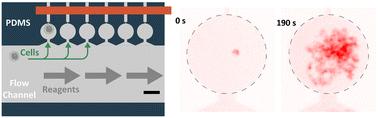
Bacterial cells organize their genomes into a compact hierarchical structure called the nucleoid. Studying the nucleoid in cells faces challenges because of the cellular complexity while in vitro assays have difficulty in handling the fragile megabase-scale DNA biopolymers that make up bacterial genomes. Here, we introduce a method that overcomes these limitations as we develop and use a microfluidic device for the sequential extraction, purification, and analysis of bacterial nucleoids in individual microchambers. Our approach avoids any transfer or pipetting of the fragile megabase-size genomes and thereby prevents their fragmentation. We show how the microfluidic system can be used to extract and analyze single chromosomes from B. subtilis cells. Upon on-chip lysis, the bacterial genome expands in size and DNA-binding proteins are flushed away. Subsequently, exogeneous proteins can be added to the trapped DNA via diffusion. We envision that integrated microfluidic platforms will become an essential tool for the bottom-up assembly of complex biomolecular systems such as artificial chromosomes.
期刊介绍:
Lab on a Chip is the premiere journal that publishes cutting-edge research in the field of miniaturization. By their very nature, microfluidic/nanofluidic/miniaturized systems are at the intersection of disciplines, spanning fundamental research to high-end application, which is reflected by the broad readership of the journal. Lab on a Chip publishes two types of papers on original research: full-length research papers and communications. Papers should demonstrate innovations, which can come from technical advancements or applications addressing pressing needs in globally important areas. The journal also publishes Comments, Reviews, and Perspectives.




 京公网安备 11010802042870号
京ICP备2023020795号-1
京公网安备 11010802042870号
京ICP备2023020795号-1

 分享
分享
 求助内容:
求助内容: 应助结果提醒方式:
 扫码关注我们
