Osman Coşkun, Serdar Arslan, Engin Dinç, Gökmen Yapalı
{"title":"Hip Muscle Strength and Fear of Movement are Associated with Self-Reported Function in Women with Patellofemoral Pain.","authors":"Osman Coşkun, Serdar Arslan, Engin Dinç, Gökmen Yapalı","doi":"10.22540/JMNI-25-029","DOIUrl":null,"url":null,"abstract":"<p><strong>Objectives: </strong>We aimed to investigate the relationship between self-reported lower extremity function, fear of movement, and quadriceps, hamstring, and hip stabilizer muscle strength in women with patellofemoral pain.</p><p><strong>Methods: </strong>Fifty-four women (age: 32.59±7.00) were included in the study. We assessed self-reported function with the Lower Extremity Functional Scale and fear of movement with the Tampa Scale for kinesiophobia. The strength of the quadriceps, hamstring, and hip stabilizer muscles was determined with a hand-held dynamometer. Relationships between variables were examined using Pearson correlation analysis and binary logistic regression analysis.</p><p><strong>Results: </strong>Self-reported function showed a moderate positive correlation with hip stabilizer muscle strength (r=0.408, p=0.002) and negative correlation with fear of movement (r=-0.500, p<0.01).</p><p><strong>Conclusion: </strong>The results of this study suggest that fear of movement and hip stabilizer muscle strength are factors associated with self-reported lower extremity function in women with patellofemoral pain.</p>","PeriodicalId":16430,"journal":{"name":"Journal of musculoskeletal & neuronal interactions","volume":"25 1","pages":"29-35"},"PeriodicalIF":1.6000,"publicationDate":"2025-03-01","publicationTypes":"Journal Article","fieldsOfStudy":null,"isOpenAccess":false,"openAccessPdf":"https://www.ncbi.nlm.nih.gov/pmc/articles/PMC11880857/pdf/","citationCount":"0","resultStr":null,"platform":"Semanticscholar","paperid":null,"PeriodicalName":"Journal of musculoskeletal & neuronal interactions","FirstCategoryId":"3","ListUrlMain":"https://doi.org/10.22540/JMNI-25-029","RegionNum":4,"RegionCategory":"医学","ArticlePicture":[],"TitleCN":null,"AbstractTextCN":null,"PMCID":null,"EPubDate":"","PubModel":"","JCR":"Q4","JCRName":"NEUROSCIENCES","Score":null,"Total":0}
引用次数: 0
Abstract
Objectives: We aimed to investigate the relationship between self-reported lower extremity function, fear of movement, and quadriceps, hamstring, and hip stabilizer muscle strength in women with patellofemoral pain.
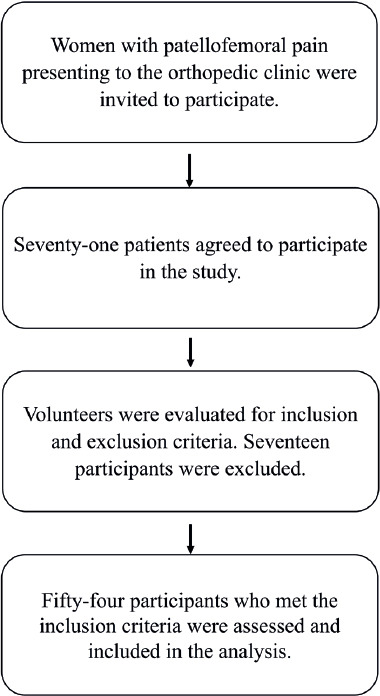
Methods: Fifty-four women (age: 32.59±7.00) were included in the study. We assessed self-reported function with the Lower Extremity Functional Scale and fear of movement with the Tampa Scale for kinesiophobia. The strength of the quadriceps, hamstring, and hip stabilizer muscles was determined with a hand-held dynamometer. Relationships between variables were examined using Pearson correlation analysis and binary logistic regression analysis.
Results: Self-reported function showed a moderate positive correlation with hip stabilizer muscle strength (r=0.408, p=0.002) and negative correlation with fear of movement (r=-0.500, p<0.01).
Conclusion: The results of this study suggest that fear of movement and hip stabilizer muscle strength are factors associated with self-reported lower extremity function in women with patellofemoral pain.
期刊介绍:
The Journal of Musculoskeletal and Neuronal Interactions (JMNI) is an academic journal dealing with the pathophysiology and treatment of musculoskeletal disorders. It is published quarterly (months of issue March, June, September, December). Its purpose is to publish original, peer-reviewed papers of research and clinical experience in all areas of the musculoskeletal system and its interactions with the nervous system, especially metabolic bone diseases, with particular emphasis on osteoporosis. Additionally, JMNI publishes the Abstracts from the biannual meetings of the International Society of Musculoskeletal and Neuronal Interactions, and hosts Abstracts of other meetings on topics related to the aims and scope of JMNI.



 京公网安备 11010802042870号
京ICP备2023020795号-1
京公网安备 11010802042870号
京ICP备2023020795号-1

 分享
分享
 求助内容:
求助内容: 应助结果提醒方式:
 扫码关注我们
