Oula Knuutinen , Jenni Määttä , Anselmi Kovalainen , Anni Pohjola , Pihla Tommiska , Rahul Raj , FINISH study group
{"title":"Surgical Delay and Functional Outcome After Surgery for Chronic Subdural Hematoma","authors":"Oula Knuutinen , Jenni Määttä , Anselmi Kovalainen , Anni Pohjola , Pihla Tommiska , Rahul Raj , FINISH study group","doi":"10.1016/j.wneu.2025.123843","DOIUrl":null,"url":null,"abstract":"<div><h3>Objective</h3><div>To determine whether shorter surgical delays for chronic subdural hematoma (CSDH) are associated with improved functional outcomes.</div></div><div><h3>Methods</h3><div>Post hoc analysis of the FINISH (<em>The Finnish Study of Intraoperative Irrigation</em> vs. <em>Drain Alone After Evacuation of Chronic Subdural Hematoma</em>) trial, a nationwide multicenter randomized controlled trial. The primary outcome was functional outcome at 6 months postsurgery assessed by the modified Rankin Scale (mRS). Secondary outcomes included dichotomized mRS (0–3 favorable, 4–6 unfavorable), mortality, adverse events, and reoperation rates within 6 months.</div></div><div><h3>Results</h3><div>This study included 589 patients (median age 78 years, interquartile range: 72–84; 28.0% females) with a median surgical delay of 21 hours (interquartile range: 9–33). The optimal cut-off point for surgery delay in relation to favorable functional outcome was 22 hours. In the early surgery (≤22h) group, 10.0% had an unfavorable functional outcome versus 15.8% in the late surgery (>22h) group (<em>P</em> = 0.06). After adjusting for confounding factors, the common odds ratio for mRS for late surgery versus early surgery was 1.42 (95% confidence interval: 1.01–2.00; <em>P</em> = 0.046). The probability of unfavorable functional outcome increased with surgical delay, peaking between 72 and 96 hours. There was no association between surgical delay, mortality, and adverse events after confounding adjustment. Reoperation rates were 17.5% in the early surgery groups and 13.1% in the late surgery group (<em>P</em> = 0.14).</div></div><div><h3>Conclusions</h3><div>In this post hoc analysis, shorter surgical delays for CSDH were associated with improved functional outcome. Our findings suggest that symptomatic CSDH patients should be operated on as soon as reasonably possible.</div></div>","PeriodicalId":23906,"journal":{"name":"World neurosurgery","volume":"197 ","pages":"Article 123843"},"PeriodicalIF":2.1000,"publicationDate":"2025-05-01","publicationTypes":"Journal Article","fieldsOfStudy":null,"isOpenAccess":false,"openAccessPdf":"","citationCount":"0","resultStr":null,"platform":"Semanticscholar","paperid":null,"PeriodicalName":"World neurosurgery","FirstCategoryId":"3","ListUrlMain":"https://www.sciencedirect.com/science/article/pii/S1878875025001998","RegionNum":4,"RegionCategory":"医学","ArticlePicture":[],"TitleCN":null,"AbstractTextCN":null,"PMCID":null,"EPubDate":"2025/2/28 0:00:00","PubModel":"Epub","JCR":"Q3","JCRName":"CLINICAL NEUROLOGY","Score":null,"Total":0}
引用次数: 0
Abstract
Objective
To determine whether shorter surgical delays for chronic subdural hematoma (CSDH) are associated with improved functional outcomes.
Methods
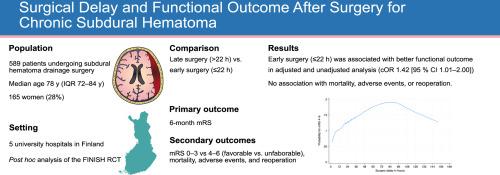
Post hoc analysis of the FINISH (The Finnish Study of Intraoperative Irrigation vs. Drain Alone After Evacuation of Chronic Subdural Hematoma) trial, a nationwide multicenter randomized controlled trial. The primary outcome was functional outcome at 6 months postsurgery assessed by the modified Rankin Scale (mRS). Secondary outcomes included dichotomized mRS (0–3 favorable, 4–6 unfavorable), mortality, adverse events, and reoperation rates within 6 months.
Results
This study included 589 patients (median age 78 years, interquartile range: 72–84; 28.0% females) with a median surgical delay of 21 hours (interquartile range: 9–33). The optimal cut-off point for surgery delay in relation to favorable functional outcome was 22 hours. In the early surgery (≤22h) group, 10.0% had an unfavorable functional outcome versus 15.8% in the late surgery (>22h) group (P = 0.06). After adjusting for confounding factors, the common odds ratio for mRS for late surgery versus early surgery was 1.42 (95% confidence interval: 1.01–2.00; P = 0.046). The probability of unfavorable functional outcome increased with surgical delay, peaking between 72 and 96 hours. There was no association between surgical delay, mortality, and adverse events after confounding adjustment. Reoperation rates were 17.5% in the early surgery groups and 13.1% in the late surgery group (P = 0.14).
Conclusions
In this post hoc analysis, shorter surgical delays for CSDH were associated with improved functional outcome. Our findings suggest that symptomatic CSDH patients should be operated on as soon as reasonably possible.
期刊介绍:
World Neurosurgery has an open access mirror journal World Neurosurgery: X, sharing the same aims and scope, editorial team, submission system and rigorous peer review.
The journal''s mission is to:
-To provide a first-class international forum and a 2-way conduit for dialogue that is relevant to neurosurgeons and providers who care for neurosurgery patients. The categories of the exchanged information include clinical and basic science, as well as global information that provide social, political, educational, economic, cultural or societal insights and knowledge that are of significance and relevance to worldwide neurosurgery patient care.
-To act as a primary intellectual catalyst for the stimulation of creativity, the creation of new knowledge, and the enhancement of quality neurosurgical care worldwide.
-To provide a forum for communication that enriches the lives of all neurosurgeons and their colleagues; and, in so doing, enriches the lives of their patients.
Topics to be addressed in World Neurosurgery include: EDUCATION, ECONOMICS, RESEARCH, POLITICS, HISTORY, CULTURE, CLINICAL SCIENCE, LABORATORY SCIENCE, TECHNOLOGY, OPERATIVE TECHNIQUES, CLINICAL IMAGES, VIDEOS



 京公网安备 11010802042870号
京ICP备2023020795号-1
京公网安备 11010802042870号
京ICP备2023020795号-1

 分享
分享
 求助内容:
求助内容: 应助结果提醒方式:
 扫码关注我们
