Mong Yung Fung, Yuen Lung Wong, Ka Man Cheung, King Hei Kelvin Bao, Winnie Wing Yan Sung
{"title":"Prognostic models for survival predictions in advanced cancer patients: a systematic review and meta-analysis.","authors":"Mong Yung Fung, Yuen Lung Wong, Ka Man Cheung, King Hei Kelvin Bao, Winnie Wing Yan Sung","doi":"10.1186/s12904-025-01696-4","DOIUrl":null,"url":null,"abstract":"<p><strong>Background: </strong>Prognostication of survival among patients with advanced cancer is essential for palliative care (PC) planning. The implementation of a clinical point-of-care prognostic model may inform clinicians and facilitate decision-making. While early PC referral yields better clinical outcomes, actual referral time differs by clinical contexts and accessible. To summarize the various prognostic models that may cater to these needs, we conducted a systematic review and meta-analysis.</p><p><strong>Methods: </strong>A systematic literature search was conducted in Ovid Medline, Embase, CINAHL Ultimate, and Scopus to identify eligible studies focusing on incurable solid tumors, validation of prognostic models, and measurement of predictive performances. Model characteristics and performances were summarized in tables. Prediction model study Risk Of Bias Assessment Tool (PROBAST) was adopted for risk of bias assessment. Meta-analysis of individual models, where appropriate, was performed by pooling C-index.</p><p><strong>Results: </strong>35 studies covering 35 types of prognostic models were included. Palliative Prognostic Index (PPI), Palliative Prognostic Score (PaP), and Objective Prognostic Score (OPS) were most frequently identified models. The pooled C-statistic of PPI for 30-day survival prediction was 0.68 (95% CI: 0.62-0.73, n = 6). The pooled C-statistic of PaP for 30-day survival prediction was 0.76 (95% CI: 0.70-0.80, n = 11), while that for 21-day survival prediction was 0.80 (0.71-0.86, n = 4). The pooled C-statistic of OPS for 30-days survival prediction was 0.69 (95% CI: 0.65-0.72, n = 3). All included studies had high risk of bias.</p><p><strong>Conclusion: </strong>PaP appears to perform better but further validation and implementation studies were needed for confirmation.</p>","PeriodicalId":48945,"journal":{"name":"BMC Palliative Care","volume":"24 1","pages":"54"},"PeriodicalIF":2.5000,"publicationDate":"2025-03-01","publicationTypes":"Journal Article","fieldsOfStudy":null,"isOpenAccess":false,"openAccessPdf":"https://www.ncbi.nlm.nih.gov/pmc/articles/PMC11871741/pdf/","citationCount":"0","resultStr":null,"platform":"Semanticscholar","paperid":null,"PeriodicalName":"BMC Palliative Care","FirstCategoryId":"3","ListUrlMain":"https://doi.org/10.1186/s12904-025-01696-4","RegionNum":2,"RegionCategory":"医学","ArticlePicture":[],"TitleCN":null,"AbstractTextCN":null,"PMCID":null,"EPubDate":"","PubModel":"","JCR":"Q2","JCRName":"HEALTH CARE SCIENCES & SERVICES","Score":null,"Total":0}
引用次数: 0
Abstract
Background: Prognostication of survival among patients with advanced cancer is essential for palliative care (PC) planning. The implementation of a clinical point-of-care prognostic model may inform clinicians and facilitate decision-making. While early PC referral yields better clinical outcomes, actual referral time differs by clinical contexts and accessible. To summarize the various prognostic models that may cater to these needs, we conducted a systematic review and meta-analysis.
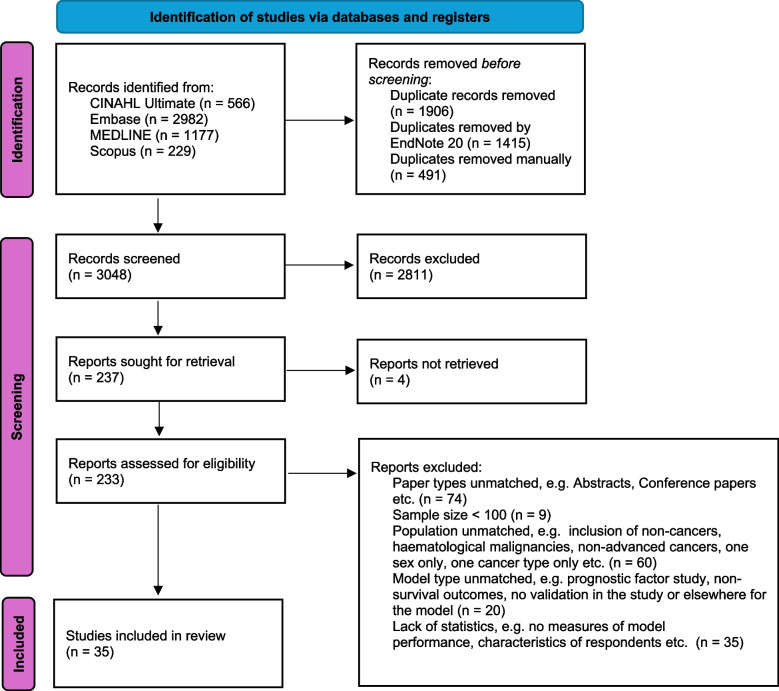
Methods: A systematic literature search was conducted in Ovid Medline, Embase, CINAHL Ultimate, and Scopus to identify eligible studies focusing on incurable solid tumors, validation of prognostic models, and measurement of predictive performances. Model characteristics and performances were summarized in tables. Prediction model study Risk Of Bias Assessment Tool (PROBAST) was adopted for risk of bias assessment. Meta-analysis of individual models, where appropriate, was performed by pooling C-index.
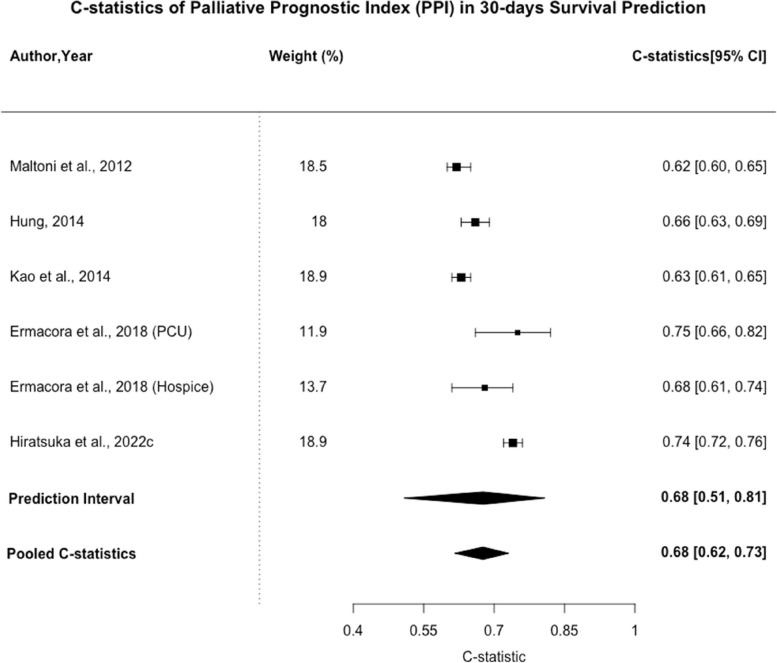
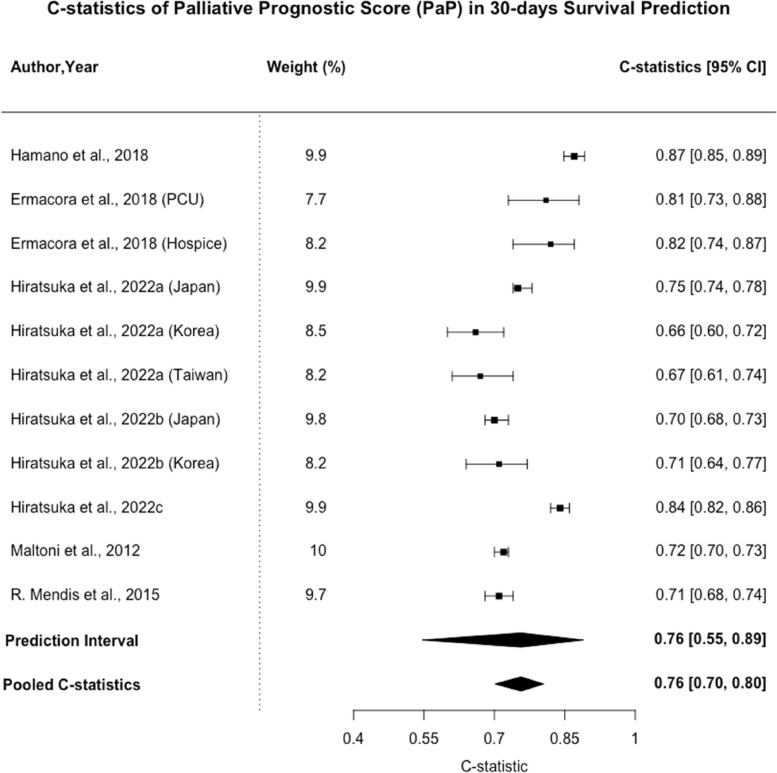
Results: 35 studies covering 35 types of prognostic models were included. Palliative Prognostic Index (PPI), Palliative Prognostic Score (PaP), and Objective Prognostic Score (OPS) were most frequently identified models. The pooled C-statistic of PPI for 30-day survival prediction was 0.68 (95% CI: 0.62-0.73, n = 6). The pooled C-statistic of PaP for 30-day survival prediction was 0.76 (95% CI: 0.70-0.80, n = 11), while that for 21-day survival prediction was 0.80 (0.71-0.86, n = 4). The pooled C-statistic of OPS for 30-days survival prediction was 0.69 (95% CI: 0.65-0.72, n = 3). All included studies had high risk of bias.
Conclusion: PaP appears to perform better but further validation and implementation studies were needed for confirmation.
期刊介绍:
BMC Palliative Care is an open access journal publishing original peer-reviewed research articles in the clinical, scientific, ethical and policy issues, local and international, regarding all aspects of hospice and palliative care for the dying and for those with profound suffering related to chronic illness.



 京公网安备 11010802042870号
京ICP备2023020795号-1
京公网安备 11010802042870号
京ICP备2023020795号-1

 分享
分享
 求助内容:
求助内容: 应助结果提醒方式:
 扫码关注我们
