The Impact of Hepatitis B Surface Antigen Reduction via Small Interfering RNA Treatment on Natural and Vaccine (BRII-179)-Induced Hepatitis B Virus-Specific Humoral and Cellular Immune Responses
Yun Ji , Nina Le Bert , Grace Lai-Hung Wong , Mark W. Douglas , Ariel Lee , Chong Zhu , Bing Wang , Jianxiang Lv , Dong Li , Ying Tan , Haiyan Ma , Jieliang Chen , Xiaofei Chen , Qing Zhu , Man-Fung Yuen , Antonio Bertoletti
{"title":"The Impact of Hepatitis B Surface Antigen Reduction via Small Interfering RNA Treatment on Natural and Vaccine (BRII-179)-Induced Hepatitis B Virus-Specific Humoral and Cellular Immune Responses","authors":"Yun Ji , Nina Le Bert , Grace Lai-Hung Wong , Mark W. Douglas , Ariel Lee , Chong Zhu , Bing Wang , Jianxiang Lv , Dong Li , Ying Tan , Haiyan Ma , Jieliang Chen , Xiaofei Chen , Qing Zhu , Man-Fung Yuen , Antonio Bertoletti","doi":"10.1053/j.gastro.2025.02.016","DOIUrl":null,"url":null,"abstract":"<div><h3>Background & Aims</h3><div>The impact of hepatitis B surface antigen (HBsAg) reduction from small interfering RNA (siRNA) treatments on hepatitis B virus (HBV)-specific immunity of individuals with chronic hepatitis B (CHB) has not been adequately analyzed in humans. We conducted a phase 2a study treating CHB participants with nine 4-weekly doses of HBV-targeted siRNA elebsiran (BRII-835), either alone (n = 10) or in combination with a virus-like particle-based therapeutic vaccine (BRII-179) containing Pre-S1, Pre-S2, and S antigens, coadministered with (n = 39) or without (n = 41) interferon alfa.</div></div><div><h3>Methods</h3><div>We analyzed longitudinally for 72 weeks virologic, clinical, and immunologic parameters, including HBsAg, alanine aminotransferase, hepatitis B surface antibody (anti-HBs), the neutralizing activity of representative sera, and frequency and cytokine secretion ability of T cells specific for Pre-S1, Pre-S2, and S both directly ex vivo and after in vitro expansion.</div></div><div><h3>Results</h3><div>Combination therapy with elebsiran and BRII-179 was well tolerated. Although no sustained HBsAg seroclearance or notable difference in mean HBsAg reduction at the group level was observed, we detected marked heterogeneity in immunologic responses among groups. HBsAg reduction mediated by siRNA alone was associated with minimal HBV-specific immune response recovery. In contrast, combination of elebsiran with BRII-179 induced a significant modification of immune responses demonstrated by anti-HBs antibody production and an expansion of interleukin 2-producing helper T cells specific for Pre-S1/Pre-S2 antigens only. Importantly, anti-HBs antibodies persisted at ≥100 IU/L in ∼40% of the participants for at least 32 weeks after combined treatment. Moreover, the neutralizing ability of the anti-HBs–positive sera was associated with HBsAg reduction.</div></div><div><h3>Conclusions</h3><div>siRNA-induced HBsAg reduction may contribute to the persistence and efficacy of the humoral arm of HBV-specific adaptive immunity in CHB participants receiving the therapeutic vaccine BRII-179. <span><span>Clinicaltrials.gov</span><svg><path></path></svg></span> number: NCT04749368</div></div>","PeriodicalId":12590,"journal":{"name":"Gastroenterology","volume":"169 1","pages":"Pages 136-149"},"PeriodicalIF":25.1000,"publicationDate":"2025-03-03","publicationTypes":"Journal Article","fieldsOfStudy":null,"isOpenAccess":false,"openAccessPdf":"","citationCount":"0","resultStr":null,"platform":"Semanticscholar","paperid":null,"PeriodicalName":"Gastroenterology","FirstCategoryId":"3","ListUrlMain":"https://www.sciencedirect.com/science/article/pii/S0016508525004664","RegionNum":1,"RegionCategory":"医学","ArticlePicture":[],"TitleCN":null,"AbstractTextCN":null,"PMCID":null,"EPubDate":"","PubModel":"","JCR":"Q1","JCRName":"GASTROENTEROLOGY & HEPATOLOGY","Score":null,"Total":0}
引用次数: 0
Abstract
Background & Aims
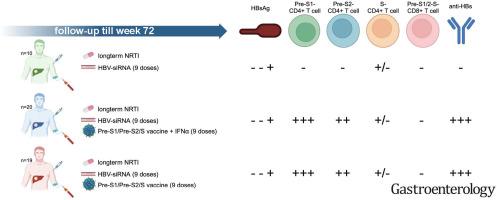
The impact of hepatitis B surface antigen (HBsAg) reduction from small interfering RNA (siRNA) treatments on hepatitis B virus (HBV)-specific immunity of individuals with chronic hepatitis B (CHB) has not been adequately analyzed in humans. We conducted a phase 2a study treating CHB participants with nine 4-weekly doses of HBV-targeted siRNA elebsiran (BRII-835), either alone (n = 10) or in combination with a virus-like particle-based therapeutic vaccine (BRII-179) containing Pre-S1, Pre-S2, and S antigens, coadministered with (n = 39) or without (n = 41) interferon alfa.
Methods
We analyzed longitudinally for 72 weeks virologic, clinical, and immunologic parameters, including HBsAg, alanine aminotransferase, hepatitis B surface antibody (anti-HBs), the neutralizing activity of representative sera, and frequency and cytokine secretion ability of T cells specific for Pre-S1, Pre-S2, and S both directly ex vivo and after in vitro expansion.
Results
Combination therapy with elebsiran and BRII-179 was well tolerated. Although no sustained HBsAg seroclearance or notable difference in mean HBsAg reduction at the group level was observed, we detected marked heterogeneity in immunologic responses among groups. HBsAg reduction mediated by siRNA alone was associated with minimal HBV-specific immune response recovery. In contrast, combination of elebsiran with BRII-179 induced a significant modification of immune responses demonstrated by anti-HBs antibody production and an expansion of interleukin 2-producing helper T cells specific for Pre-S1/Pre-S2 antigens only. Importantly, anti-HBs antibodies persisted at ≥100 IU/L in ∼40% of the participants for at least 32 weeks after combined treatment. Moreover, the neutralizing ability of the anti-HBs–positive sera was associated with HBsAg reduction.
Conclusions
siRNA-induced HBsAg reduction may contribute to the persistence and efficacy of the humoral arm of HBV-specific adaptive immunity in CHB participants receiving the therapeutic vaccine BRII-179. Clinicaltrials.gov number: NCT04749368
期刊介绍:
Gastroenterology is the most prominent journal in the field of gastrointestinal disease. It is the flagship journal of the American Gastroenterological Association and delivers authoritative coverage of clinical, translational, and basic studies of all aspects of the digestive system, including the liver and pancreas, as well as nutrition.
Some regular features of Gastroenterology include original research studies by leading authorities, comprehensive reviews and perspectives on important topics in adult and pediatric gastroenterology and hepatology. The journal also includes features such as editorials, correspondence, and commentaries, as well as special sections like "Mentoring, Education and Training Corner," "Diversity, Equity and Inclusion in GI," "Gastro Digest," "Gastro Curbside Consult," and "Gastro Grand Rounds."
Gastroenterology also provides digital media materials such as videos and "GI Rapid Reel" animations. It is abstracted and indexed in various databases including Scopus, Biological Abstracts, Current Contents, Embase, Nutrition Abstracts, Chemical Abstracts, Current Awareness in Biological Sciences, PubMed/Medline, and the Science Citation Index.




 京公网安备 11010802042870号
京ICP备2023020795号-1
京公网安备 11010802042870号
京ICP备2023020795号-1

 分享
分享
 求助内容:
求助内容: 应助结果提醒方式:
 扫码关注我们
