Yukun Pan, Hai Xu, Lekang Cui, Zhiqiang Zhao, Weibing Du, Jianghao Ye, Bo Niu, Yayun Zhang and Donghui Long
{"title":"Increasing the local electron density of carbons for enhanced O2 activation at room temperature†","authors":"Yukun Pan, Hai Xu, Lekang Cui, Zhiqiang Zhao, Weibing Du, Jianghao Ye, Bo Niu, Yayun Zhang and Donghui Long","doi":"10.1039/D4CP04264F","DOIUrl":null,"url":null,"abstract":"<p >Room-temperature activation of O<small><sub>2</sub></small> into a super dioxide radical (O<small><sub>2</sub></small>˙<small><sup>−</sup></small>) is a crucial step in oxidation processes. Here, the concept of tuning the local electron density of carbons is adopted to develop highly efficient catalysts for molecular oxygen activation. We demonstrate that the π electron of sp<small><sup>2</sup></small> carbons is essential for activating O<small><sub>2</sub></small> with the assistance of ultra-micropores, while varying defects or functional groups induce local electron rearrangement of carbons, thereby altering their catalytic capacity. Electron rich non-metallic doping can increase the local electron intensity of modified carbons with improved oxygen activation. In addition, transition-metal-sp<small><sup>2</sup></small>-carbon nano-composites that readily surrender electrons are constructed, achieving O<small><sub>2</sub></small>˙<small><sup>−</sup></small> formation without spatial confinement. Our findings provide fundamental insights into the intrinsic mechanism of O<small><sub>2</sub></small> activation and offer a general protocol for the design and development of advanced carbon catalysts for low-temperature oxidations.</p>","PeriodicalId":99,"journal":{"name":"Physical Chemistry Chemical Physics","volume":" 13","pages":" 6593-6603"},"PeriodicalIF":2.9000,"publicationDate":"2025-03-04","publicationTypes":"Journal Article","fieldsOfStudy":null,"isOpenAccess":false,"openAccessPdf":"","citationCount":"0","resultStr":null,"platform":"Semanticscholar","paperid":null,"PeriodicalName":"Physical Chemistry Chemical Physics","FirstCategoryId":"92","ListUrlMain":"https://pubs.rsc.org/en/content/articlelanding/2025/cp/d4cp04264f","RegionNum":3,"RegionCategory":"化学","ArticlePicture":[],"TitleCN":null,"AbstractTextCN":null,"PMCID":null,"EPubDate":"","PubModel":"","JCR":"Q3","JCRName":"CHEMISTRY, PHYSICAL","Score":null,"Total":0}
引用次数: 0
Abstract
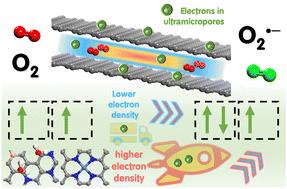
Room-temperature activation of O2 into a super dioxide radical (O2˙−) is a crucial step in oxidation processes. Here, the concept of tuning the local electron density of carbons is adopted to develop highly efficient catalysts for molecular oxygen activation. We demonstrate that the π electron of sp2 carbons is essential for activating O2 with the assistance of ultra-micropores, while varying defects or functional groups induce local electron rearrangement of carbons, thereby altering their catalytic capacity. Electron rich non-metallic doping can increase the local electron intensity of modified carbons with improved oxygen activation. In addition, transition-metal-sp2-carbon nano-composites that readily surrender electrons are constructed, achieving O2˙− formation without spatial confinement. Our findings provide fundamental insights into the intrinsic mechanism of O2 activation and offer a general protocol for the design and development of advanced carbon catalysts for low-temperature oxidations.
期刊介绍:
Physical Chemistry Chemical Physics (PCCP) is an international journal co-owned by 19 physical chemistry and physics societies from around the world. This journal publishes original, cutting-edge research in physical chemistry, chemical physics and biophysical chemistry. To be suitable for publication in PCCP, articles must include significant innovation and/or insight into physical chemistry; this is the most important criterion that reviewers and Editors will judge against when evaluating submissions.
The journal has a broad scope and welcomes contributions spanning experiment, theory, computation and data science. Topical coverage includes spectroscopy, dynamics, kinetics, statistical mechanics, thermodynamics, electrochemistry, catalysis, surface science, quantum mechanics, quantum computing and machine learning. Interdisciplinary research areas such as polymers and soft matter, materials, nanoscience, energy, surfaces/interfaces, and biophysical chemistry are welcomed if they demonstrate significant innovation and/or insight into physical chemistry. Joined experimental/theoretical studies are particularly appreciated when complementary and based on up-to-date approaches.




 京公网安备 11010802042870号
京ICP备2023020795号-1
京公网安备 11010802042870号
京ICP备2023020795号-1

 分享
分享
 求助内容:
求助内容: 应助结果提醒方式:
 扫码关注我们
