Kalle Kalliorinne, Joakim Sandberg, Gustav Hindér, Hans-Christer Holmberg, Matej Supej, Roland Larsson, Andreas Almqvist
{"title":"Quantifying cross-country ski–snow friction using real-time kinematic positioning","authors":"Kalle Kalliorinne, Joakim Sandberg, Gustav Hindér, Hans-Christer Holmberg, Matej Supej, Roland Larsson, Andreas Almqvist","doi":"10.26599/frict.2025.9441011","DOIUrl":null,"url":null,"abstract":"<p>In cross-country skiing, athletes expend large amounts of energy to overcome friction as their skis interact with snow. Even minor reductions in the friction can significantly influence race outcomes. Over the years, researchers have found many ways of quantifying ski–snow friction, but there are only a few methods that consider the glide of real-sized skis under natural conditions during both accelerating and decelerating movements. This study introduces a novel experimental setup, consisting of a sled equipped with authentic cross-country skis and a base station that uses satellite receivers to communicate via radio, constituting a real-time kinematic positioning system with centimetre accuracy. While the sled was running on a classic ski track with natural height variations, altitude and velocity data were recorded for quantification of the coefficient of friction (COF), both for accelerating and decelerating motion, employing a model based on Newton’s second law. The results show that the COF during acceleration was more than 20% higher than during deceleration, demonstrating dynamic changes in the frictional behaviour between these phases. This finding is crucial for the execution of all types of cross-country skiing techniques, where the athlete either accelerates or decelerates while moving forward. The ability of the current experimental set-up to distinguish between the COF during acceleration and deceleration has considerable implications for further developments.</p>","PeriodicalId":12442,"journal":{"name":"Friction","volume":"29 1","pages":""},"PeriodicalIF":8.2000,"publicationDate":"2025-02-27","publicationTypes":"Journal Article","fieldsOfStudy":null,"isOpenAccess":false,"openAccessPdf":"","citationCount":"0","resultStr":null,"platform":"Semanticscholar","paperid":null,"PeriodicalName":"Friction","FirstCategoryId":"5","ListUrlMain":"https://doi.org/10.26599/frict.2025.9441011","RegionNum":1,"RegionCategory":"工程技术","ArticlePicture":[],"TitleCN":null,"AbstractTextCN":null,"PMCID":null,"EPubDate":"","PubModel":"","JCR":"Q1","JCRName":"ENGINEERING, MECHANICAL","Score":null,"Total":0}
引用次数: 0
Abstract
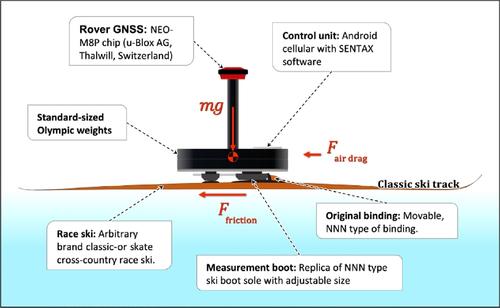
In cross-country skiing, athletes expend large amounts of energy to overcome friction as their skis interact with snow. Even minor reductions in the friction can significantly influence race outcomes. Over the years, researchers have found many ways of quantifying ski–snow friction, but there are only a few methods that consider the glide of real-sized skis under natural conditions during both accelerating and decelerating movements. This study introduces a novel experimental setup, consisting of a sled equipped with authentic cross-country skis and a base station that uses satellite receivers to communicate via radio, constituting a real-time kinematic positioning system with centimetre accuracy. While the sled was running on a classic ski track with natural height variations, altitude and velocity data were recorded for quantification of the coefficient of friction (COF), both for accelerating and decelerating motion, employing a model based on Newton’s second law. The results show that the COF during acceleration was more than 20% higher than during deceleration, demonstrating dynamic changes in the frictional behaviour between these phases. This finding is crucial for the execution of all types of cross-country skiing techniques, where the athlete either accelerates or decelerates while moving forward. The ability of the current experimental set-up to distinguish between the COF during acceleration and deceleration has considerable implications for further developments.
期刊介绍:
Friction is a peer-reviewed international journal for the publication of theoretical and experimental research works related to the friction, lubrication and wear. Original, high quality research papers and review articles on all aspects of tribology are welcome, including, but are not limited to, a variety of topics, such as:
Friction: Origin of friction, Friction theories, New phenomena of friction, Nano-friction, Ultra-low friction, Molecular friction, Ultra-high friction, Friction at high speed, Friction at high temperature or low temperature, Friction at solid/liquid interfaces, Bio-friction, Adhesion, etc.
Lubrication: Superlubricity, Green lubricants, Nano-lubrication, Boundary lubrication, Thin film lubrication, Elastohydrodynamic lubrication, Mixed lubrication, New lubricants, New additives, Gas lubrication, Solid lubrication, etc.
Wear: Wear materials, Wear mechanism, Wear models, Wear in severe conditions, Wear measurement, Wear monitoring, etc.
Surface Engineering: Surface texturing, Molecular films, Surface coatings, Surface modification, Bionic surfaces, etc.
Basic Sciences: Tribology system, Principles of tribology, Thermodynamics of tribo-systems, Micro-fluidics, Thermal stability of tribo-systems, etc.
Friction is an open access journal. It is published quarterly by Tsinghua University Press and Springer, and sponsored by the State Key Laboratory of Tribology (TsinghuaUniversity) and the Tribology Institute of Chinese Mechanical Engineering Society.



 京公网安备 11010802042870号
京ICP备2023020795号-1
京公网安备 11010802042870号
京ICP备2023020795号-1

 分享
分享
 求助内容:
求助内容: 应助结果提醒方式:
 扫码关注我们
