{"title":"Metal-Free Nanozyme-Hydrogel Enabled by Conductive Polymer Nanofibers for Multimodal Antibacterial Therapy","authors":"Wenya Xu, Ziyi Zhu, Zhen Tan, Ziteng Fan, Shibing Wei, Kaili Yang, Lihui Yuwen, Wen Jing Yang, En-Tang Kang, Lianhui Wang","doi":"10.1021/acs.chemmater.4c02480","DOIUrl":null,"url":null,"abstract":"The nanozyme antibacterial materials have been of great interest due to their broad-spectrum activity and minimal drug resistance. A variety of metal-based nanozymes have been designed as bactericidal agents, whereas their biosafety issues are still serious concerns. Accordingly, the development of metal-free nanozymes and the corresponding hydrogel dressings is of great importance for antibacterial applications. Herein, a classical conductive polymer, polyaniline nanofibers (PANI NF), has been developed as a three-pronged metal-free enzyme-like antibacterial material. They exhibited high oxidase-like and peroxidase-like activities for reactive oxygen species (ROS) production, positively charged surfaces capable of capturing/trapping bacteria to reduce ROS diffusion distance, and unique photothermal ablation effect. By harnessing the intrinsic merits of PANI NF, a PANI/poly(vinyl alcohol) (PANI/PVA) nanocomposite hydrogel, with high stability, soft-tissue adhesion properties, self-healing capability, remoldability, and biocompatibility, has been fabricated as biomedical dressings to promote bacteria-infected wound healing. The studies on antibacterial activities of polyaniline nanofibers shed light on the conductive polymer as promising metal-free enzyme-like antibacterial materials. The prepared PANI/PVA hydrogel provides a stable hydrogel dressing without toxic metal leakage for biomedical applications.","PeriodicalId":33,"journal":{"name":"Chemistry of Materials","volume":"24 1","pages":""},"PeriodicalIF":7.0000,"publicationDate":"2025-03-04","publicationTypes":"Journal Article","fieldsOfStudy":null,"isOpenAccess":false,"openAccessPdf":"","citationCount":"0","resultStr":null,"platform":"Semanticscholar","paperid":null,"PeriodicalName":"Chemistry of Materials","FirstCategoryId":"88","ListUrlMain":"https://doi.org/10.1021/acs.chemmater.4c02480","RegionNum":2,"RegionCategory":"材料科学","ArticlePicture":[],"TitleCN":null,"AbstractTextCN":null,"PMCID":null,"EPubDate":"","PubModel":"","JCR":"Q2","JCRName":"CHEMISTRY, PHYSICAL","Score":null,"Total":0}
引用次数: 0
Abstract
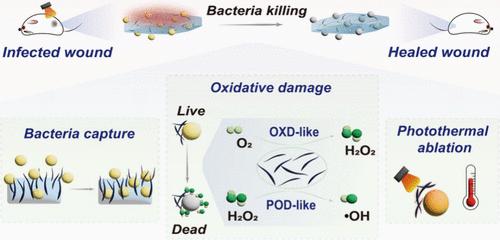
The nanozyme antibacterial materials have been of great interest due to their broad-spectrum activity and minimal drug resistance. A variety of metal-based nanozymes have been designed as bactericidal agents, whereas their biosafety issues are still serious concerns. Accordingly, the development of metal-free nanozymes and the corresponding hydrogel dressings is of great importance for antibacterial applications. Herein, a classical conductive polymer, polyaniline nanofibers (PANI NF), has been developed as a three-pronged metal-free enzyme-like antibacterial material. They exhibited high oxidase-like and peroxidase-like activities for reactive oxygen species (ROS) production, positively charged surfaces capable of capturing/trapping bacteria to reduce ROS diffusion distance, and unique photothermal ablation effect. By harnessing the intrinsic merits of PANI NF, a PANI/poly(vinyl alcohol) (PANI/PVA) nanocomposite hydrogel, with high stability, soft-tissue adhesion properties, self-healing capability, remoldability, and biocompatibility, has been fabricated as biomedical dressings to promote bacteria-infected wound healing. The studies on antibacterial activities of polyaniline nanofibers shed light on the conductive polymer as promising metal-free enzyme-like antibacterial materials. The prepared PANI/PVA hydrogel provides a stable hydrogel dressing without toxic metal leakage for biomedical applications.
期刊介绍:
The journal Chemistry of Materials focuses on publishing original research at the intersection of materials science and chemistry. The studies published in the journal involve chemistry as a prominent component and explore topics such as the design, synthesis, characterization, processing, understanding, and application of functional or potentially functional materials. The journal covers various areas of interest, including inorganic and organic solid-state chemistry, nanomaterials, biomaterials, thin films and polymers, and composite/hybrid materials. The journal particularly seeks papers that highlight the creation or development of innovative materials with novel optical, electrical, magnetic, catalytic, or mechanical properties. It is essential that manuscripts on these topics have a primary focus on the chemistry of materials and represent a significant advancement compared to prior research. Before external reviews are sought, submitted manuscripts undergo a review process by a minimum of two editors to ensure their appropriateness for the journal and the presence of sufficient evidence of a significant advance that will be of broad interest to the materials chemistry community.



 京公网安备 11010802042870号
京ICP备2023020795号-1
京公网安备 11010802042870号
京ICP备2023020795号-1

 分享
分享
 求助内容:
求助内容: 应助结果提醒方式:
 扫码关注我们
