Keisuke Imaeda, Rin Miyazaki, Sou Ryuzaki, Kosei Ueno
{"title":"High-Q Plasmonic Nanocavities Enabled by Integration of Au Nanogap Dimers with a Distributed Bragg Reflector","authors":"Keisuke Imaeda, Rin Miyazaki, Sou Ryuzaki, Kosei Ueno","doi":"10.1021/acs.jpcc.4c08669","DOIUrl":null,"url":null,"abstract":"The light confinement capability of optical cavities plays an important role in amplifying the light–matter interactions. To realize high-performance optical cavities, not only a small mode volume but also a high quality (<i>Q</i>) factor is indispensable. Plasmonic nanocavities can squeeze light into deep subwavelength spaces, resulting in ultrasmall mode volumes. However, the <i>Q</i> factors of plasmonic nanocavities are seriously impaired by the intrinsic Ohmic losses, and thus the improvement of the <i>Q</i> factors of plasmonic nanocavities is highly challenging. In this study, we integrate Au nanogap dimers with a distributed Bragg reflector (DBR) to realize the high-<i>Q</i> plasmonic nanocavities. Near-field spectral characterizations reveal that the sharp resonance peak appears near the photonic stopband of the DBR, resulting in a <i>Q</i> factor of ∼75. Ultrafast time-resolved measurements also unveil that the plasmon dephasing time of the Au dimer on the DBR is extended compared to that on a glass substrate. The electromagnetic simulations can qualitatively reproduce the experimental observations and reveal that the high-<i>Q</i> plasmonic nanocavities are achievable due to the synergistic interaction of the Au dimers with the slow light induced at the photonic band edge of the DBR. The integrated system demonstrated in this study exhibits stronger near-field enhancement compared to conventional plasmonic nanocavities on a glass substrate, providing a promising platform for boosting the performance of plasmonic nanocavities in various applications.","PeriodicalId":61,"journal":{"name":"The Journal of Physical Chemistry C","volume":"22 1","pages":""},"PeriodicalIF":3.2000,"publicationDate":"2025-03-04","publicationTypes":"Journal Article","fieldsOfStudy":null,"isOpenAccess":false,"openAccessPdf":"","citationCount":"0","resultStr":null,"platform":"Semanticscholar","paperid":null,"PeriodicalName":"The Journal of Physical Chemistry C","FirstCategoryId":"1","ListUrlMain":"https://doi.org/10.1021/acs.jpcc.4c08669","RegionNum":3,"RegionCategory":"化学","ArticlePicture":[],"TitleCN":null,"AbstractTextCN":null,"PMCID":null,"EPubDate":"","PubModel":"","JCR":"Q2","JCRName":"CHEMISTRY, PHYSICAL","Score":null,"Total":0}
引用次数: 0
Abstract
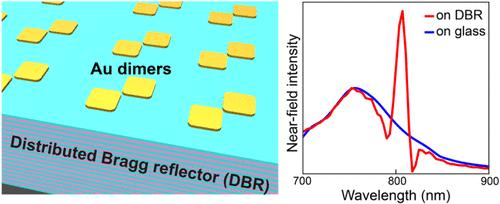
The light confinement capability of optical cavities plays an important role in amplifying the light–matter interactions. To realize high-performance optical cavities, not only a small mode volume but also a high quality (Q) factor is indispensable. Plasmonic nanocavities can squeeze light into deep subwavelength spaces, resulting in ultrasmall mode volumes. However, the Q factors of plasmonic nanocavities are seriously impaired by the intrinsic Ohmic losses, and thus the improvement of the Q factors of plasmonic nanocavities is highly challenging. In this study, we integrate Au nanogap dimers with a distributed Bragg reflector (DBR) to realize the high-Q plasmonic nanocavities. Near-field spectral characterizations reveal that the sharp resonance peak appears near the photonic stopband of the DBR, resulting in a Q factor of ∼75. Ultrafast time-resolved measurements also unveil that the plasmon dephasing time of the Au dimer on the DBR is extended compared to that on a glass substrate. The electromagnetic simulations can qualitatively reproduce the experimental observations and reveal that the high-Q plasmonic nanocavities are achievable due to the synergistic interaction of the Au dimers with the slow light induced at the photonic band edge of the DBR. The integrated system demonstrated in this study exhibits stronger near-field enhancement compared to conventional plasmonic nanocavities on a glass substrate, providing a promising platform for boosting the performance of plasmonic nanocavities in various applications.
期刊介绍:
The Journal of Physical Chemistry A/B/C is devoted to reporting new and original experimental and theoretical basic research of interest to physical chemists, biophysical chemists, and chemical physicists.




 京公网安备 11010802042870号
京ICP备2023020795号-1
京公网安备 11010802042870号
京ICP备2023020795号-1

 分享
分享
 求助内容:
求助内容: 应助结果提醒方式:
 扫码关注我们
