{"title":"Improvement in Fluorescence Intensity of Color Centers in Diamond by High-Fluence Irradiation","authors":"Jinpeng Lv, Hancheng Feng, Ruoxin Bai","doi":"10.1021/acs.jpcc.4c07916","DOIUrl":null,"url":null,"abstract":"The high transmissivity, high thermal conductivity, and radiation hardness of diamond make it ideal for use in harsh radiative environments. Herein, the influence of 90 keV O<sup>+</sup> and H<sup>+</sup> as well as 1 MeV electron irradiation with fluence up to 1 × 10<sup>17</sup> ions/cm<sup>2</sup> on bulk diamond crystals are systematically investigated, in combination with morphological, structural, and optoelectronic characterization. The results show that H<sup>+</sup> irradiation increases the electron concentration of diamond, while O<sup>+</sup> and electrons show adverse effects. H<sup>+</sup> irradiation turns the diamond from colorless to brownish, while O<sup>+</sup> irradiation results in a blackness appearance. Although electron irradiation drastically decreases the transmissivity in the near-infrared region (1–2.5 μm) from 33% to only 2%, it still remains visually transparent. Interestingly, irradiation remarkably enhances the room temperature 575, 637, and 738 nm related luminescence, due to the formation of the NV and SiV defects facilitated by irradiation-created vacancies. Compared to H<sup>+</sup> and O<sup>+</sup> irradiation, electron irradiation creates the strongest defect luminescence (intensified by nearly 9 times) while undergoing moderate radiation damage, which could be employed as an efficient method to tune defect luminescence in diamonds for quantum sensing.","PeriodicalId":61,"journal":{"name":"The Journal of Physical Chemistry C","volume":"23 1","pages":""},"PeriodicalIF":3.2000,"publicationDate":"2025-03-03","publicationTypes":"Journal Article","fieldsOfStudy":null,"isOpenAccess":false,"openAccessPdf":"","citationCount":"0","resultStr":null,"platform":"Semanticscholar","paperid":null,"PeriodicalName":"The Journal of Physical Chemistry C","FirstCategoryId":"1","ListUrlMain":"https://doi.org/10.1021/acs.jpcc.4c07916","RegionNum":3,"RegionCategory":"化学","ArticlePicture":[],"TitleCN":null,"AbstractTextCN":null,"PMCID":null,"EPubDate":"","PubModel":"","JCR":"Q2","JCRName":"CHEMISTRY, PHYSICAL","Score":null,"Total":0}
引用次数: 0
Abstract
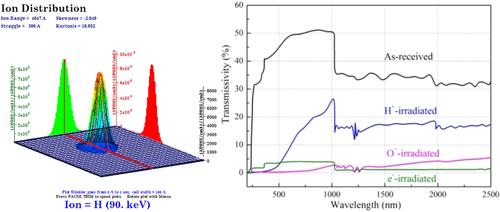
The high transmissivity, high thermal conductivity, and radiation hardness of diamond make it ideal for use in harsh radiative environments. Herein, the influence of 90 keV O+ and H+ as well as 1 MeV electron irradiation with fluence up to 1 × 10¹⁷ ions/cm2 on bulk diamond crystals are systematically investigated, in combination with morphological, structural, and optoelectronic characterization. The results show that H+ irradiation increases the electron concentration of diamond, while O+ and electrons show adverse effects. H+ irradiation turns the diamond from colorless to brownish, while O+ irradiation results in a blackness appearance. Although electron irradiation drastically decreases the transmissivity in the near-infrared region (1–2.5 μm) from 33% to only 2%, it still remains visually transparent. Interestingly, irradiation remarkably enhances the room temperature 575, 637, and 738 nm related luminescence, due to the formation of the NV and SiV defects facilitated by irradiation-created vacancies. Compared to H+ and O+ irradiation, electron irradiation creates the strongest defect luminescence (intensified by nearly 9 times) while undergoing moderate radiation damage, which could be employed as an efficient method to tune defect luminescence in diamonds for quantum sensing.
期刊介绍:
The Journal of Physical Chemistry A/B/C is devoted to reporting new and original experimental and theoretical basic research of interest to physical chemists, biophysical chemists, and chemical physicists.




 京公网安备 11010802042870号
京ICP备2023020795号-1
京公网安备 11010802042870号
京ICP备2023020795号-1

 分享
分享
 求助内容:
求助内容: 应助结果提醒方式:
 扫码关注我们
