Yuting Min, Mingquan Pi, Zihang Peng, Gangyun Guan, Lei Liang, Fang Song, Yiding Wang, Yu Zhang, Xue Bai and Chuantao Zheng
{"title":"On-chip near-infrared multi-gas sensing using chalcogenide anti-resonant hollow-core waveguides","authors":"Yuting Min, Mingquan Pi, Zihang Peng, Gangyun Guan, Lei Liang, Fang Song, Yiding Wang, Yu Zhang, Xue Bai and Chuantao Zheng","doi":"10.1039/D4LC00971A","DOIUrl":null,"url":null,"abstract":"<p >On-chip infrared spectroscopic gas sensing using a hollow-core anti-resonant reflecting optical waveguide (ARROW) with a large external confinement factor (ECF) was rarely reported due to the complex fabrication process and polarization dependence. Alternatively, we proposed ARROW gas sensors using chalcogenide (ChG) anti-resonant layers which require thermal evaporation and epoxy resin bonding for fabrication instead of the complicated wafer bonding process. Polarization characteristics and ethylene (C<small><sub>2</sub></small>H<small><sub>2</sub></small>) sensing performance at 1.532 μm were measured for two ARROW sensors with four-side (WG_A) and three-side (WG_B) anti-resonant layers around the hollow-core. Due to a symmetric structure, the 1 cm-long WG_A sensor exhibits polarization-insensitive characteristics, which does not require an additional polarization controller for integrated on-chip sensors and enhances the stability and reliability of the sensor under fluctuating polarization states. A high ECF of 71% and a 1<em>σ</em> limit of detection (LoD) of ∼23 parts-per-million (ppm) for WG_A were achieved at an averaging time of 39.2 s. The broadband multi-gas detection capability of WG_A was verified through C<small><sub>2</sub></small>H<small><sub>2</sub></small> detection at 1.532 μm and CH<small><sub>4</sub></small> at 1.654 μm, highlighting the potential of ARROWs for on-chip multi-gas sensing.</p>","PeriodicalId":85,"journal":{"name":"Lab on a Chip","volume":" 7","pages":" 1801-1812"},"PeriodicalIF":5.4000,"publicationDate":"2025-02-26","publicationTypes":"Journal Article","fieldsOfStudy":null,"isOpenAccess":false,"openAccessPdf":"","citationCount":"0","resultStr":null,"platform":"Semanticscholar","paperid":null,"PeriodicalName":"Lab on a Chip","FirstCategoryId":"5","ListUrlMain":"https://pubs.rsc.org/en/content/articlelanding/2025/lc/d4lc00971a","RegionNum":2,"RegionCategory":"工程技术","ArticlePicture":[],"TitleCN":null,"AbstractTextCN":null,"PMCID":null,"EPubDate":"","PubModel":"","JCR":"Q1","JCRName":"BIOCHEMICAL RESEARCH METHODS","Score":null,"Total":0}
引用次数: 0
Abstract
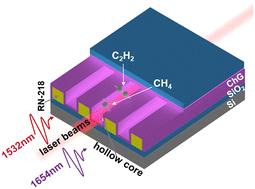
On-chip infrared spectroscopic gas sensing using a hollow-core anti-resonant reflecting optical waveguide (ARROW) with a large external confinement factor (ECF) was rarely reported due to the complex fabrication process and polarization dependence. Alternatively, we proposed ARROW gas sensors using chalcogenide (ChG) anti-resonant layers which require thermal evaporation and epoxy resin bonding for fabrication instead of the complicated wafer bonding process. Polarization characteristics and ethylene (C2H2) sensing performance at 1.532 μm were measured for two ARROW sensors with four-side (WG_A) and three-side (WG_B) anti-resonant layers around the hollow-core. Due to a symmetric structure, the 1 cm-long WG_A sensor exhibits polarization-insensitive characteristics, which does not require an additional polarization controller for integrated on-chip sensors and enhances the stability and reliability of the sensor under fluctuating polarization states. A high ECF of 71% and a 1σ limit of detection (LoD) of ∼23 parts-per-million (ppm) for WG_A were achieved at an averaging time of 39.2 s. The broadband multi-gas detection capability of WG_A was verified through C2H2 detection at 1.532 μm and CH4 at 1.654 μm, highlighting the potential of ARROWs for on-chip multi-gas sensing.
期刊介绍:
Lab on a Chip is the premiere journal that publishes cutting-edge research in the field of miniaturization. By their very nature, microfluidic/nanofluidic/miniaturized systems are at the intersection of disciplines, spanning fundamental research to high-end application, which is reflected by the broad readership of the journal. Lab on a Chip publishes two types of papers on original research: full-length research papers and communications. Papers should demonstrate innovations, which can come from technical advancements or applications addressing pressing needs in globally important areas. The journal also publishes Comments, Reviews, and Perspectives.



 京公网安备 11010802042870号
京ICP备2023020795号-1
京公网安备 11010802042870号
京ICP备2023020795号-1

 分享
分享
 求助内容:
求助内容: 应助结果提醒方式:
 扫码关注我们
