Identification of novel tetrabromobisphenol A byproducts in industrial chemicals and the environment near a manufacturing site: an overlooked source of novel pollutants†
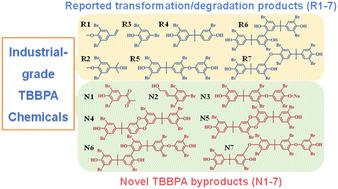
{"title":"Identification of novel tetrabromobisphenol A byproducts in industrial chemicals and the environment near a manufacturing site: an overlooked source of novel pollutants†","authors":"Weihao Xu, Xiaoxuan Han, Yong Tian, Jiakui Liang and Yanfeng Zhang","doi":"10.1039/D5EM00030K","DOIUrl":null,"url":null,"abstract":"<p >To evaluate the migration, transformation, and fate of tetrabromobisphenol A (TBBPA) in the environment, the transformation/degradation (T/D) products of TBBPA and byproducts of industrial production should be distinguished. Herein, 7 reported T/D products (R1–R7) and 7 novel byproducts (N1–N7) of TBBPA were identified in industrial-grade TBBPA chemicals by using high-performance liquid chromatography coupled ion trap mass spectrometry and high-resolution mass spectrometry with a suspect screening strategy. The possible formation pathways of these byproducts were attributed to the bromination, debromination, methylation, demethylation, hydroxylation, substitution, and radical coupling reactions of bisphenol A (BPA), BPA impurities, and TBBPA. The detection frequencies of R1–R7 and N3 (80–100%) were higher than those of N1, N2, and N4–N7 (20–60%) in industrial-grade TBBPA chemicals, with contents extended to 2.29% and 0.0989%, respectively. In the soils and sediments near the TBBPA plants, R1–R4 and N1 were detected with the highest concentration of 1.56 × 10<small><sup>2</sup></small> ng g<small><sup>−1</sup></small> dry weight, while in the river waters, only R1–R4 were detected with the highest concentration of 4.57 × 10<small><sup>2</sup></small> ng L<small><sup>−1</sup></small>. An <em>in silico</em> analysis indicated the potential toxicity of these compounds, including their hepatotoxicity and carcinogenicity. To accurately estimate the environmental effects of the T/D products of TBBPA, the contributions of byproducts in industrial-grade TBBPA chemicals should be considered separately.</p>","PeriodicalId":74,"journal":{"name":"Environmental Science: Processes & Impacts","volume":" 4","pages":" 950-959"},"PeriodicalIF":3.9000,"publicationDate":"2025-02-20","publicationTypes":"Journal Article","fieldsOfStudy":null,"isOpenAccess":false,"openAccessPdf":"","citationCount":"0","resultStr":null,"platform":"Semanticscholar","paperid":null,"PeriodicalName":"Environmental Science: Processes & Impacts","FirstCategoryId":"93","ListUrlMain":"https://pubs.rsc.org/en/content/articlelanding/2025/em/d5em00030k","RegionNum":3,"RegionCategory":"环境科学与生态学","ArticlePicture":[],"TitleCN":null,"AbstractTextCN":null,"PMCID":null,"EPubDate":"","PubModel":"","JCR":"Q1","JCRName":"CHEMISTRY, ANALYTICAL","Score":null,"Total":0}
引用次数: 0
Abstract
To evaluate the migration, transformation, and fate of tetrabromobisphenol A (TBBPA) in the environment, the transformation/degradation (T/D) products of TBBPA and byproducts of industrial production should be distinguished. Herein, 7 reported T/D products (R1–R7) and 7 novel byproducts (N1–N7) of TBBPA were identified in industrial-grade TBBPA chemicals by using high-performance liquid chromatography coupled ion trap mass spectrometry and high-resolution mass spectrometry with a suspect screening strategy. The possible formation pathways of these byproducts were attributed to the bromination, debromination, methylation, demethylation, hydroxylation, substitution, and radical coupling reactions of bisphenol A (BPA), BPA impurities, and TBBPA. The detection frequencies of R1–R7 and N3 (80–100%) were higher than those of N1, N2, and N4–N7 (20–60%) in industrial-grade TBBPA chemicals, with contents extended to 2.29% and 0.0989%, respectively. In the soils and sediments near the TBBPA plants, R1–R4 and N1 were detected with the highest concentration of 1.56 × 10² ng g−1 dry weight, while in the river waters, only R1–R4 were detected with the highest concentration of 4.57 × 10² ng L−1. An in silico analysis indicated the potential toxicity of these compounds, including their hepatotoxicity and carcinogenicity. To accurately estimate the environmental effects of the T/D products of TBBPA, the contributions of byproducts in industrial-grade TBBPA chemicals should be considered separately.
期刊介绍:
Environmental Science: Processes & Impacts publishes high quality papers in all areas of the environmental chemical sciences, including chemistry of the air, water, soil and sediment. We welcome studies on the environmental fate and effects of anthropogenic and naturally occurring contaminants, both chemical and microbiological, as well as related natural element cycling processes.



 京公网安备 11010802042870号
京ICP备2023020795号-1
京公网安备 11010802042870号
京ICP备2023020795号-1

 分享
分享
 求助内容:
求助内容: 应助结果提醒方式:
 扫码关注我们
