An overview of insulin therapy for the non-specialist

IF 5.7 2区 医学 Q1 ENDOCRINOLOGY & METABOLISM Diabetes, Obesity & Metabolism Pub Date : 2025-03-04 DOI:10.1111/dom.16280
Philip D. Home DPhil
{"title":"An overview of insulin therapy for the non-specialist","authors":"Philip D. Home DPhil","doi":"10.1111/dom.16280","DOIUrl":null,"url":null,"abstract":"<div>\n \n \n <section>\n \n <p>Nearly all health professionals, whatever their practice or speciality, now have contact with a significant number of insulin-using people with diabetes. People with type 1 diabetes are nearly universally managed on more complex insulin regimens, increasingly with complex support technology, and with some understanding of the concepts underlying these needed by anyone with responsibility for other aspects of their health care. People with type 2 diabetes usually come to insulin therapy in time, now with a prevalence for insulin administration of ≈50%, thanks to improved management of associated health risks giving longer life expectancy. But while some understandings have simplified the usual approach (basal insulin, self-adjustment dose algorithms), the advent of other medical products offering cardio-renal protection, the use of insulin in combination with these, and the marketing of novel insulin analogues and biosimilars, have all added complexity to clinical decision making. However for the insulin user in the mainstream of care (ambulatory diabetes services in primary and secondary care) the broad principles of choice and management of insulin therapy are fairly easily applied. In the current article, the complexity is dissected and addressed, some of the stigma around insulin therapy is neutralised, and the fundamental approach in regular care drawn into focus.</p>\n </section>\n \n <section>\n \n <h3> Plain Language Summary</h3>\n \n <p>Insulin therapy is used in their diabetes lifetime by nearly all people with type 2 diabetes (T2DM), as well as in all people with type 1 diabetes (T1DM). In T2DM this is in the context of the usual progression of islet B-cell secretory failure, but also very often in the context of other conditions, from cancer or steroid therapy to acute arterial events or major surgery. Its prescription in these circumstances means that, in pharmaco-epidemiological studies, insulin use is invariably associated with poor health outcomes, but in a series of major RCTs of 5–15 years duration no excess of vascular or oncological adverse health outcomes was found. Physiologically insulin secretion occurs in two scenarios, namely basal insulin at night and between meals (≈50%), and in short (≈4 h) bursts with meals (≈50%). The former suppresses liver glucose production, which in its absence causes plasma glucose to rise threefold to around 12 mmol/l (but much higher if metabolic stress or with sugar-containing drinks). Meal-time insulin secretion in addition promotes glucose storage in skeletal muscle. People with T1DM, having no endogenous insulin secretion, thus require a multiple injection regimen (basal + meal-time), or pumped insulin, often now moderated by continuous glucose monitoring (CGM). Basal and meal-time preparations of pharmaceutical insulin analogues are also used for T2DM, with GLP-1RA and metformin usually continued. The starting regimen is normally basal only, usually with insulin glargine (100 U/ml), originator or biosimilar, while insulin degludec or glargine 300 U/ml can have advantage as basal insulins where true 24-h cover is found to be needed. Weekly insulins (developmental or marketed) may have a role in injection acceptability in T2DM, at a cost of some increase in hypoglycaemia. In ambulatory care a meal-time insulin analogue, originator or biosimilar, is added when required, often after some years on basal insulin. Meal insulins are also used in insulin pumps. Hypoglycaemia is a significant issue in T1DM, limiting insulin dosing, but can be helped by CGM, with or without pumps, and careful dose adjustment. It is a much lesser issue in T2DM, until meal-time insulins are introduced, or in people of thinner phenotype, whence again expertise in dose adjustment may be needed. Body weight gain with insulin is usually modest, particularly if basal insulin is begun appropriately before glycosuria has influenced calorie balance. In mainstream ambulatory care the broad principles of insulin therapy are fairly easily applied, the main resources being team familiarity with a basal insulin (glargine/biosimilar), a finger-prick glucose-monitoring system, basic patient education on use of these, and time to supervise dose titration. Beginning with a fixed dose (e.g. 10 U/day) and increasing by 2 U twice a week is simple, but may take months of persistent input to reach target fasting plasma glucose levels. In conclusion, insulin is a usual therapy in both T1DM and T2DM, and in the latter initially at least is fairly easily applied, in combination with other glucose-lowering agents. However it can be more challenging in the context of the technology used in T1DM, once meal-time insulin is added to basal in T2DM, and when dose requirements are complex and unstable in conjunction with other medical conditions.</p>\n </section>\n </div>","PeriodicalId":158,"journal":{"name":"Diabetes, Obesity & Metabolism","volume":"27 S5","pages":"3-15"},"PeriodicalIF":5.7000,"publicationDate":"2025-03-04","publicationTypes":"Journal Article","fieldsOfStudy":null,"isOpenAccess":false,"openAccessPdf":"https://onlinelibrary.wiley.com/doi/epdf/10.1111/dom.16280","citationCount":"0","resultStr":null,"platform":"Semanticscholar","paperid":null,"PeriodicalName":"Diabetes, Obesity & Metabolism","FirstCategoryId":"3","ListUrlMain":"https://dom-pubs.onlinelibrary.wiley.com/doi/10.1111/dom.16280","RegionNum":2,"RegionCategory":"医学","ArticlePicture":[],"TitleCN":null,"AbstractTextCN":null,"PMCID":null,"EPubDate":"","PubModel":"","JCR":"Q1","JCRName":"ENDOCRINOLOGY & METABOLISM","Score":null,"Total":0}
引用次数: 0

Abstract

Nearly all health professionals, whatever their practice or speciality, now have contact with a significant number of insulin-using people with diabetes. People with type 1 diabetes are nearly universally managed on more complex insulin regimens, increasingly with complex support technology, and with some understanding of the concepts underlying these needed by anyone with responsibility for other aspects of their health care. People with type 2 diabetes usually come to insulin therapy in time, now with a prevalence for insulin administration of ≈50%, thanks to improved management of associated health risks giving longer life expectancy. But while some understandings have simplified the usual approach (basal insulin, self-adjustment dose algorithms), the advent of other medical products offering cardio-renal protection, the use of insulin in combination with these, and the marketing of novel insulin analogues and biosimilars, have all added complexity to clinical decision making. However for the insulin user in the mainstream of care (ambulatory diabetes services in primary and secondary care) the broad principles of choice and management of insulin therapy are fairly easily applied. In the current article, the complexity is dissected and addressed, some of the stigma around insulin therapy is neutralised, and the fundamental approach in regular care drawn into focus.

Plain Language Summary

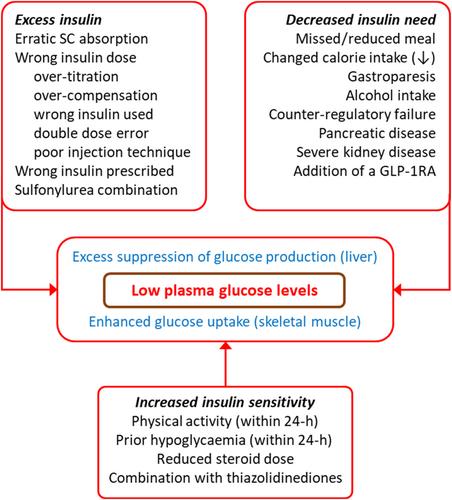
Insulin therapy is used in their diabetes lifetime by nearly all people with type 2 diabetes (T2DM), as well as in all people with type 1 diabetes (T1DM). In T2DM this is in the context of the usual progression of islet B-cell secretory failure, but also very often in the context of other conditions, from cancer or steroid therapy to acute arterial events or major surgery. Its prescription in these circumstances means that, in pharmaco-epidemiological studies, insulin use is invariably associated with poor health outcomes, but in a series of major RCTs of 5–15 years duration no excess of vascular or oncological adverse health outcomes was found. Physiologically insulin secretion occurs in two scenarios, namely basal insulin at night and between meals (≈50%), and in short (≈4 h) bursts with meals (≈50%). The former suppresses liver glucose production, which in its absence causes plasma glucose to rise threefold to around 12 mmol/l (but much higher if metabolic stress or with sugar-containing drinks). Meal-time insulin secretion in addition promotes glucose storage in skeletal muscle. People with T1DM, having no endogenous insulin secretion, thus require a multiple injection regimen (basal + meal-time), or pumped insulin, often now moderated by continuous glucose monitoring (CGM). Basal and meal-time preparations of pharmaceutical insulin analogues are also used for T2DM, with GLP-1RA and metformin usually continued. The starting regimen is normally basal only, usually with insulin glargine (100 U/ml), originator or biosimilar, while insulin degludec or glargine 300 U/ml can have advantage as basal insulins where true 24-h cover is found to be needed. Weekly insulins (developmental or marketed) may have a role in injection acceptability in T2DM, at a cost of some increase in hypoglycaemia. In ambulatory care a meal-time insulin analogue, originator or biosimilar, is added when required, often after some years on basal insulin. Meal insulins are also used in insulin pumps. Hypoglycaemia is a significant issue in T1DM, limiting insulin dosing, but can be helped by CGM, with or without pumps, and careful dose adjustment. It is a much lesser issue in T2DM, until meal-time insulins are introduced, or in people of thinner phenotype, whence again expertise in dose adjustment may be needed. Body weight gain with insulin is usually modest, particularly if basal insulin is begun appropriately before glycosuria has influenced calorie balance. In mainstream ambulatory care the broad principles of insulin therapy are fairly easily applied, the main resources being team familiarity with a basal insulin (glargine/biosimilar), a finger-prick glucose-monitoring system, basic patient education on use of these, and time to supervise dose titration. Beginning with a fixed dose (e.g. 10 U/day) and increasing by 2 U twice a week is simple, but may take months of persistent input to reach target fasting plasma glucose levels. In conclusion, insulin is a usual therapy in both T1DM and T2DM, and in the latter initially at least is fairly easily applied, in combination with other glucose-lowering agents. However it can be more challenging in the context of the technology used in T1DM, once meal-time insulin is added to basal in T2DM, and when dose requirements are complex and unstable in conjunction with other medical conditions.
Abstract Image

Abstract Image

Abstract Image

查看原文
分享 分享
微信好友 朋友圈 QQ好友 复制链接
本刊更多论文
非专科患者胰岛素治疗综述。
几乎所有的卫生专业人员,无论他们的实践或专业,现在都接触到大量使用胰岛素的糖尿病患者。1型糖尿病患者几乎普遍采用更复杂的胰岛素治疗方案,越来越多地采用复杂的支持技术,并且对负责其医疗保健其他方面的任何人所需要的潜在概念有所了解。2型糖尿病患者通常会及时接受胰岛素治疗,由于相关健康风险管理的改善,预期寿命延长,目前胰岛素治疗的患病率约为50%。但是,虽然一些理解简化了通常的方法(基础胰岛素,自我调整剂量算法),但其他提供心脏-肾脏保护的医疗产品的出现,胰岛素与这些药物的联合使用,以及新型胰岛素类似物和生物仿制药的营销,都增加了临床决策的复杂性。然而,对于主流护理中的胰岛素使用者(初级和二级护理中的门诊糖尿病服务),选择和管理胰岛素治疗的广泛原则相当容易应用。在当前的文章中,复杂性被剖析和解决,围绕胰岛素治疗的一些污名被中和,并在常规护理的基本方法成为焦点。摘要:几乎所有2型糖尿病(T2DM)患者和所有1型糖尿病(T1DM)患者在糖尿病一生中都使用胰岛素治疗。在T2DM中,这通常是胰岛b细胞分泌衰竭的进展,但也经常是在其他情况下,从癌症或类固醇治疗到急性动脉事件或大手术。在这些情况下,它的处方意味着,在药物流行病学研究中,胰岛素的使用总是与不良健康结果相关,但在一系列5-15年的主要随机对照试验中,没有发现过多的血管或肿瘤不良健康结果。生理性胰岛素分泌在两种情况下发生,即夜间和两餐之间的基础胰岛素(≈50%),以及短时间(≈4小时)随餐爆发(≈50%)。前者会抑制肝脏葡萄糖的产生,缺乏葡萄糖会导致血浆葡萄糖上升三倍,达到12毫摩尔/升左右(但如果代谢压力或含糖饮料会高得多)。此外,进餐时胰岛素分泌促进骨骼肌中的葡萄糖储存。T1DM患者没有内源性胰岛素分泌,因此需要多次注射方案(基础+用餐时间),或泵送胰岛素,现在通常通过连续血糖监测(CGM)来调节。T2DM患者也使用基础和餐时药物胰岛素类似物制剂,通常继续使用GLP-1RA和二甲双胍。起始方案通常仅为基础方案,通常使用甘精胰岛素(100 U/ml)、原药或生物仿制药,而在需要真正24小时覆盖的情况下,去葡萄糖胰岛素或甘精胰岛素300 U/ml可作为基础胰岛素具有优势。每周胰岛素(开发或上市)可能在2型糖尿病患者的注射接受性中起作用,其代价是低血糖增加。在门诊治疗中,需要时添加餐时胰岛素类似物,原药或生物类似药,通常在基础胰岛素治疗数年后。膳食胰岛素也用于胰岛素泵。低血糖是T1DM的一个重要问题,限制了胰岛素的剂量,但可以通过CGM(有或没有泵)和谨慎的剂量调整来帮助。在2型糖尿病患者中,这个问题要小得多,直到餐时胰岛素被引入,或者在更瘦的人群中,这时可能需要剂量调整方面的专业知识。胰岛素的体重增加通常是适度的,特别是如果在糖尿影响热量平衡之前适当地开始基础胰岛素。在主流门诊护理中,胰岛素治疗的广泛原则相当容易应用,主要资源是团队熟悉基础胰岛素(甘精/生物仿制药),手指刺破血糖监测系统,对患者进行基本的使用教育,以及监督剂量滴定的时间。从固定剂量开始(例如10 U/天),然后每周增加2 U,这很简单,但可能需要数月的持续投入才能达到目标空腹血糖水平。总之,胰岛素是T1DM和T2DM的常用治疗方法,在T2DM中,与其他降糖药联合使用至少在最初是相当容易的。然而,在T2DM中使用的技术背景下,一旦在T2DM中添加餐时胰岛素,并且剂量需求复杂且不稳定,并伴有其他医疗条件,则可能更具挑战性。
本文章由计算机程序翻译,如有差异,请以英文原文为准。
求助全文
约1分钟内获得全文 去求助
来源期刊
Diabetes, Obesity & Metabolism
Diabetes, Obesity & Metabolism 医学-内分泌学与代谢
CiteScore
10.90
自引率
6.90%
发文量
319
审稿时长
3-8 weeks
期刊介绍: Diabetes, Obesity and Metabolism is primarily a journal of clinical and experimental pharmacology and therapeutics covering the interrelated areas of diabetes, obesity and metabolism. The journal prioritises high-quality original research that reports on the effects of new or existing therapies, including dietary, exercise and lifestyle (non-pharmacological) interventions, in any aspect of metabolic and endocrine disease, either in humans or animal and cellular systems. ‘Metabolism’ may relate to lipids, bone and drug metabolism, or broader aspects of endocrine dysfunction. Preclinical pharmacology, pharmacokinetic studies, meta-analyses and those addressing drug safety and tolerability are also highly suitable for publication in this journal. Original research may be published as a main paper or as a research letter.
期刊最新文献
Effects of GLP-1 receptor agonists on cognitive function in patients with type 2 diabetes: A systematic review and meta-analysis based on randomized controlled trials. The importance of treatment sequencing with SGLT2 inhibitors and GLP-1 receptor agonists combination for kidney function preservation in type 2 diabetes. Dual action of imeglimin on insulin secretion and sensitivity in type 2 diabetes. Comparison of DXA, BIA, and anthropometry for assessing subcutaneous, visceral, liver, and pancreas fat measured by MRI. Elevated triglyceride-glucose index is associated with increased risk of chronic kidney disease and end-stage renal disease in type 1 diabetes: Nationwide cohort study.
×
引用
GB/T 7714-2015
复制
MLA
复制
APA
复制
导出至
BibTeX EndNote RefMan NoteFirst NoteExpress
×
×
提示
您的信息不完整,为了账户安全,请先补充。
现在去补充
×
提示
您因"违规操作"
具体请查看互助需知
我知道了
×
提示
现在去查看 取消
×
提示
确定
0
微信
客服QQ
Book学术公众号 扫码关注我们
反馈
×
意见反馈
请填写您的意见或建议
请填写您的手机或邮箱
已复制链接
已复制链接
快去分享给好友吧!
我知道了
×
扫码分享
扫码分享
Book学术官方微信
Book学术文献互助
Book学术文献互助群
群 号:604180095
Book学术
文献互助 智能选刊 最新文献 互助须知 联系我们:info@booksci.cn
Book学术提供免费学术资源搜索服务,方便国内外学者检索中英文文献。致力于提供最便捷和优质的服务体验。
Copyright © 2023 Book学术 All rights reserved.
ghs 京公网安备 11010802042870号 京ICP备2023020795号-1