Marco Artini, Irene Paris, Esther Imperlini, Francesco Buonocore, Gianluca Vrenna, Rosanna Papa, Laura Selan
{"title":"A chionodracine-derived peptide, KHS-Cnd, as an anti-virulence agent against multidrug-resistant <i>Acinetobacter baumannii</i> clinical strains.","authors":"Marco Artini, Irene Paris, Esther Imperlini, Francesco Buonocore, Gianluca Vrenna, Rosanna Papa, Laura Selan","doi":"10.3389/fcimb.2025.1526246","DOIUrl":null,"url":null,"abstract":"<p><p>About 71% of healthcare-associated infections are due to antibiotic-resistant bacteria, such as carbapenem-resistant <i>A. baumannii</i>, classified by World Health Organization into a critical priority group of pathogens. The antimicrobial resistance profile of <i>A. baumannii</i> relies on its ability to produce several virulence factors, including biofilm formation. Its ability to adhere and persist on surfaces as biofilm has contributed to its pathogenicity and drug resistance. In this study, the ability of an antimicrobial peptide (a chionodracine-derived peptide named KHS-Cnd) to inhibit or reduce biofilm formation was investigated as an example of a potential strategy to counteract infections caused by biofilm-forming pathogens. To this aim, the antimicrobial profiles were first analyzed in selected <i>A. baumannii</i> strains, two reference and six clinical strains, all biofilm-forming with different capability, regardless of whether they are drug resistant or sensitive. Successively, we investigated the bactericidal activity of the peptide that showed MIC values ranging from 5 to 10 µM and a significative antibiofilm activity on all tested strains at sub-inhibitory concentrations. In fact, KHS-Cnd can hinder biofilm <i>A. baumannii</i> strains formation with an inhibition percentage ranging between 65% and 10%. Also a statistically significant reduction of mature biofilm ranging from 20% to 50% was observed in four out of eight tested <i>A. baumannii</i> strains. KHS-Cnd impacts various stages of biofilm formation, including the inhibition of surface-associated and twitching motilities depending on the different strain. In particular, our results showed that only two strains possessed surface-associated motility that was strongly impaired by KHS-Cnd treatment; three clinical strains, instead, showed twitching motility, whose inhibition for two of them was evident after 24 h of incubation with peptide. Moreover, the invasion of pulmonary cells by <i>A. baumannii</i> was significantly impaired with a reduction of about 32% after treatment with 1.25 µM KHS-Cnd. Finally, when the peptide was used together with ceftazidime/avibactam against resistant <i>A. baumannii</i> strains, it was able to reduce the minimal inhibitory concentration of antibiotics needed to inhibit the microorganism growth.</p>","PeriodicalId":12458,"journal":{"name":"Frontiers in Cellular and Infection Microbiology","volume":"15 ","pages":"1526246"},"PeriodicalIF":4.8000,"publicationDate":"2025-02-14","publicationTypes":"Journal Article","fieldsOfStudy":null,"isOpenAccess":false,"openAccessPdf":"https://www.ncbi.nlm.nih.gov/pmc/articles/PMC11868114/pdf/","citationCount":"0","resultStr":null,"platform":"Semanticscholar","paperid":null,"PeriodicalName":"Frontiers in Cellular and Infection Microbiology","FirstCategoryId":"3","ListUrlMain":"https://doi.org/10.3389/fcimb.2025.1526246","RegionNum":2,"RegionCategory":"医学","ArticlePicture":[],"TitleCN":null,"AbstractTextCN":null,"PMCID":null,"EPubDate":"2025/1/1 0:00:00","PubModel":"eCollection","JCR":"Q2","JCRName":"IMMUNOLOGY","Score":null,"Total":0}
引用次数: 0
Abstract
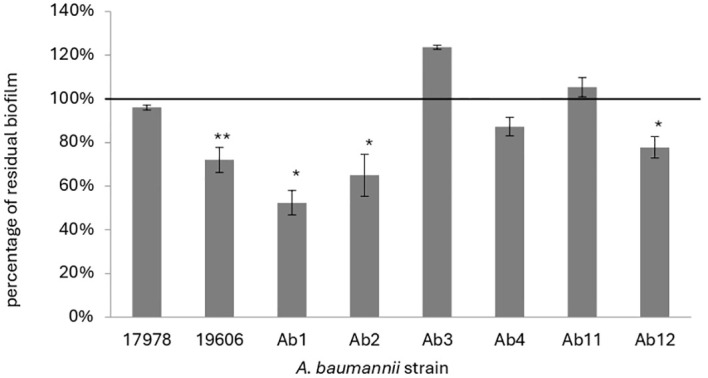
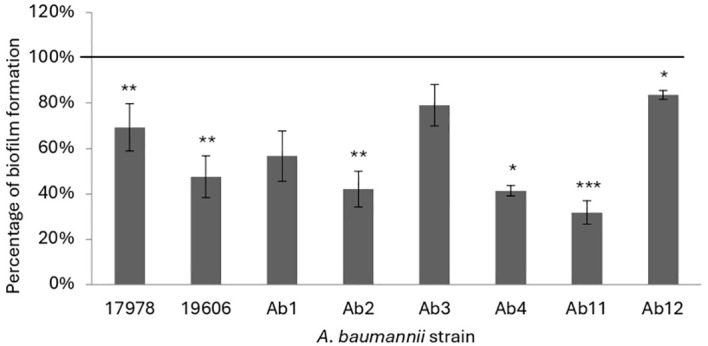
About 71% of healthcare-associated infections are due to antibiotic-resistant bacteria, such as carbapenem-resistant A. baumannii, classified by World Health Organization into a critical priority group of pathogens. The antimicrobial resistance profile of A. baumannii relies on its ability to produce several virulence factors, including biofilm formation. Its ability to adhere and persist on surfaces as biofilm has contributed to its pathogenicity and drug resistance. In this study, the ability of an antimicrobial peptide (a chionodracine-derived peptide named KHS-Cnd) to inhibit or reduce biofilm formation was investigated as an example of a potential strategy to counteract infections caused by biofilm-forming pathogens. To this aim, the antimicrobial profiles were first analyzed in selected A. baumannii strains, two reference and six clinical strains, all biofilm-forming with different capability, regardless of whether they are drug resistant or sensitive. Successively, we investigated the bactericidal activity of the peptide that showed MIC values ranging from 5 to 10 µM and a significative antibiofilm activity on all tested strains at sub-inhibitory concentrations. In fact, KHS-Cnd can hinder biofilm A. baumannii strains formation with an inhibition percentage ranging between 65% and 10%. Also a statistically significant reduction of mature biofilm ranging from 20% to 50% was observed in four out of eight tested A. baumannii strains. KHS-Cnd impacts various stages of biofilm formation, including the inhibition of surface-associated and twitching motilities depending on the different strain. In particular, our results showed that only two strains possessed surface-associated motility that was strongly impaired by KHS-Cnd treatment; three clinical strains, instead, showed twitching motility, whose inhibition for two of them was evident after 24 h of incubation with peptide. Moreover, the invasion of pulmonary cells by A. baumannii was significantly impaired with a reduction of about 32% after treatment with 1.25 µM KHS-Cnd. Finally, when the peptide was used together with ceftazidime/avibactam against resistant A. baumannii strains, it was able to reduce the minimal inhibitory concentration of antibiotics needed to inhibit the microorganism growth.
期刊介绍:
Frontiers in Cellular and Infection Microbiology is a leading specialty journal, publishing rigorously peer-reviewed research across all pathogenic microorganisms and their interaction with their hosts. Chief Editor Yousef Abu Kwaik, University of Louisville is supported by an outstanding Editorial Board of international experts. This multidisciplinary open-access journal is at the forefront of disseminating and communicating scientific knowledge and impactful discoveries to researchers, academics, clinicians and the public worldwide.
Frontiers in Cellular and Infection Microbiology includes research on bacteria, fungi, parasites, viruses, endosymbionts, prions and all microbial pathogens as well as the microbiota and its effect on health and disease in various hosts. The research approaches include molecular microbiology, cellular microbiology, gene regulation, proteomics, signal transduction, pathogenic evolution, genomics, structural biology, and virulence factors as well as model hosts. Areas of research to counteract infectious agents by the host include the host innate and adaptive immune responses as well as metabolic restrictions to various pathogenic microorganisms, vaccine design and development against various pathogenic microorganisms, and the mechanisms of antibiotic resistance and its countermeasures.





 京公网安备 11010802042870号
京ICP备2023020795号-1
京公网安备 11010802042870号
京ICP备2023020795号-1

 分享
分享
 求助内容:
求助内容: 应助结果提醒方式:
 扫码关注我们
