Hyunjin Kyoung, Ikcheol Shin, Younghoon Kim, Jin Ho Cho, Kyeong Il Park, Yonghee Kim, Jinmu Ahn, Jinuk Nam, Kimoon Kim, Yonggu Kang, Hyeun Bum Kim, Minho Song
{"title":"Mixed supplementation of dietary inorganic and organic selenium modulated systemic health parameters and fecal microbiota in weaned pigs.","authors":"Hyunjin Kyoung, Ikcheol Shin, Younghoon Kim, Jin Ho Cho, Kyeong Il Park, Yonghee Kim, Jinmu Ahn, Jinuk Nam, Kimoon Kim, Yonggu Kang, Hyeun Bum Kim, Minho Song","doi":"10.3389/fvets.2025.1531336","DOIUrl":null,"url":null,"abstract":"<p><p>This study was conducted to evaluate the effects of dietary mixed selenium [MSe: inorganic selenium (ISe) + organic selenium (OSe)] levels on the growth performance, blood parameters, and fecal microbiota of weaned pigs. In a randomized complete block design (block = initial body weight), 156 weaned pigs were allotted to three dietary treatments (4 pigs per pen; 13 replicates per treatment) for 42 days. Dietary treatments included (1) a non-Se-fortified diet based on corn and soybean meal (CON), (2) CON + 0.15 ppm ISe and 0.15 ppm OSe (MSe3), and (3) CON + 0.25 ppm ISe and 0.25 ppm OSe (MSe5). Pigs fed both MSe diets showed no effects on growth performance or diarrhea frequency compared with those fed the CON diet. However, pigs fed MSe3 and MSe5 had higher serum interleukin-6 (<i>p</i> = 0.021, linear <i>p</i> = 0.011) on day 7 and higher Se concentrations (<i>p</i> = 0.002, linear <i>p</i> = 0.001) on day 42 than those fed the CON. In addition, pigs fed different levels of MSe exhibited quadratic (<i>p</i> = 0.054) and linear (<i>p</i> = 0.069) effects on the number of white blood cells and hematocrit on day 42 compared with those fed CON, respectively. Moreover, the MSe3 group had higher total protein concentration (<i>p</i> = 0.049, quadratic <i>p</i> = 0.026) on day 42 than the CON group, and the MSe5 group had lower blood urea nitrogen concentration (<i>p</i> = 0.094, linear <i>p</i> = 0.033). There were no differences in alpha diversity indices of fecal microbiota among dietary treatments. However, beta diversity indices based on the Bray-Curtis dissimilarity were clustered differently (<i>r</i> <sup>2</sup> = 0.56, <i>p</i> = 0.001) among dietary treatments. Pigs fed the MSe5 diet showed an increase in the relative abundance of phylum Bacteroidetes [false discovery rate (FDR) adjusted <i>p</i> = 0.004], families Barnesiellaceae (FDR adjusted <i>p</i> = 0.006) and Veillonellaceae (FDR adjusted <i>p</i> = 0.006), genera <i>Barnesiella</i> (FDR adjusted <i>p</i> = 0.023) and <i>Megasphaera</i> (FDR adjusted <i>p</i> = 0.023), and species <i>Barnesiella intestinihominis</i> (FDR adjusted <i>p</i> = 0.016) and <i>Megasphaera elsdenii</i> (FDR adjusted <i>p</i> = 0.019) compared with those fed the CON diet. In conclusion, dietary MSe modulated the systemic health parameters and fecal microbial community in weaned pigs.</p>","PeriodicalId":12772,"journal":{"name":"Frontiers in Veterinary Science","volume":"12 ","pages":"1531336"},"PeriodicalIF":2.9000,"publicationDate":"2025-02-14","publicationTypes":"Journal Article","fieldsOfStudy":null,"isOpenAccess":false,"openAccessPdf":"https://www.ncbi.nlm.nih.gov/pmc/articles/PMC11869213/pdf/","citationCount":"0","resultStr":null,"platform":"Semanticscholar","paperid":null,"PeriodicalName":"Frontiers in Veterinary Science","FirstCategoryId":"97","ListUrlMain":"https://doi.org/10.3389/fvets.2025.1531336","RegionNum":2,"RegionCategory":"农林科学","ArticlePicture":[],"TitleCN":null,"AbstractTextCN":null,"PMCID":null,"EPubDate":"2025/1/1 0:00:00","PubModel":"eCollection","JCR":"Q1","JCRName":"VETERINARY SCIENCES","Score":null,"Total":0}
引用次数: 0
Abstract
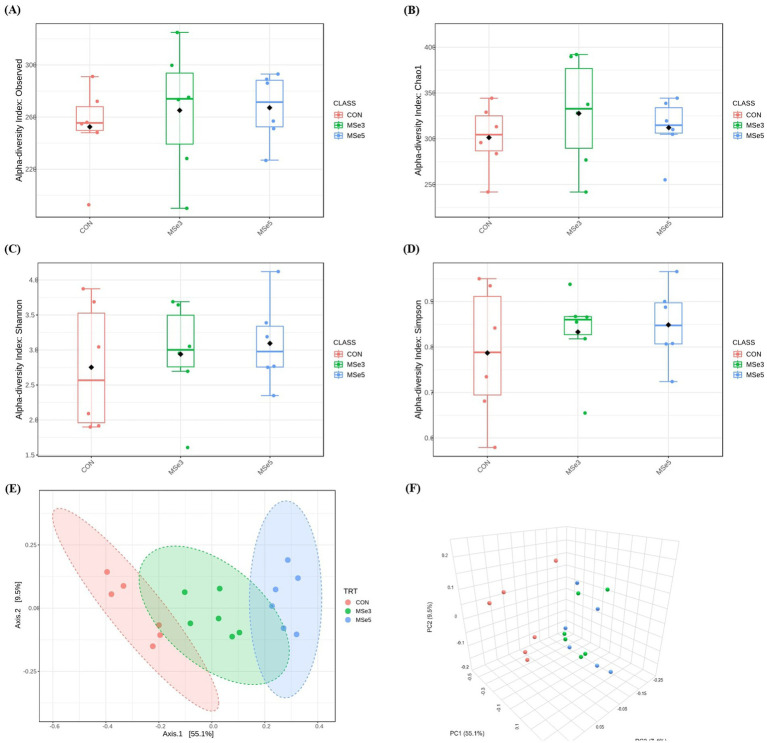
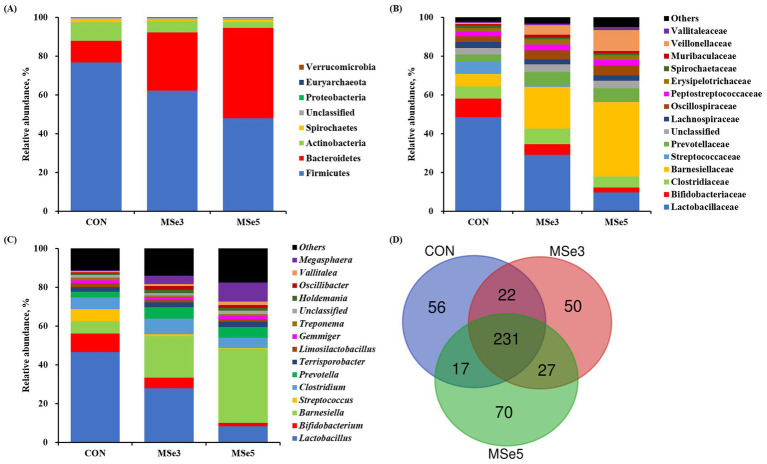
This study was conducted to evaluate the effects of dietary mixed selenium [MSe: inorganic selenium (ISe) + organic selenium (OSe)] levels on the growth performance, blood parameters, and fecal microbiota of weaned pigs. In a randomized complete block design (block = initial body weight), 156 weaned pigs were allotted to three dietary treatments (4 pigs per pen; 13 replicates per treatment) for 42 days. Dietary treatments included (1) a non-Se-fortified diet based on corn and soybean meal (CON), (2) CON + 0.15 ppm ISe and 0.15 ppm OSe (MSe3), and (3) CON + 0.25 ppm ISe and 0.25 ppm OSe (MSe5). Pigs fed both MSe diets showed no effects on growth performance or diarrhea frequency compared with those fed the CON diet. However, pigs fed MSe3 and MSe5 had higher serum interleukin-6 (p = 0.021, linear p = 0.011) on day 7 and higher Se concentrations (p = 0.002, linear p = 0.001) on day 42 than those fed the CON. In addition, pigs fed different levels of MSe exhibited quadratic (p = 0.054) and linear (p = 0.069) effects on the number of white blood cells and hematocrit on day 42 compared with those fed CON, respectively. Moreover, the MSe3 group had higher total protein concentration (p = 0.049, quadratic p = 0.026) on day 42 than the CON group, and the MSe5 group had lower blood urea nitrogen concentration (p = 0.094, linear p = 0.033). There were no differences in alpha diversity indices of fecal microbiota among dietary treatments. However, beta diversity indices based on the Bray-Curtis dissimilarity were clustered differently (r2 = 0.56, p = 0.001) among dietary treatments. Pigs fed the MSe5 diet showed an increase in the relative abundance of phylum Bacteroidetes [false discovery rate (FDR) adjusted p = 0.004], families Barnesiellaceae (FDR adjusted p = 0.006) and Veillonellaceae (FDR adjusted p = 0.006), genera Barnesiella (FDR adjusted p = 0.023) and Megasphaera (FDR adjusted p = 0.023), and species Barnesiella intestinihominis (FDR adjusted p = 0.016) and Megasphaera elsdenii (FDR adjusted p = 0.019) compared with those fed the CON diet. In conclusion, dietary MSe modulated the systemic health parameters and fecal microbial community in weaned pigs.
期刊介绍:
Frontiers in Veterinary Science is a global, peer-reviewed, Open Access journal that bridges animal and human health, brings a comparative approach to medical and surgical challenges, and advances innovative biotechnology and therapy.
Veterinary research today is interdisciplinary, collaborative, and socially relevant, transforming how we understand and investigate animal health and disease. Fundamental research in emerging infectious diseases, predictive genomics, stem cell therapy, and translational modelling is grounded within the integrative social context of public and environmental health, wildlife conservation, novel biomarkers, societal well-being, and cutting-edge clinical practice and specialization. Frontiers in Veterinary Science brings a 21st-century approach—networked, collaborative, and Open Access—to communicate this progress and innovation to both the specialist and to the wider audience of readers in the field.
Frontiers in Veterinary Science publishes articles on outstanding discoveries across a wide spectrum of translational, foundational, and clinical research. The journal''s mission is to bring all relevant veterinary sciences together on a single platform with the goal of improving animal and human health.




 京公网安备 11010802042870号
京ICP备2023020795号-1
京公网安备 11010802042870号
京ICP备2023020795号-1

 分享
分享
 求助内容:
求助内容: 应助结果提醒方式:
 扫码关注我们
