Riccardo Cappato, Samuel Levy, Rui Providencia, Hussam Ali, Andrey Ardashev, Sergio Barra, Antonio Creta, Michal Farkowski, Christian-Hendrik Heeger, Prapa Kanagaratnam, Thorsten Lewalter, Silvia Magnani, Richard Schilling, Internal reviewers
{"title":"Concise Guidelines of the European Cardiac Arrhythmias Society (ECAS) on “Catheter Ablation of Atrial Fibrillation”","authors":"Riccardo Cappato, Samuel Levy, Rui Providencia, Hussam Ali, Andrey Ardashev, Sergio Barra, Antonio Creta, Michal Farkowski, Christian-Hendrik Heeger, Prapa Kanagaratnam, Thorsten Lewalter, Silvia Magnani, Richard Schilling, Internal reviewers","doi":"10.1111/jce.16561","DOIUrl":null,"url":null,"abstract":"<p>Guidelines have been introduced to provide “systematically developed statements to assist practitioner and patient decisions about appropriate health care for specific clinical circumstances” [<span>1</span>]. Since their introduction, they have been a valuable tool for a large population of stakeholders, including physicians, patients, hospitals, educational bodies, manufacturers, health providers and insurers in medicine.</p><p>While guidelines are meant to help professionals in taking routine clinical decisions, there are very few studies possessing the quality required to generate solid recommendations. Despite limited high-quality evidence, guidelines typically consist of full-bodied texts and tables reporting extensive lists of recommendation [<span>2-4</span>].</p><p>To compensate for lack of evidence-based documentation, studies of incomplete quality and condensed judgment among authors are used to generate recommendations of intermediate class enriched with sub-categorization based on multiple arbitrarily generated “levels of evidence”.</p><p>Frequent updating produced by different scientific bodies adds to the model complexity. In addition, guidelines are increasingly perceived as creating unjustified legal liability for practitioners despite the limited evidence on which they are based. To address this, processes have been proposed to impose rigor and transparency with which guideline documents are developed [<span>5, 6</span>] to assess the quality of guidelines, provide a methodological strategy for their development, and clarify what information and how this information should be reported in guideline documents [<span>7, 8</span>]. As a result, guidelines should contract in volume and re-direct focus on recommendations based on clinical indications supported by more solid evidence. Criteria adopted to substantiate the need for high-quality in our guidelines are described in paragraphs “Criteria for Class I, Class II and Class III recommendations” of <b>Chapter 5</b>.</p><p>Catheter ablation of AF represents a situation in which high-quality studies are rather limited. Yet, guidelines and consensus documents have resulted in the production of copious documents [<span>2-4, 9</span>].</p><p>With the intent of producing a guideline that serves its intended purpose and reconciling with the art of medicine, the European Cardiac Arrhythmia Society (ECAS) proposes a concise and coordinate document to assist practitioner and patient decisions in this field. ECAS is an independent society founded in 2004 in Paris with the mission to promote the discipline of better care in diagnosing and treating cardiac arrhythmias. The criteria used in this document to define recommendation classes are summarized in the paragraph “criteria for recommendations” below.</p><p>Definition of truth in science has been subjected to considerable modifications over time [<span>12</span>]. In the 2nd century A.C., Ptolemy proposed a cosmologic model according to which the earth would stand motionless at the center of universe. It took 13 centuries before Copernicus proposed a new, revolutionary model supporting the concept that the earth would rotate around the sun and one more century before Copernicus theory became widely accepted [<span>13</span>]. In the present era, technological development accelerates progress in science and communication. As a result, even when created using high-quality science, guidelines become out of date quickly. Therefore, it is inevitable that current methods for producing guidelines will be reviewed and changed in the future.</p><p>The universal adoption of evidence-based medicine has recast medical knowledge in such a way that experimental studies designed to validate single isolated interventions take on the highest status and, by so doing, undermine clinical judgment and lock in place a reductive model of health and disease [<span>10, 13</span>].</p><p>In the present document, evidence-based medicine will be used solely as a reference point for management of AF. This is consistent with the methods used by other societies in guidelines preparation and is taken under the assumption that new paradigms may surface in the future that offer different base theories, methods of investigation and validation that may subvert the current guideline's structure.</p><p>Given the impact that the clinical presentation of AF plays on the outcomes and, therefore, the techniques used for catheter ablation, it is important to have a valid classification of AF type. Of the many models proposed, the most appropriate for the purposes of catheter ablation appears to be the one based on temporal duration of single AF episodes [<span>47</span>]. While classification into paroxysmal (i.e., AF that terminates spontaneously, with or without AADs, within 7 days from onset), persistent (i.e., continuous AF that is sustained beyond 7 days and for no longer than 1 year in spite of AADs, or that is susceptible to successful cardioversion) and long-standing persistent AF (i.e., continuous AF that is sustained beyond 1 year in spite of AADs) is simple and intuitive, it should be noted that accurate categorization within these groups is not always easy, as episode duration may vary in the individual patient and are not always symptomatic. In the same individual, AF may fall into one category from a clinical point of view but may fall into another category when based on continuous monitoring [<span>48</span>]. Similarly, dissociation between AF-type and pathophysiologic background (i.e., substrate fibrosis) has been documented [<span>49</span>].</p><p>While we recognize the value of categorization into paroxysmal, persistent and long-standing persistent AF, ideally guideline recommendations should use the episode duration characteristics by the referenced studies. Because definitions differ even within the same sub-category of AF (paroxysmal, persistent or long-standing persistent), the present document will provide a detailed list of references indicating those studies that contributed to generate our recommendation scheme. In these studies, readers will find the AF type definition provided by the authors. It will be the reader's decision whether to apply these recommendations based strictly on the AF definitions reported in the original sources, or whether they are applicable to patients with similar if not identical clinical presentations.</p><p>Classes I–III recommendations are reported in Tables 1–3, respectively. Flowcharts showing clinical conditions for which catheter ablation of AF is indicated based on the proposed recommendation scheme are reported below in Figures 1-3, and 3b. Supporting Information: Figures S1–S3 provide complimentary information on clinical data including number of patients enrolled, randomization ratio and follow-up duration in reference studies. Supporting Information: Figures S4, S5a, and S5b provide an alternative scheme of Supporting Information: Figures S1, S2a, S2b, S3a, and S3b, focusing primarily on techniques and technologies used to obtain designated outcomes. Supporting Information material provides the list of literature contributions representing the basis of our research (pages 24–54). Criteria for selection of recommendation classes in the present document are reported below.</p><p>Compilation of the present recommendation scheme is made under the assumption that future studies showing evidence against the current indications or new evidence from previously unaddressed indications will lead to appropriate changes in the new programmed edition of ECAS guidelines. This will apply especially for studies reporting outcome results from single high-quality studies and for follow-up extended beyond 12-month duration, where applicable.</p><p>There is a large body of studies investigating the role of supplementary linear lesion, CFAE or ganglionated plexi ablation. In patients with persistent AF, adding linear lesions [<span>74</span>], ablating fractionated atrial electrograms [<span>39</span>], adding posterior left atrial wall isolation [<span>75</span>] and ligation of the left atrial appendix [<span>76</span>] do not reduce atrial arrhythmia recurrences. Thus, at present, the available evidence does not fulfill our current Classes I and II recommendation requirements for using these supplementary ablation strategies in a generic, one size fits all approaches.</p><p>The therapeutic rationale behind these strategies and the possible reasons for their inability to improve clinical outcome in addition to PV isolation have been discussed in <b>Chapter 3</b>.</p><p>Despite the large number of studies conducted, the true efficacy of AF ablation is difficult to estimate. An important limitation in this respect is represented by the definition used to assess post-procedural recurrences, as several confounders may considerably affect reliable assessment of outcome measures. They include the definition of recurrent AF, duration of single episodes, presence of asymptomatic episodes, AF burden and methods used for documenting recurrent episodes. The variable combination of criteria used to assess efficacy is well reflected in literature and precludes rigorous comparability of outcomes among studies. A further confounder in efficacy assessment is represented by the presence of new arrhythmias whose substrate is determined by the scar lesions generated during catheter ablation. Finally, post-procedural efficacy can be obtained with no need for AADs in some patients while others require chronic administration of previously ineffective AADs. Consistent with these limitations, efficacy rates of AF ablation have been reported to range between 52% and 83% in patient with paroxysmal AF, and between 37% and 77% in patients with persistent AF (Supporting Information: Table S10).</p><p>Growing awareness about the limitations of assessing the efficacy of catheter ablation of AF has prompted scientific societies to introduce specific recommendations on the methods and tools that best recognize and quantify post-procedural atrial arrhythmia recurrences. Adoption of these recommendations has contributed to improving accuracy of outcome measures in recent years.</p><p>A method to obviate the current limitations is providing comparative assessment of post-ablation outcomes between different strategies, such as in the case of catheter ablation versus AADs or control [<span>50, 51</span>] or one catheter ablation energy form versus another one [<span>68, 69</span>]. In such cases, adoption of prospective models combined with pre-determined definitions of outcome obtained with rigorous diagnostic tools provides reliable estimate of comparative outcomes which, in turn, can be effectively transferred to clinical practice.</p><p>Given the limitations above, we present a tabulation on outcome efficacy data on paroxysmal AF (Supporting Information: Table S10a), persistent AF (Supporting Information: Table S10b and combined paroxysmal and persistent AF (Supporting Information: Table S10c) published in prospective studies enrolling at least 100 patients together with type of AF, role of AADs and methods used to assess atrial arrhythmia recurrences. Similarly, outcome safety data reported in these same studies on paroxysmal AF, persistent AF and combined paroxysmal and persistent AF are presented in Supporting Information: Tables S11a, S11b, and S11c, respectively. Data in these tables offer a comprehensive view on the range of efficacy and safety of catheter ablation of AF in different series and gives information on the conditions and limitations that might be expected when patients are referred for this procedure. They will also help investigators when introducing or assessing ablation programs in their institutions.</p><p>Periprocedural anticoagulation is meant to limit the risk of periprocedural thromboembolism [<span>106</span>] and comprises three management phases: (1) antithrombotic treatment before the ablation session; (2) intraprocedural anticoagulation; and (3) post-procedural anticoagulation. Anticoagulation strategies and regimens need to be selected considering that even within therapeutic range, they may cause or worsen periprocedural bleeding. Bleeding is mostly observed at the site of vascular access, within the cardiovascular system (because of catheter-induced cardiac or vessel perforation) and at peripheral sites, including intracranial, ocular, retroperitoneal [<span>107</span>].</p><p>The acceptability of an interventional or surgical procedure depends on the balance between efficacy and safety and catheter ablation of AF is no exception to this rule.</p><p>The overall complication rate of catheter ablation of AF is estimated to be around between 5.1% and 7.5% [<span>133-137</span>] with the commonest complications being those related to vascular access, followed by manifestations of volume overload, the occurrence of pericardial effusion and tamponade, and cerebrovascular accidents or TIAs.</p><p>Other less frequent complications include lesions of the vagus or phrenic nerve and pulmonary vein stenosis, inflammation or infection.</p><p>Esophageal fistulas, including atrio-esophageal fistulas are by far the most lethal complication but fortunately the rarest as well in current practice.</p><p>Recent retrospective data on large collective indicate that complications with PF ablation may be less frequent than with former energy ablation techniques [<span>138</span>]. This observation contrasts with the data obtained in the first randomized study prospectively reporting comparative safety outcomes in patients assigned to PF ablation versus RF or cryo-ablation [<span>69</span>] and awaits confirmative evidence from more objective data as those generated for RF and cryo-ablation [<span>133-137</span>] as well as from further studies comparing PF ablation with these former techniques.</p><p>Incidences for each complication in the following list refer to NIS data sets [<span>133</span>] and literature searches from RCTs on AF ablation [<span>137</span>].</p><p>The following description provides information that may be helpful to prevent, recognize and efficiently treat peri-procedural complications of AF ablation.</p><p>While the present document is published, dozens of RCTs are being conducted addressing clinically and technologically relevant items in the field of AF ablation. The results of these trials will contribute to improve our knowledge and guide future clinical activities.</p><p>With the aim of providing readers with detailed information about the ongoing research, we have incorporated a dedicated table reporting the list of ongoing RCTs currently registered on the clinicaltrials.gov (date of access) platform in Supporting Information S2. Overall, 233 RCTs are presently underway of which 21 will investigate the impact of catheter ablation on clinically relevant outcomes, 55 will investigate the impact of novel ablation catheters/technologies, 69 will investigate the efficacy of new catheter approaches or targets on clinical outcomes, 14 will investigate the benefit of complimentary drugs or other interventions to improve catheter ablation outcomes, 12 will investigate the role of novel mapping strategies on catheter ablation outcomes, 10 will investigate the benefit of novel anticoagulation strategies on peri-procedural protection from thromboembolism and bleeding, 6 will investigate interventions aimed at reducing peri-procedural complications, 4 will compare the benefit of catheter ablation versus sham control, and 2 will investigate prediction models for favorable outcome. There will be 16 more RCTs investigating the benefit of surgical ablation versus various comparative treatments, and 21 investigating other aspects of peri-procedural care (i.e., sedation, etc).</p><p>Supporting Information: Tables S7–S9 is meant to provide readers with a comprehensive picture of current research and which pending clinical and technique/technology questions will likely be answered in the months and years to come.</p><p>As we write the present document, a large bulk of studies are being published or underway to investigate the role of pulsed field energy delivery, a new emerging technology for lesion deployment in the heart, for catheter ablation of AF. This energy form consists in the transmission of pulsed energy to the heart that determines electroporation of the cell membrane leading to irreversible tissue damage.</p><p>The claimed selectivity for cardiac tissue associated with the rapid effect (within second) after onset of energy release, has boosted great enthusiasm about the efficacy and safety potential of this technology for treating AF [<span>149</span>]. While we recognize the potential, the available data should still be considered preliminary and certainly not comparable in size with the multi-decade experience of RF and Cryo-ablation. In the first RCT of RF versus PF ablation, the two techniques showed similar efficacy in patients with paroxysmal AF and one fatality case was observed in the PF study group [<span>69</span>]. More recently, unexpected complications such as coronary artery spasm, renal insufficiency, hemolysis and cerebral thromboembolism have been documented during and after PF ablation of AF patients [<span>150-153</span>]. Meanwhile, experimental studies have shown that early disappearance of electrical activity is transient unless obtained with high contact pressure at target ablation sites, a factor possibly affecting long-term efficacy and peri-procedural safety [<span>154</span>]. Most studies using this technique, conducted prospectively in patients with persistent AF are observational [<span>155</span>] and require rigorous comparison with control techniques before superiority of PF ablation can be established.</p><p>For these reasons, we have elected to adopt a prudent approach when including PF ablation in our recommendation scheme. Ongoing trials will contribute to refining the present scheme based on study results.</p><p>The clinical findings of heart failure or imaging evidence of impaired cardiac function occurring with AF can be a management dilemma. If the AF is assumed to be secondary to the heart failure, the initial practice would be the commencement of heart failure drugs and screening for secondary causes of heart failure. This will be followed by a determination of the need for device prophylaxis with an implantable defibrillator. However, AF-induced cardiomyopathy (AFICM) is now well-described, and the restoration of sinus rhythm may result in complete resolution of cardiac impairment. This form of cardiomyopathy may arise secondary to the tachycardia but is also seen in the presence of rate-controlled AF. Functional mitral regurgitation of varying severity may also be part of a vicious cycle that exacerbates this type of cardiomyopathy. Failing to identify those patients with AFICM can compromise the optimal management of this important group of patients with heart failure.</p><p>The diagnostic and therapeutic challenge for the clinician is determining whether to focus treatment on the heart failure or the AF. If the clinical history is suspicious for AFICM, then restoration of sinus rhythm using a combination of AADs, DC-cardioversion or AF ablation may help the need for heart failure treatment. In some patients, the restoration of sinus rhythm will not fully resolve the impairment of cardiac function but will markedly improve the symptoms and cardiac function. These patients will not be diagnosed as having AFICM, but cardiomyopathy that has been exacerbated by AF.</p><p>Several trials may help determine the optimal approach to managing this group patients. Early restoration of sinus rhythm also resulted in improved cardiovascular outcomes in the EAST-AFNET study, but only a minority of these patients had concomitant heart failure [<span>156</span>]. Some of them have directly addressed the question of whether AF ablation to restore sinus rhythm in patients with heart failure is beneficial compared to optimal medical therapy alone. The CAMTAF trial [<span>157</span>] and the CAMERA-MRI [<span>158</span>] trial both showed catheter ablation was superior to rate control for improving LV ejection fraction. The AATAC trial was able to show reduced mortality and hospitalization in the ablation group as a secondary outcome [<span>159</span>]. Further, confirmation of this finding came from the CASTLE-AF trial which showed superiority of catheter ablation to medical therapy as the primary objective [<span>57</span>]. The more recent RAFT-AF trial used the same composite endpoint of death and heart failure hospitalization and showed a trend favoring catheter ablation, but this did not reach significance [<span>160</span>]. The CASTLE-AF trial patients had a median ejection fraction of 32% and all had a defibrillator in-situ, whereas only about 25% of patients had a defibrillator in RAFT-AF and 40% of patients had an ejection fraction > 45%. The left atrial diameters and proportion of patients with persistent AF were similar in both studies, implying that restoration of sinus rhythm is even more important in those with more severe LV dysfunction. This suggests that there are subgroups, within the AF with heart failure population, who may have greater benefit and the current trial data may not help identify these patients. For example, it is not known if a trial of DC cardioversion to identify patients whose LV function improves is a beneficial strategy or whether the mortality and hospitalization benefits are independent of such findings. Aggressive rate control with AV node ablation should also be considered as the APAF-CRT trial suggested a resynchronization pacemaker followed by rate control by AV-node ablation was more effective at reducing mortality than medical therapy alone [<span>161</span>]. It is not known if such a strategy is comparable to achieving sinus rhythm or should only be applied in those patients in whom sinus rhythm cannot be maintained.</p><p>While consistent evidence has been reported about the role of AF ablation in patients with CHF, we acknowledge missing evidence about the benefit that AF ablation may provide depending on CHF sub-categories, such as for example primary CHF, CHF secondary to AF and intermediate groups, or HFrEF, HFmrEF and HFpEF [<span>162</span>]. With the aim of fulfilling this gap, we encourage research that will accurately distinguish sub-categories of CHF and AF at the time of screening. To this purpose, indicators of heart performance such as cardiac index or LVEF assessment after pharmacological or electrical restoration of sinus rhythm would help to distinguish between CHF sub-categories. Randomized comparison between AF ablation and drug treatment within each sub-category would help filling a relevant knowledge gap in this discipline and identify sub-groups of CHF patients obtaining better prognostic benefit from ablation.</p><p>Among procedure-related complications, early mortality accounts for up of 0.5% of patients [<span>133</span>]. Accurate estimates of the true incidence of peri-procedural mortality are difficult to obtain. The earliest documentation of its occurrence was reported about one decade after the introduction of this technique in clinical practice [<span>163</span>], and was based on a rather approximate, voluntary-based contribution by centers contributing to a worldwide survey. At that time, the reported incidence of this complication was 0.5%. Since then, various studies have addressed this issue giving the perception that the incidence of peri-procedural mortality was decreasing as investigator experience was growing. This is of great importance because of the increasing volume of procedures treating increasingly sicker patients with more complex substrates. However, the question remained whether the accuracy of data reported from single studies or multi-center registries and surveys are representative of the true incidence of this complication in the real world.</p><p>A robust method for accurate assessment of peri-procedural mortality was first introduced in 2013, when Deshmukh et al. [<span>133</span>] reported on a large survey of in-hospital complications associated with 93 801 AF ablation procedures in the United States between 2000 and 2010. Data was obtained from NIS data set representing a nation-based survey conducted by the Healthcare Cost and Utilization Project in collaboration with the participating states. ICD-9-CM codes were used to identify each of the study diagnoses investigated. Trends in complications showed that in-hospitalization death occurred at a rate of 0.42% and that this figure tended to be stable throughout the investigated period [<span>133</span>]. Mortality rates were found to be higher in centers with lower patient volumes and less operator experience. Using a similar method (i.e., the United States Agency for Healthcare Research and Quality—AHRQ), Cheng et al. [<span>147</span>] reported an early mortality rate of 0.46% in 60 203 patients during the years 2000–2015 with 54% of deaths occurring during 30-day readmission.</p><p>These figures reliably indicate the true incidence of peri-procedural mortality of AF ablation and indicate that death may occur in 1:200 patients undergoing this procedure.</p><p>Historical studies examining the mortality benefit for rhythm control of AF (vs. rate control) have primarily focused on the use of antiarrhythmic drugs [<span>164, 165</span>]. These studies have been relatively small and have either been neutral or have suggested that rhythm control is associated with greater mortality. The obvious ease of prescribing drug therapy is countered by the limited success, lack of precision of antiarrhythmic drugs, and their potential side effects, pro-arrhythmia being the most concerning. Catheter ablation by contrast has been shown to be superior to drugs in achieving rhythm control but has a front-loaded risk [<span>166</span>]. Several case cohort and population studies have sought to examine the impact of catheter ablation on mortality and have shown benefit. These studies however are limited by their size or design. To date only two large randomized controlled trials have been performed. CABANA compared catheter ablation to standard medical therapy in a large patient cohort [<span>51</span>]. The results were neutral if one examined the data as the trial was designed, intention to treat. The study outcomes were significantly limited by the one-third of patients who crossed from the medical arm and received catheter ablation and only when performing a per treatment analysis was a statistically significant mortality benefit seen. The EAST trial examined the impact of early rhythm control (within 1 year of AF diagnosis) in patients with concomitant cardiovascular risk factors [<span>156</span>]. The study compared usual care (which limited rhythm control only for AF related symptoms) to early rhythm control. Rhythm control was initially predominantly antiarrhythmic drug therapy with catheter ablation performed in about one-fifth of patients at the 2-year follow up point. In this study early rhythm control did have mortality benefit but the study did not have sufficient data to examine the impact of catheter ablation which contributed to only 20% of adopted strategies to achieve rhythm control.</p><p>The impact of catheter ablation of AF associated with heart failure has been examined and several studies have shown that AF ablation is associated with a mortality benefit. CASTLE- AF is the largest randomized trial and showed a significant mortality benefit [<span>57</span>]. Although the results of this trial have been challenged because of the very high success rates for the AF ablation, the methodology was sound, and the results have been echoed in other studies and reviews [<span>157-159, 166</span>].</p><p>It is reasonable to conclude that while there are signals in the literature that catheter ablation may be associated with a reduced mortality, there are insufficient data to conclude that this should be recommended in the absence of AF symptoms other than in patients who have associated heart failure, in which case one might argue they do have symptoms, the symptoms from the heart failure if not directly from the AF.</p><p>One challenge in this area is that the patients who may be most likely to gain from successful catheter ablation, namely young patients with lone paroxysmal AF who are likely to have a good outcome from ablation and be exposed to many years of AF or antiarrhythmic drugs in its absence. These patients very unlikely to be included in mortality trials because of the very low event rate and long follow up period in large numbers of patients that will be required to have a chance of showing a significant difference. This problem was, until this decade, somewhat academic because patients with symptoms would have ablation for this reason and patients without symptoms would be unlikely to be diagnosed. However, the increasing use of wearable technologies that diagnose AF [<span>167</span>], mean that there is a growing population of patients who are faced with the dilemma of having highly treatable AF without symptoms and have to make a decision whether to have catheter ablation in the hope that this will have a prognostic impact without the support of robust data.</p><p>If patients do decide to undergo an ablation, a full discussion should be given allowing them to understand the risks and success rates of the procedure in their specific case. Asymptomatic AF patients with a low probability of successful ablation, for example patients with persistent AF with severely dilated atria and no evidence of sinus rhythm in the last 1–3 years should probably be dissuaded from ablation given the lack of evidence supporting this approach.</p><p>The main differences between ECAS GLs and the most recently published documents in the field, including the 2024 ESC GLs [<span>3</span>], the 2023 ACC/AHA/HRS GLs [<span>2</span>] and the EHRA/HRS/APHRS/LAHRS consensus document [<span>4</span>], are reported in Supporting Information: Table S6. In brief, the classification scheme in the present GLs appears simpler than the one adopted by the other documents. This is justified by complete elimination of level or type of evidence for each recommendation class. With respect to specific indications, the more rigorous inclusion criteria adopted in the present GLs is reflected in the lower number of recommendations addressed as compared with the number of recommendations in the other documents. The difference within specific indications across the four GL and consensus documents is reflected by the statement “Cannot be classified” in the ECAS pertinent row of Supporting Information: Table S6. Adoption of more rigorous inclusion criteria and rejection of level or type of evidence sub-classification within single classes in the ECAS GLs is also reflected in Supporting Information: Table S6 by the less populated justifications for most indications.</p><p>Adopting the growing request for rigor and transparency, the present document provides a concise scheme on Classes I–III recommendations relative to beneficial effects of catheter ablation of AF and of specific ablation strategies or techniques for which high-quality evidence of greater benefit than risk is demonstrated. Consistent with the rigorous methods adopted, subclassifications and levels of evidence have been deleted with the aim of mitigating arbitrariness in document production. The copious ongoing research in the field, of which we have provided a custom-built list for readers reference, will enrich our recommendation list in future guidelines, with the awareness that new paradigms may surface offering different base theories, methods of investigation and validation may subvert current guidelines' structure. The model used here is meant to preserve the original mission of guidelines to assist, not to impose practitioner decisions about appropriate health care and reconcile them with the true art of medicine. The rigor, simplicity and transparency of the present document may serve other societies in preparation guideline documents.</p>","PeriodicalId":15178,"journal":{"name":"Journal of Cardiovascular Electrophysiology","volume":"36 5","pages":"1076-1099"},"PeriodicalIF":2.6000,"publicationDate":"2025-03-04","publicationTypes":"Journal Article","fieldsOfStudy":null,"isOpenAccess":false,"openAccessPdf":"https://onlinelibrary.wiley.com/doi/epdf/10.1111/jce.16561","citationCount":"0","resultStr":null,"platform":"Semanticscholar","paperid":null,"PeriodicalName":"Journal of Cardiovascular Electrophysiology","FirstCategoryId":"3","ListUrlMain":"https://onlinelibrary.wiley.com/doi/10.1111/jce.16561","RegionNum":3,"RegionCategory":"医学","ArticlePicture":[],"TitleCN":null,"AbstractTextCN":null,"PMCID":null,"EPubDate":"","PubModel":"","JCR":"Q2","JCRName":"CARDIAC & CARDIOVASCULAR SYSTEMS","Score":null,"Total":0}
引用次数: 0
Abstract
Guidelines have been introduced to provide “systematically developed statements to assist practitioner and patient decisions about appropriate health care for specific clinical circumstances” [1]. Since their introduction, they have been a valuable tool for a large population of stakeholders, including physicians, patients, hospitals, educational bodies, manufacturers, health providers and insurers in medicine.
While guidelines are meant to help professionals in taking routine clinical decisions, there are very few studies possessing the quality required to generate solid recommendations. Despite limited high-quality evidence, guidelines typically consist of full-bodied texts and tables reporting extensive lists of recommendation [2-4].
To compensate for lack of evidence-based documentation, studies of incomplete quality and condensed judgment among authors are used to generate recommendations of intermediate class enriched with sub-categorization based on multiple arbitrarily generated “levels of evidence”.
Frequent updating produced by different scientific bodies adds to the model complexity. In addition, guidelines are increasingly perceived as creating unjustified legal liability for practitioners despite the limited evidence on which they are based. To address this, processes have been proposed to impose rigor and transparency with which guideline documents are developed [5, 6] to assess the quality of guidelines, provide a methodological strategy for their development, and clarify what information and how this information should be reported in guideline documents [7, 8]. As a result, guidelines should contract in volume and re-direct focus on recommendations based on clinical indications supported by more solid evidence. Criteria adopted to substantiate the need for high-quality in our guidelines are described in paragraphs “Criteria for Class I, Class II and Class III recommendations” of Chapter 5.
Catheter ablation of AF represents a situation in which high-quality studies are rather limited. Yet, guidelines and consensus documents have resulted in the production of copious documents [2-4, 9].
With the intent of producing a guideline that serves its intended purpose and reconciling with the art of medicine, the European Cardiac Arrhythmia Society (ECAS) proposes a concise and coordinate document to assist practitioner and patient decisions in this field. ECAS is an independent society founded in 2004 in Paris with the mission to promote the discipline of better care in diagnosing and treating cardiac arrhythmias. The criteria used in this document to define recommendation classes are summarized in the paragraph “criteria for recommendations” below.
Definition of truth in science has been subjected to considerable modifications over time [12]. In the 2nd century A.C., Ptolemy proposed a cosmologic model according to which the earth would stand motionless at the center of universe. It took 13 centuries before Copernicus proposed a new, revolutionary model supporting the concept that the earth would rotate around the sun and one more century before Copernicus theory became widely accepted [13]. In the present era, technological development accelerates progress in science and communication. As a result, even when created using high-quality science, guidelines become out of date quickly. Therefore, it is inevitable that current methods for producing guidelines will be reviewed and changed in the future.
The universal adoption of evidence-based medicine has recast medical knowledge in such a way that experimental studies designed to validate single isolated interventions take on the highest status and, by so doing, undermine clinical judgment and lock in place a reductive model of health and disease [10, 13].
In the present document, evidence-based medicine will be used solely as a reference point for management of AF. This is consistent with the methods used by other societies in guidelines preparation and is taken under the assumption that new paradigms may surface in the future that offer different base theories, methods of investigation and validation that may subvert the current guideline's structure.
Given the impact that the clinical presentation of AF plays on the outcomes and, therefore, the techniques used for catheter ablation, it is important to have a valid classification of AF type. Of the many models proposed, the most appropriate for the purposes of catheter ablation appears to be the one based on temporal duration of single AF episodes [47]. While classification into paroxysmal (i.e., AF that terminates spontaneously, with or without AADs, within 7 days from onset), persistent (i.e., continuous AF that is sustained beyond 7 days and for no longer than 1 year in spite of AADs, or that is susceptible to successful cardioversion) and long-standing persistent AF (i.e., continuous AF that is sustained beyond 1 year in spite of AADs) is simple and intuitive, it should be noted that accurate categorization within these groups is not always easy, as episode duration may vary in the individual patient and are not always symptomatic. In the same individual, AF may fall into one category from a clinical point of view but may fall into another category when based on continuous monitoring [48]. Similarly, dissociation between AF-type and pathophysiologic background (i.e., substrate fibrosis) has been documented [49].
While we recognize the value of categorization into paroxysmal, persistent and long-standing persistent AF, ideally guideline recommendations should use the episode duration characteristics by the referenced studies. Because definitions differ even within the same sub-category of AF (paroxysmal, persistent or long-standing persistent), the present document will provide a detailed list of references indicating those studies that contributed to generate our recommendation scheme. In these studies, readers will find the AF type definition provided by the authors. It will be the reader's decision whether to apply these recommendations based strictly on the AF definitions reported in the original sources, or whether they are applicable to patients with similar if not identical clinical presentations.
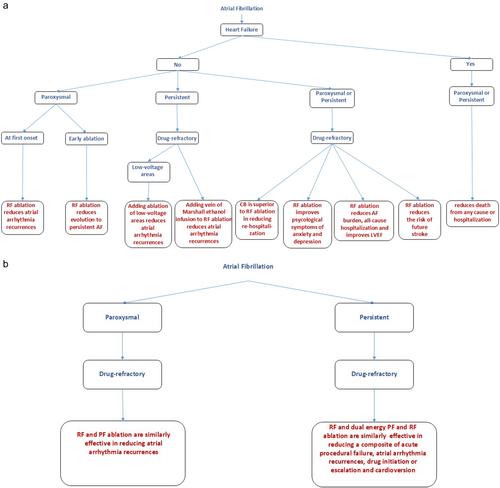
Classes I–III recommendations are reported in Tables 1–3, respectively. Flowcharts showing clinical conditions for which catheter ablation of AF is indicated based on the proposed recommendation scheme are reported below in Figures 1-3, and 3b. Supporting Information: Figures S1–S3 provide complimentary information on clinical data including number of patients enrolled, randomization ratio and follow-up duration in reference studies. Supporting Information: Figures S4, S5a, and S5b provide an alternative scheme of Supporting Information: Figures S1, S2a, S2b, S3a, and S3b, focusing primarily on techniques and technologies used to obtain designated outcomes. Supporting Information material provides the list of literature contributions representing the basis of our research (pages 24–54). Criteria for selection of recommendation classes in the present document are reported below.
Compilation of the present recommendation scheme is made under the assumption that future studies showing evidence against the current indications or new evidence from previously unaddressed indications will lead to appropriate changes in the new programmed edition of ECAS guidelines. This will apply especially for studies reporting outcome results from single high-quality studies and for follow-up extended beyond 12-month duration, where applicable.
There is a large body of studies investigating the role of supplementary linear lesion, CFAE or ganglionated plexi ablation. In patients with persistent AF, adding linear lesions [74], ablating fractionated atrial electrograms [39], adding posterior left atrial wall isolation [75] and ligation of the left atrial appendix [76] do not reduce atrial arrhythmia recurrences. Thus, at present, the available evidence does not fulfill our current Classes I and II recommendation requirements for using these supplementary ablation strategies in a generic, one size fits all approaches.
The therapeutic rationale behind these strategies and the possible reasons for their inability to improve clinical outcome in addition to PV isolation have been discussed in Chapter 3.
Despite the large number of studies conducted, the true efficacy of AF ablation is difficult to estimate. An important limitation in this respect is represented by the definition used to assess post-procedural recurrences, as several confounders may considerably affect reliable assessment of outcome measures. They include the definition of recurrent AF, duration of single episodes, presence of asymptomatic episodes, AF burden and methods used for documenting recurrent episodes. The variable combination of criteria used to assess efficacy is well reflected in literature and precludes rigorous comparability of outcomes among studies. A further confounder in efficacy assessment is represented by the presence of new arrhythmias whose substrate is determined by the scar lesions generated during catheter ablation. Finally, post-procedural efficacy can be obtained with no need for AADs in some patients while others require chronic administration of previously ineffective AADs. Consistent with these limitations, efficacy rates of AF ablation have been reported to range between 52% and 83% in patient with paroxysmal AF, and between 37% and 77% in patients with persistent AF (Supporting Information: Table S10).
Growing awareness about the limitations of assessing the efficacy of catheter ablation of AF has prompted scientific societies to introduce specific recommendations on the methods and tools that best recognize and quantify post-procedural atrial arrhythmia recurrences. Adoption of these recommendations has contributed to improving accuracy of outcome measures in recent years.
A method to obviate the current limitations is providing comparative assessment of post-ablation outcomes between different strategies, such as in the case of catheter ablation versus AADs or control [50, 51] or one catheter ablation energy form versus another one [68, 69]. In such cases, adoption of prospective models combined with pre-determined definitions of outcome obtained with rigorous diagnostic tools provides reliable estimate of comparative outcomes which, in turn, can be effectively transferred to clinical practice.
Given the limitations above, we present a tabulation on outcome efficacy data on paroxysmal AF (Supporting Information: Table S10a), persistent AF (Supporting Information: Table S10b and combined paroxysmal and persistent AF (Supporting Information: Table S10c) published in prospective studies enrolling at least 100 patients together with type of AF, role of AADs and methods used to assess atrial arrhythmia recurrences. Similarly, outcome safety data reported in these same studies on paroxysmal AF, persistent AF and combined paroxysmal and persistent AF are presented in Supporting Information: Tables S11a, S11b, and S11c, respectively. Data in these tables offer a comprehensive view on the range of efficacy and safety of catheter ablation of AF in different series and gives information on the conditions and limitations that might be expected when patients are referred for this procedure. They will also help investigators when introducing or assessing ablation programs in their institutions.
Periprocedural anticoagulation is meant to limit the risk of periprocedural thromboembolism [106] and comprises three management phases: (1) antithrombotic treatment before the ablation session; (2) intraprocedural anticoagulation; and (3) post-procedural anticoagulation. Anticoagulation strategies and regimens need to be selected considering that even within therapeutic range, they may cause or worsen periprocedural bleeding. Bleeding is mostly observed at the site of vascular access, within the cardiovascular system (because of catheter-induced cardiac or vessel perforation) and at peripheral sites, including intracranial, ocular, retroperitoneal [107].
The acceptability of an interventional or surgical procedure depends on the balance between efficacy and safety and catheter ablation of AF is no exception to this rule.
The overall complication rate of catheter ablation of AF is estimated to be around between 5.1% and 7.5% [133-137] with the commonest complications being those related to vascular access, followed by manifestations of volume overload, the occurrence of pericardial effusion and tamponade, and cerebrovascular accidents or TIAs.
Other less frequent complications include lesions of the vagus or phrenic nerve and pulmonary vein stenosis, inflammation or infection.
Esophageal fistulas, including atrio-esophageal fistulas are by far the most lethal complication but fortunately the rarest as well in current practice.
Recent retrospective data on large collective indicate that complications with PF ablation may be less frequent than with former energy ablation techniques [138]. This observation contrasts with the data obtained in the first randomized study prospectively reporting comparative safety outcomes in patients assigned to PF ablation versus RF or cryo-ablation [69] and awaits confirmative evidence from more objective data as those generated for RF and cryo-ablation [133-137] as well as from further studies comparing PF ablation with these former techniques.
Incidences for each complication in the following list refer to NIS data sets [133] and literature searches from RCTs on AF ablation [137].
The following description provides information that may be helpful to prevent, recognize and efficiently treat peri-procedural complications of AF ablation.
While the present document is published, dozens of RCTs are being conducted addressing clinically and technologically relevant items in the field of AF ablation. The results of these trials will contribute to improve our knowledge and guide future clinical activities.
With the aim of providing readers with detailed information about the ongoing research, we have incorporated a dedicated table reporting the list of ongoing RCTs currently registered on the clinicaltrials.gov (date of access) platform in Supporting Information S2. Overall, 233 RCTs are presently underway of which 21 will investigate the impact of catheter ablation on clinically relevant outcomes, 55 will investigate the impact of novel ablation catheters/technologies, 69 will investigate the efficacy of new catheter approaches or targets on clinical outcomes, 14 will investigate the benefit of complimentary drugs or other interventions to improve catheter ablation outcomes, 12 will investigate the role of novel mapping strategies on catheter ablation outcomes, 10 will investigate the benefit of novel anticoagulation strategies on peri-procedural protection from thromboembolism and bleeding, 6 will investigate interventions aimed at reducing peri-procedural complications, 4 will compare the benefit of catheter ablation versus sham control, and 2 will investigate prediction models for favorable outcome. There will be 16 more RCTs investigating the benefit of surgical ablation versus various comparative treatments, and 21 investigating other aspects of peri-procedural care (i.e., sedation, etc).
Supporting Information: Tables S7–S9 is meant to provide readers with a comprehensive picture of current research and which pending clinical and technique/technology questions will likely be answered in the months and years to come.
As we write the present document, a large bulk of studies are being published or underway to investigate the role of pulsed field energy delivery, a new emerging technology for lesion deployment in the heart, for catheter ablation of AF. This energy form consists in the transmission of pulsed energy to the heart that determines electroporation of the cell membrane leading to irreversible tissue damage.
The claimed selectivity for cardiac tissue associated with the rapid effect (within second) after onset of energy release, has boosted great enthusiasm about the efficacy and safety potential of this technology for treating AF [149]. While we recognize the potential, the available data should still be considered preliminary and certainly not comparable in size with the multi-decade experience of RF and Cryo-ablation. In the first RCT of RF versus PF ablation, the two techniques showed similar efficacy in patients with paroxysmal AF and one fatality case was observed in the PF study group [69]. More recently, unexpected complications such as coronary artery spasm, renal insufficiency, hemolysis and cerebral thromboembolism have been documented during and after PF ablation of AF patients [150-153]. Meanwhile, experimental studies have shown that early disappearance of electrical activity is transient unless obtained with high contact pressure at target ablation sites, a factor possibly affecting long-term efficacy and peri-procedural safety [154]. Most studies using this technique, conducted prospectively in patients with persistent AF are observational [155] and require rigorous comparison with control techniques before superiority of PF ablation can be established.
For these reasons, we have elected to adopt a prudent approach when including PF ablation in our recommendation scheme. Ongoing trials will contribute to refining the present scheme based on study results.
The clinical findings of heart failure or imaging evidence of impaired cardiac function occurring with AF can be a management dilemma. If the AF is assumed to be secondary to the heart failure, the initial practice would be the commencement of heart failure drugs and screening for secondary causes of heart failure. This will be followed by a determination of the need for device prophylaxis with an implantable defibrillator. However, AF-induced cardiomyopathy (AFICM) is now well-described, and the restoration of sinus rhythm may result in complete resolution of cardiac impairment. This form of cardiomyopathy may arise secondary to the tachycardia but is also seen in the presence of rate-controlled AF. Functional mitral regurgitation of varying severity may also be part of a vicious cycle that exacerbates this type of cardiomyopathy. Failing to identify those patients with AFICM can compromise the optimal management of this important group of patients with heart failure.
The diagnostic and therapeutic challenge for the clinician is determining whether to focus treatment on the heart failure or the AF. If the clinical history is suspicious for AFICM, then restoration of sinus rhythm using a combination of AADs, DC-cardioversion or AF ablation may help the need for heart failure treatment. In some patients, the restoration of sinus rhythm will not fully resolve the impairment of cardiac function but will markedly improve the symptoms and cardiac function. These patients will not be diagnosed as having AFICM, but cardiomyopathy that has been exacerbated by AF.
Several trials may help determine the optimal approach to managing this group patients. Early restoration of sinus rhythm also resulted in improved cardiovascular outcomes in the EAST-AFNET study, but only a minority of these patients had concomitant heart failure [156]. Some of them have directly addressed the question of whether AF ablation to restore sinus rhythm in patients with heart failure is beneficial compared to optimal medical therapy alone. The CAMTAF trial [157] and the CAMERA-MRI [158] trial both showed catheter ablation was superior to rate control for improving LV ejection fraction. The AATAC trial was able to show reduced mortality and hospitalization in the ablation group as a secondary outcome [159]. Further, confirmation of this finding came from the CASTLE-AF trial which showed superiority of catheter ablation to medical therapy as the primary objective [57]. The more recent RAFT-AF trial used the same composite endpoint of death and heart failure hospitalization and showed a trend favoring catheter ablation, but this did not reach significance [160]. The CASTLE-AF trial patients had a median ejection fraction of 32% and all had a defibrillator in-situ, whereas only about 25% of patients had a defibrillator in RAFT-AF and 40% of patients had an ejection fraction > 45%. The left atrial diameters and proportion of patients with persistent AF were similar in both studies, implying that restoration of sinus rhythm is even more important in those with more severe LV dysfunction. This suggests that there are subgroups, within the AF with heart failure population, who may have greater benefit and the current trial data may not help identify these patients. For example, it is not known if a trial of DC cardioversion to identify patients whose LV function improves is a beneficial strategy or whether the mortality and hospitalization benefits are independent of such findings. Aggressive rate control with AV node ablation should also be considered as the APAF-CRT trial suggested a resynchronization pacemaker followed by rate control by AV-node ablation was more effective at reducing mortality than medical therapy alone [161]. It is not known if such a strategy is comparable to achieving sinus rhythm or should only be applied in those patients in whom sinus rhythm cannot be maintained.
While consistent evidence has been reported about the role of AF ablation in patients with CHF, we acknowledge missing evidence about the benefit that AF ablation may provide depending on CHF sub-categories, such as for example primary CHF, CHF secondary to AF and intermediate groups, or HFrEF, HFmrEF and HFpEF [162]. With the aim of fulfilling this gap, we encourage research that will accurately distinguish sub-categories of CHF and AF at the time of screening. To this purpose, indicators of heart performance such as cardiac index or LVEF assessment after pharmacological or electrical restoration of sinus rhythm would help to distinguish between CHF sub-categories. Randomized comparison between AF ablation and drug treatment within each sub-category would help filling a relevant knowledge gap in this discipline and identify sub-groups of CHF patients obtaining better prognostic benefit from ablation.
Among procedure-related complications, early mortality accounts for up of 0.5% of patients [133]. Accurate estimates of the true incidence of peri-procedural mortality are difficult to obtain. The earliest documentation of its occurrence was reported about one decade after the introduction of this technique in clinical practice [163], and was based on a rather approximate, voluntary-based contribution by centers contributing to a worldwide survey. At that time, the reported incidence of this complication was 0.5%. Since then, various studies have addressed this issue giving the perception that the incidence of peri-procedural mortality was decreasing as investigator experience was growing. This is of great importance because of the increasing volume of procedures treating increasingly sicker patients with more complex substrates. However, the question remained whether the accuracy of data reported from single studies or multi-center registries and surveys are representative of the true incidence of this complication in the real world.
A robust method for accurate assessment of peri-procedural mortality was first introduced in 2013, when Deshmukh et al. [133] reported on a large survey of in-hospital complications associated with 93 801 AF ablation procedures in the United States between 2000 and 2010. Data was obtained from NIS data set representing a nation-based survey conducted by the Healthcare Cost and Utilization Project in collaboration with the participating states. ICD-9-CM codes were used to identify each of the study diagnoses investigated. Trends in complications showed that in-hospitalization death occurred at a rate of 0.42% and that this figure tended to be stable throughout the investigated period [133]. Mortality rates were found to be higher in centers with lower patient volumes and less operator experience. Using a similar method (i.e., the United States Agency for Healthcare Research and Quality—AHRQ), Cheng et al. [147] reported an early mortality rate of 0.46% in 60 203 patients during the years 2000–2015 with 54% of deaths occurring during 30-day readmission.
These figures reliably indicate the true incidence of peri-procedural mortality of AF ablation and indicate that death may occur in 1:200 patients undergoing this procedure.
Historical studies examining the mortality benefit for rhythm control of AF (vs. rate control) have primarily focused on the use of antiarrhythmic drugs [164, 165]. These studies have been relatively small and have either been neutral or have suggested that rhythm control is associated with greater mortality. The obvious ease of prescribing drug therapy is countered by the limited success, lack of precision of antiarrhythmic drugs, and their potential side effects, pro-arrhythmia being the most concerning. Catheter ablation by contrast has been shown to be superior to drugs in achieving rhythm control but has a front-loaded risk [166]. Several case cohort and population studies have sought to examine the impact of catheter ablation on mortality and have shown benefit. These studies however are limited by their size or design. To date only two large randomized controlled trials have been performed. CABANA compared catheter ablation to standard medical therapy in a large patient cohort [51]. The results were neutral if one examined the data as the trial was designed, intention to treat. The study outcomes were significantly limited by the one-third of patients who crossed from the medical arm and received catheter ablation and only when performing a per treatment analysis was a statistically significant mortality benefit seen. The EAST trial examined the impact of early rhythm control (within 1 year of AF diagnosis) in patients with concomitant cardiovascular risk factors [156]. The study compared usual care (which limited rhythm control only for AF related symptoms) to early rhythm control. Rhythm control was initially predominantly antiarrhythmic drug therapy with catheter ablation performed in about one-fifth of patients at the 2-year follow up point. In this study early rhythm control did have mortality benefit but the study did not have sufficient data to examine the impact of catheter ablation which contributed to only 20% of adopted strategies to achieve rhythm control.
The impact of catheter ablation of AF associated with heart failure has been examined and several studies have shown that AF ablation is associated with a mortality benefit. CASTLE- AF is the largest randomized trial and showed a significant mortality benefit [57]. Although the results of this trial have been challenged because of the very high success rates for the AF ablation, the methodology was sound, and the results have been echoed in other studies and reviews [157-159, 166].
It is reasonable to conclude that while there are signals in the literature that catheter ablation may be associated with a reduced mortality, there are insufficient data to conclude that this should be recommended in the absence of AF symptoms other than in patients who have associated heart failure, in which case one might argue they do have symptoms, the symptoms from the heart failure if not directly from the AF.
One challenge in this area is that the patients who may be most likely to gain from successful catheter ablation, namely young patients with lone paroxysmal AF who are likely to have a good outcome from ablation and be exposed to many years of AF or antiarrhythmic drugs in its absence. These patients very unlikely to be included in mortality trials because of the very low event rate and long follow up period in large numbers of patients that will be required to have a chance of showing a significant difference. This problem was, until this decade, somewhat academic because patients with symptoms would have ablation for this reason and patients without symptoms would be unlikely to be diagnosed. However, the increasing use of wearable technologies that diagnose AF [167], mean that there is a growing population of patients who are faced with the dilemma of having highly treatable AF without symptoms and have to make a decision whether to have catheter ablation in the hope that this will have a prognostic impact without the support of robust data.
If patients do decide to undergo an ablation, a full discussion should be given allowing them to understand the risks and success rates of the procedure in their specific case. Asymptomatic AF patients with a low probability of successful ablation, for example patients with persistent AF with severely dilated atria and no evidence of sinus rhythm in the last 1–3 years should probably be dissuaded from ablation given the lack of evidence supporting this approach.
The main differences between ECAS GLs and the most recently published documents in the field, including the 2024 ESC GLs [3], the 2023 ACC/AHA/HRS GLs [2] and the EHRA/HRS/APHRS/LAHRS consensus document [4], are reported in Supporting Information: Table S6. In brief, the classification scheme in the present GLs appears simpler than the one adopted by the other documents. This is justified by complete elimination of level or type of evidence for each recommendation class. With respect to specific indications, the more rigorous inclusion criteria adopted in the present GLs is reflected in the lower number of recommendations addressed as compared with the number of recommendations in the other documents. The difference within specific indications across the four GL and consensus documents is reflected by the statement “Cannot be classified” in the ECAS pertinent row of Supporting Information: Table S6. Adoption of more rigorous inclusion criteria and rejection of level or type of evidence sub-classification within single classes in the ECAS GLs is also reflected in Supporting Information: Table S6 by the less populated justifications for most indications.
Adopting the growing request for rigor and transparency, the present document provides a concise scheme on Classes I–III recommendations relative to beneficial effects of catheter ablation of AF and of specific ablation strategies or techniques for which high-quality evidence of greater benefit than risk is demonstrated. Consistent with the rigorous methods adopted, subclassifications and levels of evidence have been deleted with the aim of mitigating arbitrariness in document production. The copious ongoing research in the field, of which we have provided a custom-built list for readers reference, will enrich our recommendation list in future guidelines, with the awareness that new paradigms may surface offering different base theories, methods of investigation and validation may subvert current guidelines' structure. The model used here is meant to preserve the original mission of guidelines to assist, not to impose practitioner decisions about appropriate health care and reconcile them with the true art of medicine. The rigor, simplicity and transparency of the present document may serve other societies in preparation guideline documents.
期刊介绍:
Journal of Cardiovascular Electrophysiology (JCE) keeps its readership well informed of the latest developments in the study and management of arrhythmic disorders. Edited by Bradley P. Knight, M.D., and a distinguished international editorial board, JCE is the leading journal devoted to the study of the electrophysiology of the heart.



 京公网安备 11010802042870号
京ICP备2023020795号-1
京公网安备 11010802042870号
京ICP备2023020795号-1

 分享
分享
 求助内容:
求助内容: 应助结果提醒方式:
 扫码关注我们
