Minyoung Kevin Kim, Gina A Suh, Grace D Cullen, Saumel Perez Rodriguez, Tejas Dharmaraj, Tony Hong Wei Chang, Zhiwei Li, Qingquan Chen, Sabrina I Green, Rob Lavigne, Jean-Paul Pirnay, Paul L Bollyky, Jessica C Sacher
{"title":"Bacteriophage therapy for multidrug-resistant infections: current technologies and therapeutic approaches.","authors":"Minyoung Kevin Kim, Gina A Suh, Grace D Cullen, Saumel Perez Rodriguez, Tejas Dharmaraj, Tony Hong Wei Chang, Zhiwei Li, Qingquan Chen, Sabrina I Green, Rob Lavigne, Jean-Paul Pirnay, Paul L Bollyky, Jessica C Sacher","doi":"10.1172/JCI187996","DOIUrl":null,"url":null,"abstract":"<p><p>Bacteriophage (phage) therapy has emerged as a promising solution to combat the growing crisis of multidrug-resistant (MDR) infections. There are several international centers actively engaged in implementation of phage therapy, and recent case series have reported encouraging success rates in patients receiving personalized, compassionate phage therapy for difficult-to-treat infections. Nonetheless, substantial hurdles remain in the way of more widespread adoption and more consistent success. This Review offers a comprehensive overview of current phage therapy technologies and therapeutic approaches. We first delineate the common steps in phage therapy development, from phage bank establishment to clinical administration, and examine the spectrum of therapeutic approaches, from personalized to fixed phage cocktails. Using the framework of a conventional drug development pipeline, we then identify critical knowledge gaps in areas such as cocktail design, formulation, pharmacology, and clinical trial design. We conclude that, while phage therapy holds promise, a structured drug development pipeline and sustained government support are crucial for widespread adoption of phage therapy for MDR infections.</p>","PeriodicalId":15469,"journal":{"name":"Journal of Clinical Investigation","volume":"135 5","pages":""},"PeriodicalIF":13.6000,"publicationDate":"2025-03-03","publicationTypes":"Journal Article","fieldsOfStudy":null,"isOpenAccess":false,"openAccessPdf":"https://www.ncbi.nlm.nih.gov/pmc/articles/PMC11870740/pdf/","citationCount":"0","resultStr":null,"platform":"Semanticscholar","paperid":null,"PeriodicalName":"Journal of Clinical Investigation","FirstCategoryId":"3","ListUrlMain":"https://doi.org/10.1172/JCI187996","RegionNum":1,"RegionCategory":"医学","ArticlePicture":[],"TitleCN":null,"AbstractTextCN":null,"PMCID":null,"EPubDate":"","PubModel":"","JCR":"Q1","JCRName":"MEDICINE, RESEARCH & EXPERIMENTAL","Score":null,"Total":0}
引用次数: 0
Abstract
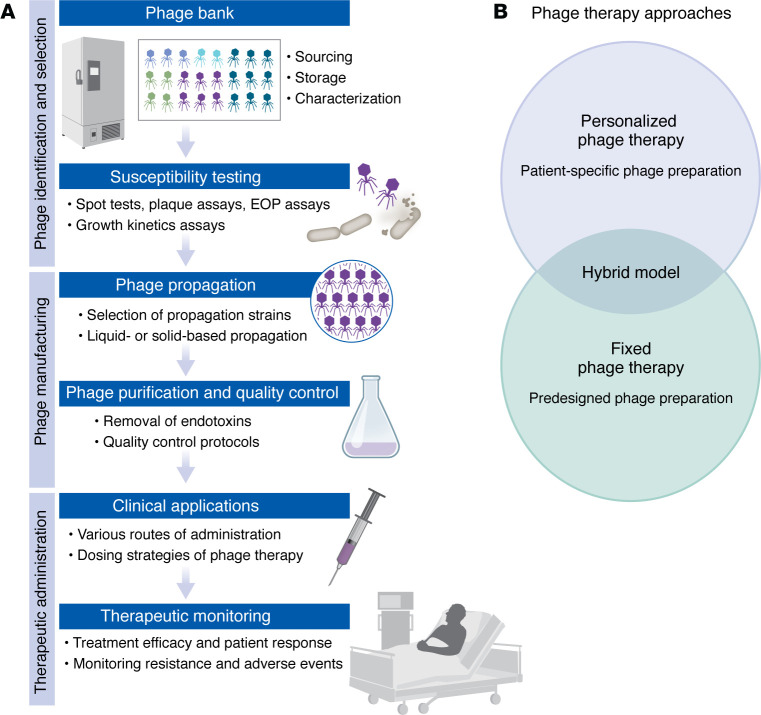
Bacteriophage (phage) therapy has emerged as a promising solution to combat the growing crisis of multidrug-resistant (MDR) infections. There are several international centers actively engaged in implementation of phage therapy, and recent case series have reported encouraging success rates in patients receiving personalized, compassionate phage therapy for difficult-to-treat infections. Nonetheless, substantial hurdles remain in the way of more widespread adoption and more consistent success. This Review offers a comprehensive overview of current phage therapy technologies and therapeutic approaches. We first delineate the common steps in phage therapy development, from phage bank establishment to clinical administration, and examine the spectrum of therapeutic approaches, from personalized to fixed phage cocktails. Using the framework of a conventional drug development pipeline, we then identify critical knowledge gaps in areas such as cocktail design, formulation, pharmacology, and clinical trial design. We conclude that, while phage therapy holds promise, a structured drug development pipeline and sustained government support are crucial for widespread adoption of phage therapy for MDR infections.
期刊介绍:
The Journal of Clinical Investigation, established in 1924 by the ASCI, is a prestigious publication that focuses on breakthroughs in basic and clinical biomedical science, with the goal of advancing the field of medicine. With an impressive Impact Factor of 15.9 in 2022, it is recognized as one of the leading journals in the "Medicine, Research & Experimental" category of the Web of Science.
The journal attracts a diverse readership from various medical disciplines and sectors. It publishes a wide range of research articles encompassing all biomedical specialties, including Autoimmunity, Gastroenterology, Immunology, Metabolism, Nephrology, Neuroscience, Oncology, Pulmonology, Vascular Biology, and many others.
The Editorial Board consists of esteemed academic editors who possess extensive expertise in their respective fields. They are actively involved in research, ensuring the journal's high standards of publication and scientific rigor.





 京公网安备 11010802042870号
京ICP备2023020795号-1
京公网安备 11010802042870号
京ICP备2023020795号-1

 分享
分享
 求助内容:
求助内容: 应助结果提醒方式:
 扫码关注我们
