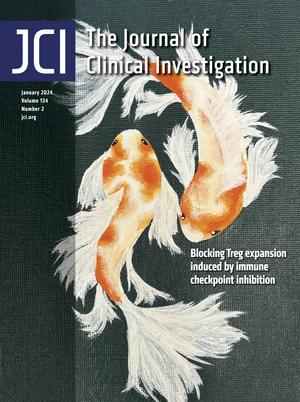
{"title":"Endothelial OX40 activation facilitates tumor cell escape from T cell surveillance through S1P/YAP-mediated angiogenesis.","authors":"Baoyu He, Rou Zhao, Baogui Zhang, Hongli Pan, Jilan Liu, Lunhua Huang, Yingying Wei, Dong Yang, Jing Liang, Mingyi Wang, Mingsheng Zhao, Sen Wang, Fengyun Dong, Junfeng Zhang, Yanhua Zhang, Xu Zhang, Xiao Zhang, Guanjun Dong, Huabao Xiong, Qingli Bie, Bin Zhang","doi":"10.1172/JCI186291","DOIUrl":null,"url":null,"abstract":"<p><p>Understanding the complexity of the tumor microenvironment is vital for improving immunotherapy outcomes. Here, we report that the T cell costimulatory molecule OX40 was highly expressed in tumor endothelial cells (ECs) and was negatively associated with the prognosis of patients, which is irrelevant to T cell activation. Analysis of conditional OX40 loss- and gain-of-function transgenic mice showed that OX40 signal in ECs counteracted the antitumor effects produced in T cells by promoting angiogenesis. Mechanistically, leucine-rich repeat-containing GPCR5 (Lgr5+ ) cancer stem cells induced OX40 expression in tumor ECs via EGF/STAT3 signaling. Activated OX40 interacted with Spns lysolipid transporter 2 (Spns2), obstructing the export of sphingosine 1-phosphate (S1P) and resulting in S1P intracellular accumulation. Increased S1P directly bound to Yes 1-associated protein (YAP), disrupting its interaction with large tumor suppressor kinase 1 (LATS1) and promoting YAP nuclear translocation. Finally, the YAP inhibitor verteporfin enhanced the antitumor effects of the OX40 agonist. Together, these findings reveal an unexpected protumor role of OX40 in ECs, highlighting the effect of nonimmune cell compartments on immunotherapy.</p>","PeriodicalId":15469,"journal":{"name":"Journal of Clinical Investigation","volume":"135 5","pages":""},"PeriodicalIF":13.6000,"publicationDate":"2025-03-03","publicationTypes":"Journal Article","fieldsOfStudy":null,"isOpenAccess":false,"openAccessPdf":"https://www.ncbi.nlm.nih.gov/pmc/articles/PMC11870743/pdf/","citationCount":"0","resultStr":null,"platform":"Semanticscholar","paperid":null,"PeriodicalName":"Journal of Clinical Investigation","FirstCategoryId":"3","ListUrlMain":"https://doi.org/10.1172/JCI186291","RegionNum":1,"RegionCategory":"医学","ArticlePicture":[],"TitleCN":null,"AbstractTextCN":null,"PMCID":null,"EPubDate":"","PubModel":"","JCR":"Q1","JCRName":"MEDICINE, RESEARCH & EXPERIMENTAL","Score":null,"Total":0}
引用次数: 0
Abstract
Understanding the complexity of the tumor microenvironment is vital for improving immunotherapy outcomes. Here, we report that the T cell costimulatory molecule OX40 was highly expressed in tumor endothelial cells (ECs) and was negatively associated with the prognosis of patients, which is irrelevant to T cell activation. Analysis of conditional OX40 loss- and gain-of-function transgenic mice showed that OX40 signal in ECs counteracted the antitumor effects produced in T cells by promoting angiogenesis. Mechanistically, leucine-rich repeat-containing GPCR5 (Lgr5+ ) cancer stem cells induced OX40 expression in tumor ECs via EGF/STAT3 signaling. Activated OX40 interacted with Spns lysolipid transporter 2 (Spns2), obstructing the export of sphingosine 1-phosphate (S1P) and resulting in S1P intracellular accumulation. Increased S1P directly bound to Yes 1-associated protein (YAP), disrupting its interaction with large tumor suppressor kinase 1 (LATS1) and promoting YAP nuclear translocation. Finally, the YAP inhibitor verteporfin enhanced the antitumor effects of the OX40 agonist. Together, these findings reveal an unexpected protumor role of OX40 in ECs, highlighting the effect of nonimmune cell compartments on immunotherapy.
期刊介绍:
The Journal of Clinical Investigation, established in 1924 by the ASCI, is a prestigious publication that focuses on breakthroughs in basic and clinical biomedical science, with the goal of advancing the field of medicine. With an impressive Impact Factor of 15.9 in 2022, it is recognized as one of the leading journals in the "Medicine, Research & Experimental" category of the Web of Science.
The journal attracts a diverse readership from various medical disciplines and sectors. It publishes a wide range of research articles encompassing all biomedical specialties, including Autoimmunity, Gastroenterology, Immunology, Metabolism, Nephrology, Neuroscience, Oncology, Pulmonology, Vascular Biology, and many others.
The Editorial Board consists of esteemed academic editors who possess extensive expertise in their respective fields. They are actively involved in research, ensuring the journal's high standards of publication and scientific rigor.



 京公网安备 11010802042870号
京ICP备2023020795号-1
京公网安备 11010802042870号
京ICP备2023020795号-1

 分享
分享
 求助内容:
求助内容: 应助结果提醒方式:
 扫码关注我们
