Maya R Rayle, Jesse L Brunner, Nicole C Dahrouge, Erin L Keller, Tracy A G Rittenhouse
{"title":"Infection intensity and severity of Ranavirus transmission in juvenile wood frogs.","authors":"Maya R Rayle, Jesse L Brunner, Nicole C Dahrouge, Erin L Keller, Tracy A G Rittenhouse","doi":"10.1007/s00442-025-05682-8","DOIUrl":null,"url":null,"abstract":"<p><p>Ranaviruses are responsible for mass die offs of wood frog (Lithobates sylvaticus) tadpoles. What happens in between epidemics is less clear, but juvenile (metamorphosed) stages are hypothesized to move Ranaviruses among wetlands and introduce or reintroduce these viruses into wetlands, initiating new outbreaks. A key question is under what circumstances can juvenile L. sylvaticus infect susceptible conspecifics. We examined Ranavirus transmission between juvenile L. sylvaticus in two settings: first, we measured transmission from a Ranavirus-infected frog to a co-housed susceptible frog via cohabitation over a range of exposure periods. Second, we measured indirect transmission to susceptible frogs from a contaminated environment after a range of waiting times (i.e., from when the infected frog was removed to when the susceptible frog was exposed to the environment). We present evidence that juvenile frogs directly transmitted Ranavirus to susceptible frogs in all exposure periods (99.2% infected), with as little as 1 h of co-housing resulting in 95.8% of susceptibles infected. Indirectly, 96.8% of susceptible frogs became infected after as long as 48 h waiting times. Neither exposure period nor wait times influenced the probability of infection, because these probabilities are already high. In our linear regression models, susceptible frog viral load was significantly correlated with exposure period and cohort for the cohabitation experiment, while wait time was significantly correlated with viral load for the sequential habitation experiment. Collectively, our results suggest that Ranavirus transmission readily occurs between recently metamorphosed wood frogs and via terrestrial environmental exposure.</p>","PeriodicalId":19473,"journal":{"name":"Oecologia","volume":"207 3","pages":"46"},"PeriodicalIF":2.3000,"publicationDate":"2025-03-04","publicationTypes":"Journal Article","fieldsOfStudy":null,"isOpenAccess":false,"openAccessPdf":"https://www.ncbi.nlm.nih.gov/pmc/articles/PMC11880146/pdf/","citationCount":"0","resultStr":null,"platform":"Semanticscholar","paperid":null,"PeriodicalName":"Oecologia","FirstCategoryId":"93","ListUrlMain":"https://doi.org/10.1007/s00442-025-05682-8","RegionNum":2,"RegionCategory":"环境科学与生态学","ArticlePicture":[],"TitleCN":null,"AbstractTextCN":null,"PMCID":null,"EPubDate":"","PubModel":"","JCR":"Q2","JCRName":"ECOLOGY","Score":null,"Total":0}
引用次数: 0
Abstract
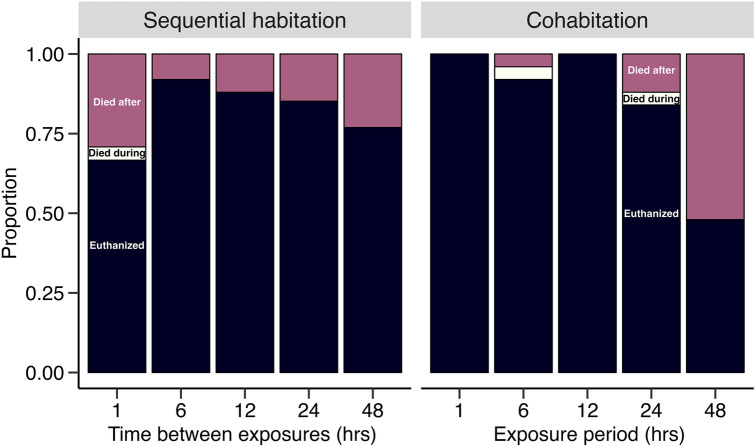
Ranaviruses are responsible for mass die offs of wood frog (Lithobates sylvaticus) tadpoles. What happens in between epidemics is less clear, but juvenile (metamorphosed) stages are hypothesized to move Ranaviruses among wetlands and introduce or reintroduce these viruses into wetlands, initiating new outbreaks. A key question is under what circumstances can juvenile L. sylvaticus infect susceptible conspecifics. We examined Ranavirus transmission between juvenile L. sylvaticus in two settings: first, we measured transmission from a Ranavirus-infected frog to a co-housed susceptible frog via cohabitation over a range of exposure periods. Second, we measured indirect transmission to susceptible frogs from a contaminated environment after a range of waiting times (i.e., from when the infected frog was removed to when the susceptible frog was exposed to the environment). We present evidence that juvenile frogs directly transmitted Ranavirus to susceptible frogs in all exposure periods (99.2% infected), with as little as 1 h of co-housing resulting in 95.8% of susceptibles infected. Indirectly, 96.8% of susceptible frogs became infected after as long as 48 h waiting times. Neither exposure period nor wait times influenced the probability of infection, because these probabilities are already high. In our linear regression models, susceptible frog viral load was significantly correlated with exposure period and cohort for the cohabitation experiment, while wait time was significantly correlated with viral load for the sequential habitation experiment. Collectively, our results suggest that Ranavirus transmission readily occurs between recently metamorphosed wood frogs and via terrestrial environmental exposure.
期刊介绍:
Oecologia publishes innovative ecological research of international interest. We seek reviews, advances in methodology, and original contributions, emphasizing the following areas:
Population ecology, Plant-microbe-animal interactions, Ecosystem ecology, Community ecology, Global change ecology, Conservation ecology,
Behavioral ecology and Physiological Ecology.
In general, studies that are purely descriptive, mathematical, documentary, and/or natural history will not be considered.





 京公网安备 11010802042870号
京ICP备2023020795号-1
京公网安备 11010802042870号
京ICP备2023020795号-1

 分享
分享
 求助内容:
求助内容: 应助结果提醒方式:
 扫码关注我们
