Synthesis of fluorinated tubastatin A derivatives with bi-, tri-, and tetracyclic cap groups: molecular docking with HDAC6 and evaluation of in vitro antitumor activity†
Huaxin Luo, Zheng Huang, Xiangdong Mo, Chunmei Long, Kaiyuan Wang, Rong Deng, Xiaofeng Zhu and Zhuo Zeng
{"title":"Synthesis of fluorinated tubastatin A derivatives with bi-, tri-, and tetracyclic cap groups: molecular docking with HDAC6 and evaluation of in vitro antitumor activity†","authors":"Huaxin Luo, Zheng Huang, Xiangdong Mo, Chunmei Long, Kaiyuan Wang, Rong Deng, Xiaofeng Zhu and Zhuo Zeng","doi":"10.1039/D4MD00898G","DOIUrl":null,"url":null,"abstract":"<p >Herein, we report the synthesis of 16 tubastatin A derivatives with fluorinated bi-, tri-, and tetracyclic cap groups. Most derivatives show strong <em>in vitro</em> antitumor activity, achieving micromolar or sub-micromolar efficacy. The most promising compound, 4-(6-bromo-3,3-difluoro-1,2,3,4-tetrahydro-9<em>H</em>-carbozol-9-yl)methyl)-<em>N</em>-hydroxybenzamide (<strong>14f</strong>), demonstrated potent anti-proliferative effects against human nasopharyngeal carcinoma cells (SUNE1) and human breast cancer cells (MDA-MB-231), with IC<small><sub>50</sub></small> values of 0.51 μM and 0.52 μM, respectively. Notably, compound 4-((8-fluoroindeno[2,1-<em>b</em>]indol-5(6<em>H</em>)-yl)-<em>N</em>-hydroxybenzamide (<strong>13c</strong>) exhibited significant anti-proliferative activity against pancreatic cancer cells (SW1990), with an IC<small><sub>50</sub></small> of 2.06 μM and low cytotoxicity to normal cells. Overall, variations in the cap group from bi- to tri-, then to tetracyclic, and the introduction of fluorinated groups enhance the antitumor activity of these derivatives. Among them, difluoromethyl-modified tricyclic derivatives show a broad spectrum <em>in vitro</em> antitumor effect. Molecular docking studies indicate that these derivatives bind to Histone Deacetylase 6 (HDAC6) at low binding energies, ranging from −6.54 to −9.84 kcal mol<small><sup>−1</sup></small>, through metal complexation, hydrogen bonding, π–π stacking, and π–cation interactions, which correlates with their good antitumor activity. Compound 4-((2-fluoro-5,6-dihydro-7<em>H</em>-benzo[<em>c</em>]carbazol-7-yl)methyl)-<em>N</em>-hydroxybenzamide (<strong>13a</strong>) with the lowest binding energy of −9.84 kcal mol<small><sup>−1</sup></small> exhibited the best <em>in vitro</em> antitumor activity against MCF-7, with IC<small><sub>50</sub></small> of 1.98 μM.</p>","PeriodicalId":21462,"journal":{"name":"RSC medicinal chemistry","volume":" 5","pages":" 2019-2026"},"PeriodicalIF":3.6000,"publicationDate":"2025-02-06","publicationTypes":"Journal Article","fieldsOfStudy":null,"isOpenAccess":false,"openAccessPdf":"","citationCount":"0","resultStr":null,"platform":"Semanticscholar","paperid":null,"PeriodicalName":"RSC medicinal chemistry","FirstCategoryId":"3","ListUrlMain":"https://pubs.rsc.org/en/content/articlelanding/2025/md/d4md00898g","RegionNum":4,"RegionCategory":"医学","ArticlePicture":[],"TitleCN":null,"AbstractTextCN":null,"PMCID":null,"EPubDate":"","PubModel":"","JCR":"Q2","JCRName":"BIOCHEMISTRY & MOLECULAR BIOLOGY","Score":null,"Total":0}
引用次数: 0
Abstract
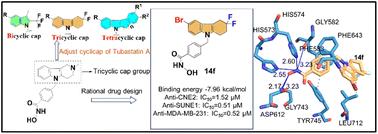
Herein, we report the synthesis of 16 tubastatin A derivatives with fluorinated bi-, tri-, and tetracyclic cap groups. Most derivatives show strong in vitro antitumor activity, achieving micromolar or sub-micromolar efficacy. The most promising compound, 4-(6-bromo-3,3-difluoro-1,2,3,4-tetrahydro-9H-carbozol-9-yl)methyl)-N-hydroxybenzamide (14f), demonstrated potent anti-proliferative effects against human nasopharyngeal carcinoma cells (SUNE1) and human breast cancer cells (MDA-MB-231), with IC50 values of 0.51 μM and 0.52 μM, respectively. Notably, compound 4-((8-fluoroindeno[2,1-b]indol-5(6H)-yl)-N-hydroxybenzamide (13c) exhibited significant anti-proliferative activity against pancreatic cancer cells (SW1990), with an IC50 of 2.06 μM and low cytotoxicity to normal cells. Overall, variations in the cap group from bi- to tri-, then to tetracyclic, and the introduction of fluorinated groups enhance the antitumor activity of these derivatives. Among them, difluoromethyl-modified tricyclic derivatives show a broad spectrum in vitro antitumor effect. Molecular docking studies indicate that these derivatives bind to Histone Deacetylase 6 (HDAC6) at low binding energies, ranging from −6.54 to −9.84 kcal mol−1, through metal complexation, hydrogen bonding, π–π stacking, and π–cation interactions, which correlates with their good antitumor activity. Compound 4-((2-fluoro-5,6-dihydro-7H-benzo[c]carbazol-7-yl)methyl)-N-hydroxybenzamide (13a) with the lowest binding energy of −9.84 kcal mol−1 exhibited the best in vitro antitumor activity against MCF-7, with IC50 of 1.98 μM.



 京公网安备 11010802042870号
京ICP备2023020795号-1
京公网安备 11010802042870号
京ICP备2023020795号-1

 分享
分享
 求助内容:
求助内容: 应助结果提醒方式:
 扫码关注我们
