Haddad A El Rabey, Samar M Rezk, Seham A Mahmoud, Zienab Abdallah, Mennatallah Loutfy, Adel I Alalawy, Yasmene F Alenazi, Heba Sheta, Nadia Bakry
{"title":"<i>Portulaca oleracea</i> L. Methanolic Extract Protects the Brain of Male Rats Against Alzheimer's Disease.","authors":"Haddad A El Rabey, Samar M Rezk, Seham A Mahmoud, Zienab Abdallah, Mennatallah Loutfy, Adel I Alalawy, Yasmene F Alenazi, Heba Sheta, Nadia Bakry","doi":"10.1155/sci5/7701263","DOIUrl":null,"url":null,"abstract":"<p><p>Alzheimer's disease (AD) occurs as a result of a chronic neurodegenerative disorder that is most frequently linked to a decline in cognitive function and memory. Twenty-four male rats were divided into four groups (<i>n</i> = 6); Group I was the negative control, Group II was the AlCl<sub>3</sub>-positive control, and Group III and Group IV were treated with 100 mg and 200 mg/kg of <i>Portulaca oleracea</i> methanolic extract, respectively. Aluminum chloride intoxication in Group II increased lipid peroxidation and decreased antioxidant parameters and affected interleukin-6 (IL-6), the tumor necrosis factor-alpha (TNF-α), acetylcholinesterase (AChE), and amyloid beta (Aβ), which lead to the induction of AD through injuring brain cells of AD rats. Treating the AD rats in Group III (GIII) and Group IV (GIV) with <i>P. oleracea</i> ameliorated the altered parameters in the AD rats. It also increased folic acid and vitamin B12 levels. <i>P. oleracea</i> modulated the physiological, biochemical, and histological changes brought on by AlCl<sub>3</sub> intoxication in rats via oxidative stress and inflammatory pathways. The dose of <i>P. oleracea</i> in GIV successfully modified the behavioral changes brought on by AlCl<sub>3</sub> in the AD rats more than that of GIII.</p>","PeriodicalId":21726,"journal":{"name":"Scientifica","volume":"2025 ","pages":"7701263"},"PeriodicalIF":2.3000,"publicationDate":"2025-02-22","publicationTypes":"Journal Article","fieldsOfStudy":null,"isOpenAccess":false,"openAccessPdf":"https://www.ncbi.nlm.nih.gov/pmc/articles/PMC11871972/pdf/","citationCount":"0","resultStr":null,"platform":"Semanticscholar","paperid":null,"PeriodicalName":"Scientifica","FirstCategoryId":"1085","ListUrlMain":"https://doi.org/10.1155/sci5/7701263","RegionNum":0,"RegionCategory":null,"ArticlePicture":[],"TitleCN":null,"AbstractTextCN":null,"PMCID":null,"EPubDate":"2025/1/1 0:00:00","PubModel":"eCollection","JCR":"Q2","JCRName":"BIOLOGY","Score":null,"Total":0}
引用次数: 0
Abstract
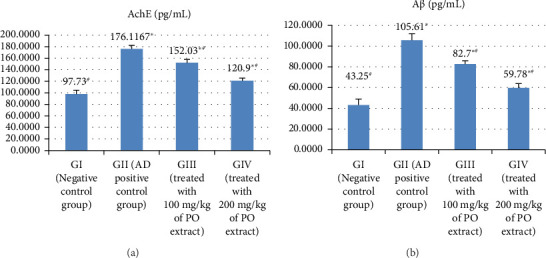
Alzheimer's disease (AD) occurs as a result of a chronic neurodegenerative disorder that is most frequently linked to a decline in cognitive function and memory. Twenty-four male rats were divided into four groups (n = 6); Group I was the negative control, Group II was the AlCl3-positive control, and Group III and Group IV were treated with 100 mg and 200 mg/kg of Portulaca oleracea methanolic extract, respectively. Aluminum chloride intoxication in Group II increased lipid peroxidation and decreased antioxidant parameters and affected interleukin-6 (IL-6), the tumor necrosis factor-alpha (TNF-α), acetylcholinesterase (AChE), and amyloid beta (Aβ), which lead to the induction of AD through injuring brain cells of AD rats. Treating the AD rats in Group III (GIII) and Group IV (GIV) with P. oleracea ameliorated the altered parameters in the AD rats. It also increased folic acid and vitamin B12 levels. P. oleracea modulated the physiological, biochemical, and histological changes brought on by AlCl3 intoxication in rats via oxidative stress and inflammatory pathways. The dose of P. oleracea in GIV successfully modified the behavioral changes brought on by AlCl3 in the AD rats more than that of GIII.
期刊介绍:
Scientifica is a peer-reviewed, Open Access journal that publishes research articles, review articles, and clinical studies covering a wide range of subjects in the life sciences, environmental sciences, health sciences, and medicine. The journal is divided into the 65 subject areas.






 京公网安备 11010802042870号
京ICP备2023020795号-1
京公网安备 11010802042870号
京ICP备2023020795号-1

 分享
分享
 求助内容:
求助内容: 应助结果提醒方式:
 扫码关注我们
