{"title":"Clinical characteristics of patients with hepatitis and cirrhosis and the construction of a prediction model.","authors":"Yu-Shuang Huang, Wei Gao, Ai-Jun Sun, Chun-Wen Pu, Shuang-Shuang Xu","doi":"10.4254/wjh.v17.i2.96506","DOIUrl":null,"url":null,"abstract":"<p><strong>Background: </strong>Hepatitis B-associated cirrhosis is an important disease burden in China. However, there is a lack of effective predictors in clinical practice to drive delivery and enable early treatment to delay disease progression.</p><p><strong>Aim: </strong>To analyzing the clinical characteristics of patients with hepatitis and cirrhosis, the nomogram model was established and validated.</p><p><strong>Methods: </strong>The clinical data of 1070 patients with hepatitis B who were treated in our hospital from October 2015 to July 2022 were collected. In a 7:3 ratio, 749 cases were divided into training cohorts and 321 cases were divided into validation cohorts. In addition, the training cohort and validation cohort were further divided into hepatitis group and hepatitis B-related cirrhosis group based on whether the patient progressed to cirrhosis. Binary logistic regression was used to analyze the influencing factors of hepatitis progression to cirrhosis. A roadmap prediction model was established, and the predictive effect of the model was evaluated by patient-subject receiver operating characteristic curve (ROC), and the effectiveness of the model was evaluated by decision curve analysis.</p><p><strong>Results: </strong>Binary logistic regression analysis was performed using hepatitis B-related cirrhosis = 1 and hepatitis = 0 as dependent variables, and univariate analysis of serological indicators was used as covariates. The results showed that glutamic oxaloacetate aminotransferase/glutamate acetone aminotransferase levels, prothrombin time activity, and hepatitis B e antigen levels were all contributing factors to the progression of hepatitis to cirrhosis. The area under the ROC curve was 0.693 [95% confidence interval (CI): 0.631 to 0.756] for the training cohort and 0.675 (95%CI: 0.561 to 0.790) for the validation cohort. In addition, the decision analysis curves of the prediction models of both the training cohort and the validation cohort confirmed the effectiveness of the nomogram prediction model.</p><p><strong>Conclusion: </strong>Three independent factors influencing the progression to cirrhosis in patients with hepatitis B were identified. The construction of a nomogram prediction model from hepatitis to cirrhosis has high application value as a tool for predicting the occurrence of liver cirrhosis in hepatitis B patients.</p>","PeriodicalId":23687,"journal":{"name":"World Journal of Hepatology","volume":"17 2","pages":"96506"},"PeriodicalIF":2.5000,"publicationDate":"2025-02-27","publicationTypes":"Journal Article","fieldsOfStudy":null,"isOpenAccess":false,"openAccessPdf":"https://www.ncbi.nlm.nih.gov/pmc/articles/PMC11866140/pdf/","citationCount":"0","resultStr":null,"platform":"Semanticscholar","paperid":null,"PeriodicalName":"World Journal of Hepatology","FirstCategoryId":"1085","ListUrlMain":"https://doi.org/10.4254/wjh.v17.i2.96506","RegionNum":0,"RegionCategory":null,"ArticlePicture":[],"TitleCN":null,"AbstractTextCN":null,"PMCID":null,"EPubDate":"","PubModel":"","JCR":"Q2","JCRName":"GASTROENTEROLOGY & HEPATOLOGY","Score":null,"Total":0}
引用次数: 0
Abstract
Background: Hepatitis B-associated cirrhosis is an important disease burden in China. However, there is a lack of effective predictors in clinical practice to drive delivery and enable early treatment to delay disease progression.
Aim: To analyzing the clinical characteristics of patients with hepatitis and cirrhosis, the nomogram model was established and validated.
Methods: The clinical data of 1070 patients with hepatitis B who were treated in our hospital from October 2015 to July 2022 were collected. In a 7:3 ratio, 749 cases were divided into training cohorts and 321 cases were divided into validation cohorts. In addition, the training cohort and validation cohort were further divided into hepatitis group and hepatitis B-related cirrhosis group based on whether the patient progressed to cirrhosis. Binary logistic regression was used to analyze the influencing factors of hepatitis progression to cirrhosis. A roadmap prediction model was established, and the predictive effect of the model was evaluated by patient-subject receiver operating characteristic curve (ROC), and the effectiveness of the model was evaluated by decision curve analysis.
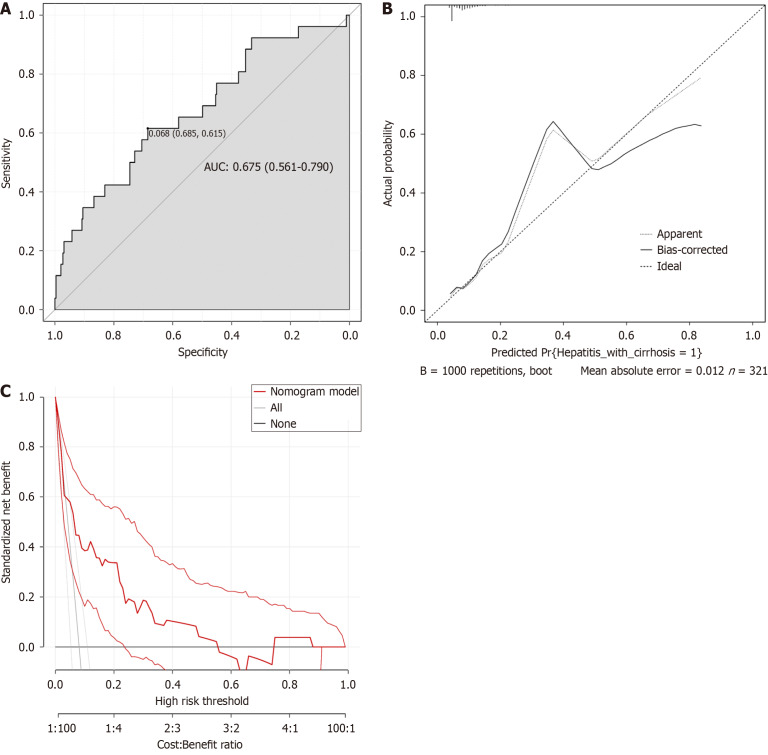
Results: Binary logistic regression analysis was performed using hepatitis B-related cirrhosis = 1 and hepatitis = 0 as dependent variables, and univariate analysis of serological indicators was used as covariates. The results showed that glutamic oxaloacetate aminotransferase/glutamate acetone aminotransferase levels, prothrombin time activity, and hepatitis B e antigen levels were all contributing factors to the progression of hepatitis to cirrhosis. The area under the ROC curve was 0.693 [95% confidence interval (CI): 0.631 to 0.756] for the training cohort and 0.675 (95%CI: 0.561 to 0.790) for the validation cohort. In addition, the decision analysis curves of the prediction models of both the training cohort and the validation cohort confirmed the effectiveness of the nomogram prediction model.
Conclusion: Three independent factors influencing the progression to cirrhosis in patients with hepatitis B were identified. The construction of a nomogram prediction model from hepatitis to cirrhosis has high application value as a tool for predicting the occurrence of liver cirrhosis in hepatitis B patients.






 京公网安备 11010802042870号
京ICP备2023020795号-1
京公网安备 11010802042870号
京ICP备2023020795号-1

 分享
分享
 求助内容:
求助内容: 应助结果提醒方式:
 扫码关注我们
