Causal Relationship Between Air Pollutants and Blood Pressure Phenotypes: A Mendelian Randomization Study.
IF 3.1 3区 医学Q2 CARDIAC & CARDIOVASCULAR SYSTEMSGlobal HeartPub Date : 2025-02-24eCollection Date: 2025-01-01DOI:10.5334/gh.1404
Xianshang Zhu, Huabo Mao, Hongyu Zeng, Fengli Lv, Jiancheng Wang
{"title":"Causal Relationship Between Air Pollutants and Blood Pressure Phenotypes: A Mendelian Randomization Study.","authors":"Xianshang Zhu, Huabo Mao, Hongyu Zeng, Fengli Lv, Jiancheng Wang","doi":"10.5334/gh.1404","DOIUrl":null,"url":null,"abstract":"<p><strong>Objectives: </strong>Hypertension is a chronic disease widely prevalent around the world. While previous observational studies have suggested a link between air pollutants and an increased risk of hypertension, causality has not been established. Our study aimed to investigate potential causal relationships between five air pollutants and four blood pressure phenotypes through two-sample Mendelian randomization.</p><p><strong>Methods: </strong>Two-sample Mendelian randomization (MR) analyses were performed using genome-wide association studies (GWAS) data from the IEU OpenGWAS project. The main analysis method was the inverse variance weighting (IVW) method. Heterogeneity was assessed by Cochran's Q test, while pleiotropy was assessed by MR-Egger regression. Sensitivity analysis was performed by weighted median method, MR-Egger method, simple mode method, weighted mode method, and leave-one-out analysis method.</p><p><strong>Results: </strong>Mendelian randomization results showed positive causal associations between PM10 with hypertension (OR: 1.49; 95%CI: 1.06, 2.09; <i>P</i>: 2.23 × 10<sup>-2</sup>) and systolic blood pressure (<i>β</i>: 1.89; 95%CI: 0.32, 3.47; <i>P</i>: 1.85 × 10<sup>-2</sup>), positive causal associations between PM2.5 and hypertension (OR: 1.26; 95%CI: 1.01, 2.58; <i>P</i>: 4.30 × 10<sup>-2</sup>), and negative causal associations between NO<sub>2</sub> and systolic blood pressure (<i>β</i>: -1.71; 95%CI: -3.39, -0.02; <i>P</i>: 4.74 × 10<sup>-2</sup>). None of the above associations were subject to pleiotropic bias, and all associations were heterogeneous except for PM10 and hypertension. The leave-one-out analysis showed that no single SNP affected the stability of the results.</p><p><strong>Conclusion: </strong>Elevated levels of PM2.5 and PM10 have been associated with an increased risk of developing hypertension, with PM10 specifically linked to higher systolic blood pressure levels. Interestingly, NO<sub>2</sub> has shown potential as a protective factor in lowering systolic blood pressure. This study clarifies the causal relationship between five air pollutants and elevated blood pressure. Ensuring good ambient air quality is essential in preventing hypertension and reducing the overall disease burden.</p>","PeriodicalId":56018,"journal":{"name":"Global Heart","volume":"20 1","pages":"18"},"PeriodicalIF":3.1000,"publicationDate":"2025-02-24","publicationTypes":"Journal Article","fieldsOfStudy":null,"isOpenAccess":false,"openAccessPdf":"https://www.ncbi.nlm.nih.gov/pmc/articles/PMC11869833/pdf/","citationCount":"0","resultStr":null,"platform":"Semanticscholar","paperid":null,"PeriodicalName":"Global Heart","FirstCategoryId":"3","ListUrlMain":"https://doi.org/10.5334/gh.1404","RegionNum":3,"RegionCategory":"医学","ArticlePicture":[],"TitleCN":null,"AbstractTextCN":null,"PMCID":null,"EPubDate":"2025/1/1 0:00:00","PubModel":"eCollection","JCR":"Q2","JCRName":"CARDIAC & CARDIOVASCULAR SYSTEMS","Score":null,"Total":0}
引用次数: 0
Abstract
Objectives: Hypertension is a chronic disease widely prevalent around the world. While previous observational studies have suggested a link between air pollutants and an increased risk of hypertension, causality has not been established. Our study aimed to investigate potential causal relationships between five air pollutants and four blood pressure phenotypes through two-sample Mendelian randomization.
Methods: Two-sample Mendelian randomization (MR) analyses were performed using genome-wide association studies (GWAS) data from the IEU OpenGWAS project. The main analysis method was the inverse variance weighting (IVW) method. Heterogeneity was assessed by Cochran's Q test, while pleiotropy was assessed by MR-Egger regression. Sensitivity analysis was performed by weighted median method, MR-Egger method, simple mode method, weighted mode method, and leave-one-out analysis method.
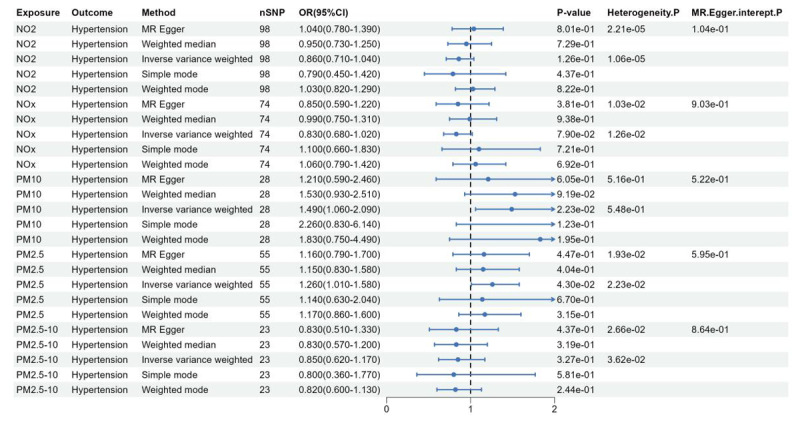
Results: Mendelian randomization results showed positive causal associations between PM10 with hypertension (OR: 1.49; 95%CI: 1.06, 2.09; P: 2.23 × 10⁻²) and systolic blood pressure (β: 1.89; 95%CI: 0.32, 3.47; P: 1.85 × 10⁻²), positive causal associations between PM2.5 and hypertension (OR: 1.26; 95%CI: 1.01, 2.58; P: 4.30 × 10⁻²), and negative causal associations between NO2 and systolic blood pressure (β: -1.71; 95%CI: -3.39, -0.02; P: 4.74 × 10⁻²). None of the above associations were subject to pleiotropic bias, and all associations were heterogeneous except for PM10 and hypertension. The leave-one-out analysis showed that no single SNP affected the stability of the results.
Conclusion: Elevated levels of PM2.5 and PM10 have been associated with an increased risk of developing hypertension, with PM10 specifically linked to higher systolic blood pressure levels. Interestingly, NO2 has shown potential as a protective factor in lowering systolic blood pressure. This study clarifies the causal relationship between five air pollutants and elevated blood pressure. Ensuring good ambient air quality is essential in preventing hypertension and reducing the overall disease burden.
Global HeartMedicine-Cardiology and Cardiovascular Medicine
CiteScore
5.70
自引率
5.40%
发文量
77
审稿时长
5 weeks
期刊介绍:
Global Heart offers a forum for dialogue and education on research, developments, trends, solutions and public health programs related to the prevention and control of cardiovascular diseases (CVDs) worldwide, with a special focus on low- and middle-income countries (LMICs). Manuscripts should address not only the extent or epidemiology of the problem, but also describe interventions to effectively control and prevent CVDs and the underlying factors. The emphasis should be on approaches applicable in settings with limited resources.
Economic evaluations of successful interventions are particularly welcome. We will also consider negative findings if important. While reports of hospital or clinic-based treatments are not excluded, particularly if they have broad implications for cost-effective disease control or prevention, we give priority to papers addressing community-based activities. We encourage submissions on cardiovascular surveillance and health policies, professional education, ethical issues and technological innovations related to prevention.
Global Heart is particularly interested in publishing data from updated national or regional demographic health surveys, World Health Organization or Global Burden of Disease data, large clinical disease databases or registries. Systematic reviews or meta-analyses on globally relevant topics are welcome. We will also consider clinical research that has special relevance to LMICs, e.g. using validated instruments to assess health-related quality-of-life in patients from LMICs, innovative diagnostic-therapeutic applications, real-world effectiveness clinical trials, research methods (innovative methodologic papers, with emphasis on low-cost research methods or novel application of methods in low resource settings), and papers pertaining to cardiovascular health promotion and policy (quantitative evaluation of health programs.






 京公网安备 11010802042870号
京ICP备2023020795号-1
京公网安备 11010802042870号
京ICP备2023020795号-1

 分享
分享
 求助内容:
求助内容: 应助结果提醒方式:
 扫码关注我们
