Qiongwei Tang, Sisi Zhu, Nannan Hu, Sainan Yin, Yuhong Yang, Yigang Teng, Dongliang Song, Xiang Liu
{"title":"Engineered T7 RNA polymerase reduces dsRNA formation by lowering terminal transferase and RNA-dependent RNA polymerase activities","authors":"Qiongwei Tang, Sisi Zhu, Nannan Hu, Sainan Yin, Yuhong Yang, Yigang Teng, Dongliang Song, Xiang Liu","doi":"10.1111/febs.70051","DOIUrl":null,"url":null,"abstract":"<p>T7 RNA polymerase (RNAP), the preferred tool for <i>in vitro</i> transcription (IVT), can generate double-stranded RNA (dsRNA) by-products that elicit immune stress and pose safety concerns. By combining the molecular beacon-based fluorescence-activated droplet sorting (FADS) utilized for random library screening with site-directed mutagenesis aimed at facilitating conformational changes in T7 RNAP, we successfully identified four mutants that exhibit reduced dsRNA content: M1 (V214A), M7 (F162S/A247T), M11 (K180E) and M14 (A70Q). Furthermore, the combinatorial mutant M17 (A70Q/F162S/K180E) exhibited significantly reduced dsRNA production under various conditions. Cellular experiments confirm the application potential of the mutants, displaying mitigated immune stress responses and enhanced protein translation compared to the wild-type protein. We then observed a close correlation between the production of dsRNA and the terminal transferase and RNA-dependent RNAP (RDRP) activities of T7 RNAP. The terminal transferase activity adds several nucleotides to the terminus of RNAs, while the RDRP activity extends the complementary region formed by self-pairing. In summary, we developed a novel approach for engineering T7 RNAP and demonstrated its potential in screening for T7 RNAP variants with reduced dsRNA production or improved product integrity.</p>","PeriodicalId":94226,"journal":{"name":"The FEBS journal","volume":"292 12","pages":"3205-3223"},"PeriodicalIF":4.2000,"publicationDate":"2025-03-03","publicationTypes":"Journal Article","fieldsOfStudy":null,"isOpenAccess":false,"openAccessPdf":"","citationCount":"0","resultStr":null,"platform":"Semanticscholar","paperid":null,"PeriodicalName":"The FEBS journal","FirstCategoryId":"1085","ListUrlMain":"https://febs.onlinelibrary.wiley.com/doi/10.1111/febs.70051","RegionNum":0,"RegionCategory":null,"ArticlePicture":[],"TitleCN":null,"AbstractTextCN":null,"PMCID":null,"EPubDate":"","PubModel":"","JCR":"","JCRName":"","Score":null,"Total":0}
引用次数: 0
Abstract
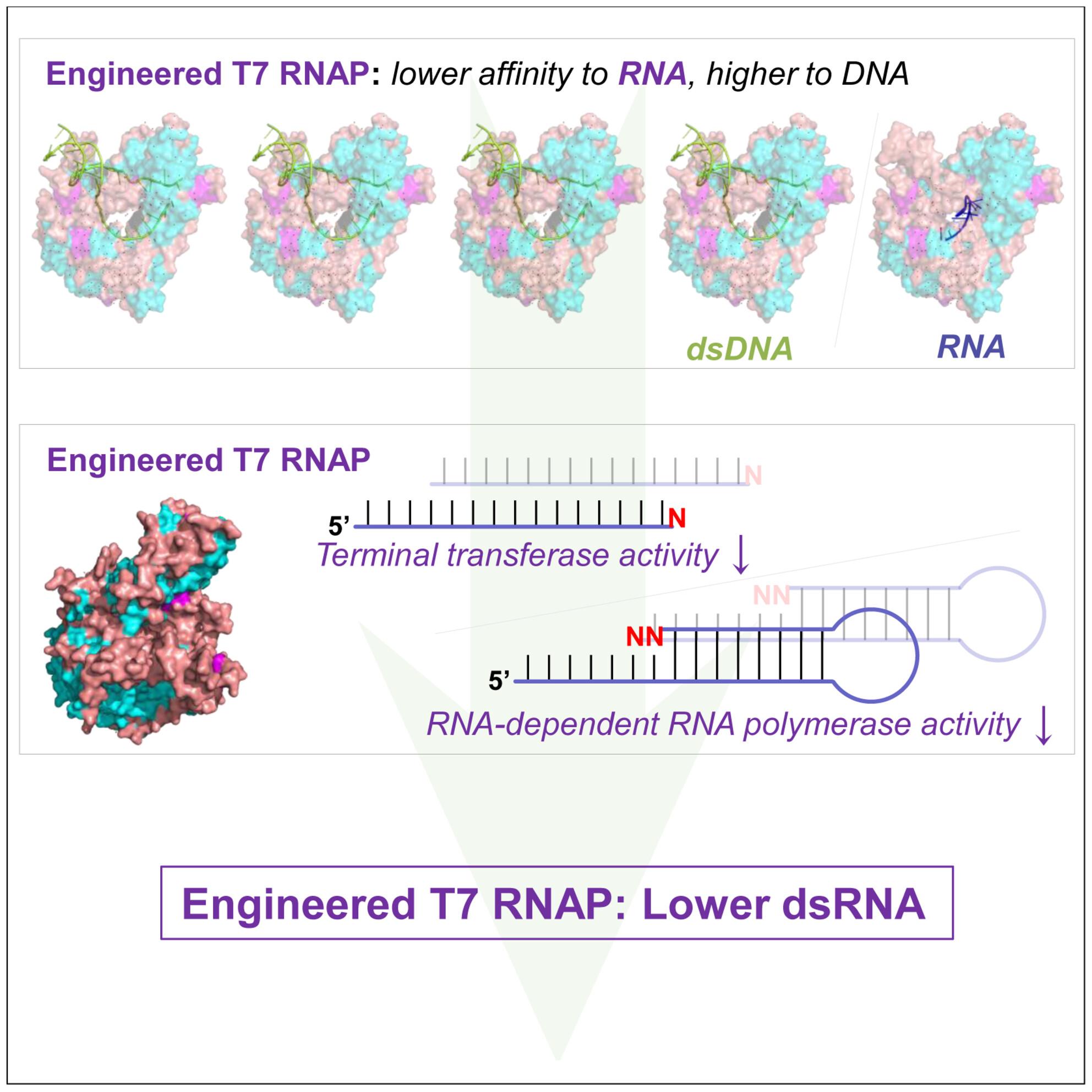
T7 RNA polymerase (RNAP), the preferred tool for in vitro transcription (IVT), can generate double-stranded RNA (dsRNA) by-products that elicit immune stress and pose safety concerns. By combining the molecular beacon-based fluorescence-activated droplet sorting (FADS) utilized for random library screening with site-directed mutagenesis aimed at facilitating conformational changes in T7 RNAP, we successfully identified four mutants that exhibit reduced dsRNA content: M1 (V214A), M7 (F162S/A247T), M11 (K180E) and M14 (A70Q). Furthermore, the combinatorial mutant M17 (A70Q/F162S/K180E) exhibited significantly reduced dsRNA production under various conditions. Cellular experiments confirm the application potential of the mutants, displaying mitigated immune stress responses and enhanced protein translation compared to the wild-type protein. We then observed a close correlation between the production of dsRNA and the terminal transferase and RNA-dependent RNAP (RDRP) activities of T7 RNAP. The terminal transferase activity adds several nucleotides to the terminus of RNAs, while the RDRP activity extends the complementary region formed by self-pairing. In summary, we developed a novel approach for engineering T7 RNAP and demonstrated its potential in screening for T7 RNAP variants with reduced dsRNA production or improved product integrity.





 京公网安备 11010802042870号
京ICP备2023020795号-1
京公网安备 11010802042870号
京ICP备2023020795号-1

 分享
分享

 求助内容:
求助内容: 应助结果提醒方式:
 扫码关注我们
