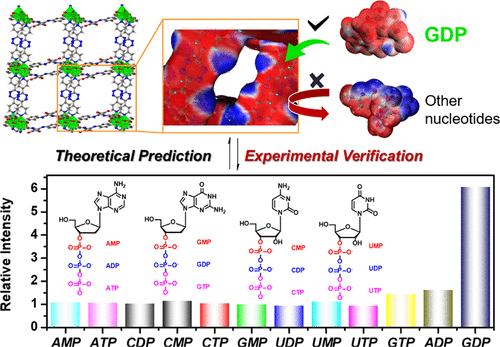
{"title":"Luminescent Metal–Organic Framework with Negative Electrostatic Pores for Highly Selective GDP Sensing","authors":"Yexin Zhang, Yuying Wei, Yuhan Li, Fangmin Huang, Jiani Pan, Shiyuan Chen, Pengyan Wu, Yuxuan Wang, Jian Wang","doi":"10.1021/acs.inorgchem.4c05544","DOIUrl":null,"url":null,"abstract":"Electrostatic potential (ESP) plays an essential role in studying interactions among molecules. Developing probe materials capable of selectively detecting analytes by aligning their molecular ESP with the electrostatic interaction of the host probe material is critically important for identifying analogous analytes; however, relevant research is extremely lacking. In this work, we synthesized a luminescent metal–organic framework (LMOF, Cd-DBDP) featuring negative electrostatic pore environments achieved by incorporating numerous electronegative oxygen atoms and N-containing aromatic rings from organic linkers. The molecular ESP distributions of Cd-DBDP and RNA-related nucleotides were calculated and employed to predict the sensing results. Fluorescence tests demonstrated that Cd-DBDP represents the first example of an MOF-based sensor for guanosine diphosphate (GDP) sensing, and the experimental observations were highly consistent with the theoretical prediction. The sensing mechanism for GDP was thoroughly studied through Fourier transform infrared spectroscopy (FT-IR), scanning electron microscopy/energy-dispersive spectroscopy (SEM/EDS), X-ray photoelectron spectroscopy (XPS), and theoretical calculations. These findings provide valuable insights into understanding the interplay between the molecular ESP distribution condition and the sensing results. This study offers a theoretical guide for future sensory research and provides effective means for the design and synthesis of highly efficient sensing MOFs, lending a solid groundwork for further exploration in this field.","PeriodicalId":40,"journal":{"name":"Inorganic Chemistry","volume":"16 1","pages":""},"PeriodicalIF":4.7000,"publicationDate":"2025-03-04","publicationTypes":"Journal Article","fieldsOfStudy":null,"isOpenAccess":false,"openAccessPdf":"","citationCount":"0","resultStr":null,"platform":"Semanticscholar","paperid":null,"PeriodicalName":"Inorganic Chemistry","FirstCategoryId":"92","ListUrlMain":"https://doi.org/10.1021/acs.inorgchem.4c05544","RegionNum":2,"RegionCategory":"化学","ArticlePicture":[],"TitleCN":null,"AbstractTextCN":null,"PMCID":null,"EPubDate":"","PubModel":"","JCR":"Q1","JCRName":"CHEMISTRY, INORGANIC & NUCLEAR","Score":null,"Total":0}
引用次数: 0
Abstract
Electrostatic potential (ESP) plays an essential role in studying interactions among molecules. Developing probe materials capable of selectively detecting analytes by aligning their molecular ESP with the electrostatic interaction of the host probe material is critically important for identifying analogous analytes; however, relevant research is extremely lacking. In this work, we synthesized a luminescent metal–organic framework (LMOF, Cd-DBDP) featuring negative electrostatic pore environments achieved by incorporating numerous electronegative oxygen atoms and N-containing aromatic rings from organic linkers. The molecular ESP distributions of Cd-DBDP and RNA-related nucleotides were calculated and employed to predict the sensing results. Fluorescence tests demonstrated that Cd-DBDP represents the first example of an MOF-based sensor for guanosine diphosphate (GDP) sensing, and the experimental observations were highly consistent with the theoretical prediction. The sensing mechanism for GDP was thoroughly studied through Fourier transform infrared spectroscopy (FT-IR), scanning electron microscopy/energy-dispersive spectroscopy (SEM/EDS), X-ray photoelectron spectroscopy (XPS), and theoretical calculations. These findings provide valuable insights into understanding the interplay between the molecular ESP distribution condition and the sensing results. This study offers a theoretical guide for future sensory research and provides effective means for the design and synthesis of highly efficient sensing MOFs, lending a solid groundwork for further exploration in this field.
期刊介绍:
Inorganic Chemistry publishes fundamental studies in all phases of inorganic chemistry. Coverage includes experimental and theoretical reports on quantitative studies of structure and thermodynamics, kinetics, mechanisms of inorganic reactions, bioinorganic chemistry, and relevant aspects of organometallic chemistry, solid-state phenomena, and chemical bonding theory. Emphasis is placed on the synthesis, structure, thermodynamics, reactivity, spectroscopy, and bonding properties of significant new and known compounds.



 京公网安备 11010802042870号
京ICP备2023020795号-1
京公网安备 11010802042870号
京ICP备2023020795号-1

 分享
分享
 求助内容:
求助内容: 应助结果提醒方式:
 扫码关注我们
