Work function and d-band center dual-modulation in hollow Ru-ZIF-8-derived Ru0–RuO2–ZnO heterointerfaces for boosted electrochemical hydrogen evolution†
Xiaoxin Xu, Ruidong Shi, Yuanting Li, Xue Wang and Gongbing Zhou
{"title":"Work function and d-band center dual-modulation in hollow Ru-ZIF-8-derived Ru0–RuO2–ZnO heterointerfaces for boosted electrochemical hydrogen evolution†","authors":"Xiaoxin Xu, Ruidong Shi, Yuanting Li, Xue Wang and Gongbing Zhou","doi":"10.1039/D4QI03353A","DOIUrl":null,"url":null,"abstract":"<p >To enhance the kinetics of the electrochemical hydrogen evolution reaction (HER) in alkaline electrolytes, metallic Ru (Ru<small><sup>0</sup></small>)–RuO<small><sub>2</sub></small>–ZnO heterointerfaces are constructed by pyrolyzing hollow Ru-ZIF-8 nanostructures with varying shapes. Systematic characterizations and theoretical simulations reveal that the exposed facets and oxygen vacancy (O<small><sub>v</sub></small>) contents of the heterointerfaces depend on the shape and pyrolysis temperature of Ru-ZIF-8. Rhombic dodecahedral Ru-ZIF-8-derived nanocrystals by pyrolyzing at 900 °C expose Ru<small><sup>0</sup></small>{1<img>0}–RuO<small><sub>2</sub></small>{<img>21}–ZnO{001} heterointerfaces with suitable O<small><sub>v</sub></small> content, resulting in an alleviated work function and a downshifted d-band center (<em>ε</em><small><sub>d</sub></small>). These structural optimizations accelerate H<small><sub>2</sub></small>O adsorption–dissociation on the nanocrystal surface, weaken the excessively strong electronic interaction between the catalytic surface and the H* intermediate, balance the strengths of H* adsorption and H<small><sub>2</sub></small> desorption, facilitate the rate-determining stage (RDS, H<small><sub>2</sub></small> desorption), and ultimately lower the apparent activation energy for HER. As a result, an overpotential of 25.0 mV at 10 mA cm<small><sup>−2</sup></small> and a turnover frequency of H<small><sub>2</sub></small> generation of 0.23 s<small><sup>−1</sup></small> at 100 mV are achieved, surpassing other heterostructure analogues. An excellent linearity between the HER overpotentials and the Gibbs free energy change of H* adsorption is substantiated, highlighting the advantage of d-orbital manipulation in expediting activity.</p>","PeriodicalId":79,"journal":{"name":"Inorganic Chemistry Frontiers","volume":" 8","pages":" 3246-3261"},"PeriodicalIF":6.4000,"publicationDate":"2025-03-05","publicationTypes":"Journal Article","fieldsOfStudy":null,"isOpenAccess":false,"openAccessPdf":"","citationCount":"0","resultStr":null,"platform":"Semanticscholar","paperid":null,"PeriodicalName":"Inorganic Chemistry Frontiers","FirstCategoryId":"92","ListUrlMain":"https://pubs.rsc.org/en/content/articlelanding/2025/qi/d4qi03353a","RegionNum":1,"RegionCategory":"化学","ArticlePicture":[],"TitleCN":null,"AbstractTextCN":null,"PMCID":null,"EPubDate":"","PubModel":"","JCR":"Q1","JCRName":"CHEMISTRY, INORGANIC & NUCLEAR","Score":null,"Total":0}
引用次数: 0
Abstract
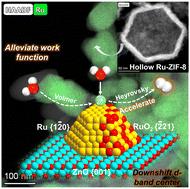
To enhance the kinetics of the electrochemical hydrogen evolution reaction (HER) in alkaline electrolytes, metallic Ru (Ru0)–RuO2–ZnO heterointerfaces are constructed by pyrolyzing hollow Ru-ZIF-8 nanostructures with varying shapes. Systematic characterizations and theoretical simulations reveal that the exposed facets and oxygen vacancy (Ov) contents of the heterointerfaces depend on the shape and pyrolysis temperature of Ru-ZIF-8. Rhombic dodecahedral Ru-ZIF-8-derived nanocrystals by pyrolyzing at 900 °C expose Ru0{10}–RuO2{21}–ZnO{001} heterointerfaces with suitable Ov content, resulting in an alleviated work function and a downshifted d-band center (εd). These structural optimizations accelerate H2O adsorption–dissociation on the nanocrystal surface, weaken the excessively strong electronic interaction between the catalytic surface and the H* intermediate, balance the strengths of H* adsorption and H2 desorption, facilitate the rate-determining stage (RDS, H2 desorption), and ultimately lower the apparent activation energy for HER. As a result, an overpotential of 25.0 mV at 10 mA cm−2 and a turnover frequency of H2 generation of 0.23 s−1 at 100 mV are achieved, surpassing other heterostructure analogues. An excellent linearity between the HER overpotentials and the Gibbs free energy change of H* adsorption is substantiated, highlighting the advantage of d-orbital manipulation in expediting activity.
空心ru - zif -8衍生Ru0-RuO2-ZnO异质界面的功函数和d波段中心双调制促进电化学析氢
为了提高碱性电解质中电化学析氢反应(HER)的动力学,通过热解不同形状的空心Ru- zif -8纳米结构,构建了金属Ru (Ru0)-RuO2-ZnO异质界面。系统表征和理论模拟表明,异质界面的暴露面和氧空位(Ov)含量与Ru-ZIF-8的形状和热解温度有关。在900℃下热解得到的正交十二面体ru - zif -8纳米晶体暴露出Ov含量合适的Ru0{1-20}-RuO2{-221}-ZnO{001}异质界面,使其功函数减轻,d带中心(εd)下降。这些结构优化加速了H2O在纳米晶表面的吸附-解离,减弱了催化表面与H*中间体之间过强的电子相互作用,平衡了H*吸附和H2脱附的强度,促进了速率决定阶段(RDS, H2脱附),最终降低了HER的表观活化能。结果表明,该材料在10 mA cm-2时的过电位为25.0 mV,在100 mV时产生H2的转换频率为0.23 s-1,优于其他异质结构类似物。研究证实了HER过电位与H*吸附的吉布斯自由能变化之间具有良好的线性关系,突出了d轨道操作在加速活性方面的优势。




 京公网安备 11010802042870号
京ICP备2023020795号-1
京公网安备 11010802042870号
京ICP备2023020795号-1

 分享
分享
 求助内容:
求助内容: 应助结果提醒方式:
 扫码关注我们
