Yunsu Byeon, Yae Won Park, Soohyun Lee, Doohyun Park, HyungSeob Shin, Kyunghwa Han, Jong Hee Chang, Se Hoon Kim, Seung-Koo Lee, Sung Soo Ahn, Dosik Hwang
{"title":"Interpretable multimodal transformer for prediction of molecular subtypes and grades in adult-type diffuse gliomas","authors":"Yunsu Byeon, Yae Won Park, Soohyun Lee, Doohyun Park, HyungSeob Shin, Kyunghwa Han, Jong Hee Chang, Se Hoon Kim, Seung-Koo Lee, Sung Soo Ahn, Dosik Hwang","doi":"10.1038/s41746-025-01530-4","DOIUrl":null,"url":null,"abstract":"<p>Molecular subtyping and grading of adult-type diffuse gliomas are essential for treatment decisions and patient prognosis. We introduce GlioMT, an interpretable multimodal transformer that integrates imaging and clinical data to predict the molecular subtype and grade of adult-type diffuse gliomas according to the 2021 WHO classification. GlioMT is trained on multiparametric MRI data from an institutional set of 1053 patients with adult-type diffuse gliomas to predict the IDH mutation status, 1p/19q codeletion status, and tumor grade. External validation on the TCGA (200 patients) and UCSF (477 patients) shows that GlioMT outperforms conventional CNNs and visual transformers, achieving AUCs of 0.915 (TCGA) and 0.981 (UCSF) for IDH mutation, 0.854 (TCGA) and 0.806 (UCSF) for 1p/19q codeletion, and 0.862 (TCGA) and 0.960 (UCSF) for grade prediction. GlioMT enhances the reliability of clinical decision-making by offering interpretability through attention maps and contributions of imaging and clinical data.</p>","PeriodicalId":19349,"journal":{"name":"NPJ Digital Medicine","volume":"32 1","pages":""},"PeriodicalIF":15.1000,"publicationDate":"2025-03-05","publicationTypes":"Journal Article","fieldsOfStudy":null,"isOpenAccess":false,"openAccessPdf":"","citationCount":"0","resultStr":null,"platform":"Semanticscholar","paperid":null,"PeriodicalName":"NPJ Digital Medicine","FirstCategoryId":"3","ListUrlMain":"https://doi.org/10.1038/s41746-025-01530-4","RegionNum":1,"RegionCategory":"医学","ArticlePicture":[],"TitleCN":null,"AbstractTextCN":null,"PMCID":null,"EPubDate":"","PubModel":"","JCR":"Q1","JCRName":"HEALTH CARE SCIENCES & SERVICES","Score":null,"Total":0}
引用次数: 0
Abstract
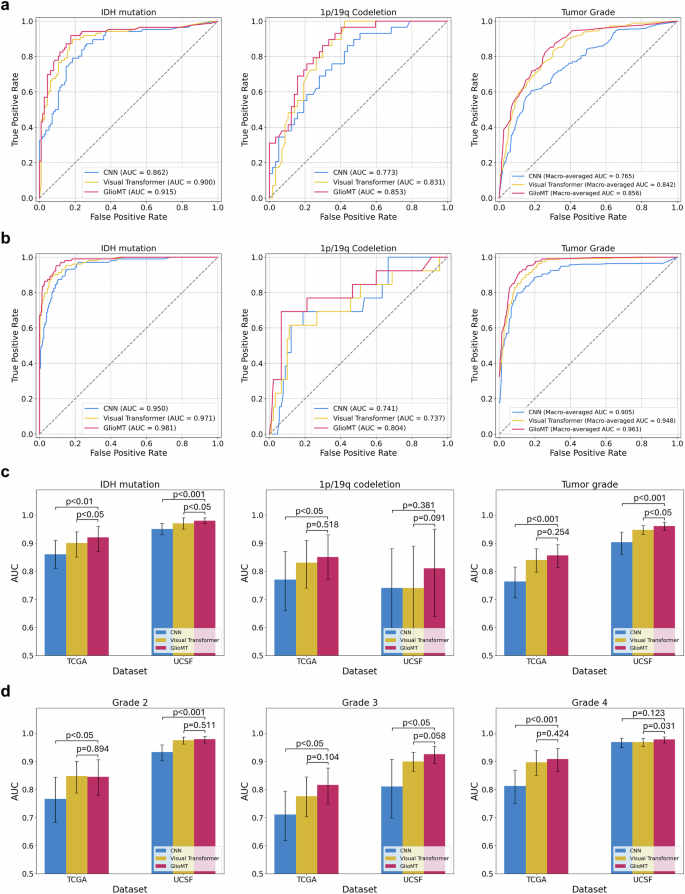
Molecular subtyping and grading of adult-type diffuse gliomas are essential for treatment decisions and patient prognosis. We introduce GlioMT, an interpretable multimodal transformer that integrates imaging and clinical data to predict the molecular subtype and grade of adult-type diffuse gliomas according to the 2021 WHO classification. GlioMT is trained on multiparametric MRI data from an institutional set of 1053 patients with adult-type diffuse gliomas to predict the IDH mutation status, 1p/19q codeletion status, and tumor grade. External validation on the TCGA (200 patients) and UCSF (477 patients) shows that GlioMT outperforms conventional CNNs and visual transformers, achieving AUCs of 0.915 (TCGA) and 0.981 (UCSF) for IDH mutation, 0.854 (TCGA) and 0.806 (UCSF) for 1p/19q codeletion, and 0.862 (TCGA) and 0.960 (UCSF) for grade prediction. GlioMT enhances the reliability of clinical decision-making by offering interpretability through attention maps and contributions of imaging and clinical data.
期刊介绍:
npj Digital Medicine is an online open-access journal that focuses on publishing peer-reviewed research in the field of digital medicine. The journal covers various aspects of digital medicine, including the application and implementation of digital and mobile technologies in clinical settings, virtual healthcare, and the use of artificial intelligence and informatics.
The primary goal of the journal is to support innovation and the advancement of healthcare through the integration of new digital and mobile technologies. When determining if a manuscript is suitable for publication, the journal considers four important criteria: novelty, clinical relevance, scientific rigor, and digital innovation.




 京公网安备 11010802042870号
京ICP备2023020795号-1
京公网安备 11010802042870号
京ICP备2023020795号-1

 分享
分享
 求助内容:
求助内容: 应助结果提醒方式:
 扫码关注我们
