Hmayag Partamian, Saeed Jahromi, Ludovica Corona, M. Scott Perry, Eleonora Tamilia, Joseph R. Madsen, Jeffrey Bolton, Scellig S. D. Stone, Phillip L. Pearl, Christos Papadelis
{"title":"Machine learning on interictal intracranial EEG predicts surgical outcome in drug resistant epilepsy","authors":"Hmayag Partamian, Saeed Jahromi, Ludovica Corona, M. Scott Perry, Eleonora Tamilia, Joseph R. Madsen, Jeffrey Bolton, Scellig S. D. Stone, Phillip L. Pearl, Christos Papadelis","doi":"10.1038/s41746-025-01531-3","DOIUrl":null,"url":null,"abstract":"<p>Surgical success for patients with focal drug resistant epilepsy (DRE) relies on accurate localization of the epileptogenic zone (EZ). Currently, no exam delineates this zone unambiguously. Instead, the EZ is approximated by the area where seizures begin, which is identified manually through a tedious process that is prone to errors and biases. More importantly, resection of this area does not always predict good surgical outcome. Here, we propose an artificially intelligent, patient-specific framework that automatically identifies the EZ requiring little to no input from clinicians, without having to wait for a seizure to occur. The framework transforms interictal intracranial electroencephalography data into spatiotemporal representations of brain activity discriminating the interictal epileptogenic network from background activity. The epileptogenic network delineates the EZ with high precision and predicts surgical outcome. Our framework eliminates the need for manual data inspection, reduces prolonged monitoring, and enhances surgical planning for DRE patients.</p>","PeriodicalId":19349,"journal":{"name":"NPJ Digital Medicine","volume":"90 1","pages":""},"PeriodicalIF":15.1000,"publicationDate":"2025-03-05","publicationTypes":"Journal Article","fieldsOfStudy":null,"isOpenAccess":false,"openAccessPdf":"","citationCount":"0","resultStr":null,"platform":"Semanticscholar","paperid":null,"PeriodicalName":"NPJ Digital Medicine","FirstCategoryId":"3","ListUrlMain":"https://doi.org/10.1038/s41746-025-01531-3","RegionNum":1,"RegionCategory":"医学","ArticlePicture":[],"TitleCN":null,"AbstractTextCN":null,"PMCID":null,"EPubDate":"","PubModel":"","JCR":"Q1","JCRName":"HEALTH CARE SCIENCES & SERVICES","Score":null,"Total":0}
引用次数: 0
Abstract
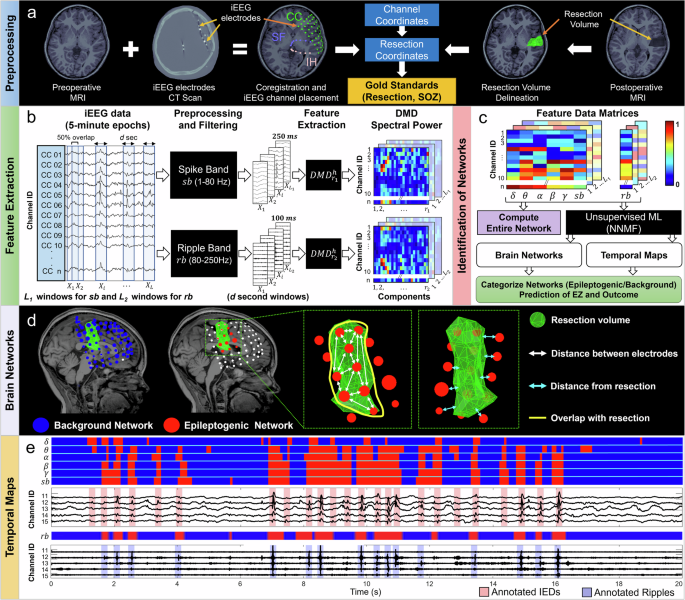
Surgical success for patients with focal drug resistant epilepsy (DRE) relies on accurate localization of the epileptogenic zone (EZ). Currently, no exam delineates this zone unambiguously. Instead, the EZ is approximated by the area where seizures begin, which is identified manually through a tedious process that is prone to errors and biases. More importantly, resection of this area does not always predict good surgical outcome. Here, we propose an artificially intelligent, patient-specific framework that automatically identifies the EZ requiring little to no input from clinicians, without having to wait for a seizure to occur. The framework transforms interictal intracranial electroencephalography data into spatiotemporal representations of brain activity discriminating the interictal epileptogenic network from background activity. The epileptogenic network delineates the EZ with high precision and predicts surgical outcome. Our framework eliminates the need for manual data inspection, reduces prolonged monitoring, and enhances surgical planning for DRE patients.
期刊介绍:
npj Digital Medicine is an online open-access journal that focuses on publishing peer-reviewed research in the field of digital medicine. The journal covers various aspects of digital medicine, including the application and implementation of digital and mobile technologies in clinical settings, virtual healthcare, and the use of artificial intelligence and informatics.
The primary goal of the journal is to support innovation and the advancement of healthcare through the integration of new digital and mobile technologies. When determining if a manuscript is suitable for publication, the journal considers four important criteria: novelty, clinical relevance, scientific rigor, and digital innovation.




 京公网安备 11010802042870号
京ICP备2023020795号-1
京公网安备 11010802042870号
京ICP备2023020795号-1

 分享
分享
 求助内容:
求助内容: 应助结果提醒方式:
 扫码关注我们
