Hang Li, Hao Liu, Shunrui Luo, Jordi Arbiol, Emmanuelle Suard, Thomas Bergfeldt, Alexander Missyul, Volodymyr Baran, Stefan Mangold, Yongchao Zhang, Weibo Hua, Michael Knapp, Helmut Ehrenberg, Feng Pan, Sylvio Indris
{"title":"Tuning Li occupancy and local structures for advanced Co-free Ni-rich positive electrodes","authors":"Hang Li, Hao Liu, Shunrui Luo, Jordi Arbiol, Emmanuelle Suard, Thomas Bergfeldt, Alexander Missyul, Volodymyr Baran, Stefan Mangold, Yongchao Zhang, Weibo Hua, Michael Knapp, Helmut Ehrenberg, Feng Pan, Sylvio Indris","doi":"10.1038/s41467-025-57063-7","DOIUrl":null,"url":null,"abstract":"<p>Structure evolution and surface reactivity have long been regarded as the most crucial points for studying Ni-rich positive electrodes for Li-ion batteries. Unfortunately, the influence of Li occupancy as a single factor on electro-chemomechanical stability has been overlooked and is missing, owing to the challenge of Li determination in the lattice. Here, a comprehensive analysis reveals different Li occupancies and related structural domains (Ni/Li exchange, Li<sub><i>a</i></sub>XO<sub><i>b</i></sub>, Li/Mn/X(Ni) ordering domains, X = Nb<sup>5+</sup>, W<sup>6+</sup>, and Mo<sup>6+</sup>) by using a combination of Li-sensitive characterization techniques. By introducing a Li-regulation strategy, the relative ratio of each domain is effectively tuned in the Ni-rich positive electrodes. Through tuning, two specific positive electrodes are designed, exhibiting notable improvement in battery cyclability. The specific Li structural units induce significant changes in redox mechanisms. This Li-occupancy-tuning approach highlights the necessity of focusing on Li distribution and opens up ideas for designing advanced Ni-rich positive electrodes with high durability.</p>","PeriodicalId":19066,"journal":{"name":"Nature Communications","volume":"34 1","pages":""},"PeriodicalIF":15.7000,"publicationDate":"2025-03-05","publicationTypes":"Journal Article","fieldsOfStudy":null,"isOpenAccess":false,"openAccessPdf":"","citationCount":"0","resultStr":null,"platform":"Semanticscholar","paperid":null,"PeriodicalName":"Nature Communications","FirstCategoryId":"103","ListUrlMain":"https://doi.org/10.1038/s41467-025-57063-7","RegionNum":1,"RegionCategory":"综合性期刊","ArticlePicture":[],"TitleCN":null,"AbstractTextCN":null,"PMCID":null,"EPubDate":"","PubModel":"","JCR":"Q1","JCRName":"MULTIDISCIPLINARY SCIENCES","Score":null,"Total":0}
引用次数: 0
Abstract
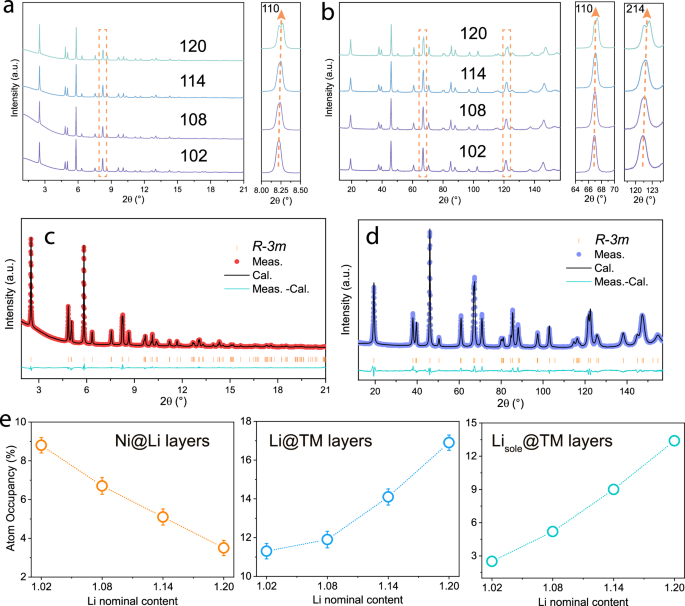
Structure evolution and surface reactivity have long been regarded as the most crucial points for studying Ni-rich positive electrodes for Li-ion batteries. Unfortunately, the influence of Li occupancy as a single factor on electro-chemomechanical stability has been overlooked and is missing, owing to the challenge of Li determination in the lattice. Here, a comprehensive analysis reveals different Li occupancies and related structural domains (Ni/Li exchange, LiaXOb, Li/Mn/X(Ni) ordering domains, X = Nb5+, W6+, and Mo6+) by using a combination of Li-sensitive characterization techniques. By introducing a Li-regulation strategy, the relative ratio of each domain is effectively tuned in the Ni-rich positive electrodes. Through tuning, two specific positive electrodes are designed, exhibiting notable improvement in battery cyclability. The specific Li structural units induce significant changes in redox mechanisms. This Li-occupancy-tuning approach highlights the necessity of focusing on Li distribution and opens up ideas for designing advanced Ni-rich positive electrodes with high durability.
期刊介绍:
Nature Communications, an open-access journal, publishes high-quality research spanning all areas of the natural sciences. Papers featured in the journal showcase significant advances relevant to specialists in each respective field. With a 2-year impact factor of 16.6 (2022) and a median time of 8 days from submission to the first editorial decision, Nature Communications is committed to rapid dissemination of research findings. As a multidisciplinary journal, it welcomes contributions from biological, health, physical, chemical, Earth, social, mathematical, applied, and engineering sciences, aiming to highlight important breakthroughs within each domain.



 京公网安备 11010802042870号
京ICP备2023020795号-1
京公网安备 11010802042870号
京ICP备2023020795号-1

 分享
分享
 求助内容:
求助内容: 应助结果提醒方式:
 扫码关注我们
