Junxi Zhang, An Pei, Huayue Yang, Weiwei Zhou, Zhenzhen Feng, Han Tian, Yun Zhao, Guangxu Chen, Jian Peng
{"title":"Copper-Optimized Active Sites in Cobalt Oxide Nanocubes for Selective Electrooxidation of 5-Hydroxymethylfurfural","authors":"Junxi Zhang, An Pei, Huayue Yang, Weiwei Zhou, Zhenzhen Feng, Han Tian, Yun Zhao, Guangxu Chen, Jian Peng","doi":"10.1021/acscatal.5c00647","DOIUrl":null,"url":null,"abstract":"An effective design of a bimetallic cobalt-based spinel oxide catalyst to selectively convert 5-hydroxymethylfurfural (HMF) into 2,5-furandicarboxylic acid (FDCA), replacing the oxygen evolution reaction (OER), demonstrates broad application prospects. However, the oxidation mechanisms differ markedly among various catalysts, and the structural transformations of transition metals within cobalt oxides remain insufficiently understood. Here we synthesized a Cu<sub>0.29</sub>Co<sub>2.71</sub>O<sub>4</sub> model catalyst using a facile solvothermal method. As the applied potential increased, Co(OH)<sub>2</sub> was generated on the surface of Cu<sub>0.29</sub>Co<sub>2.71</sub>O<sub>4</sub> and subsequently transformed into (Cu)CoO<sub><i>x</i></sub>H<sub><i>y</i></sub> via electrooxidation, followed by a rapid (nonelectrochemical) chemical oxidation reaction with HMF, achieving high selectivity (99.8%) and Faraday efficiency (91.6%) for the production of FDCA. Through comprehensive characterization coupled with electrochemical measurements and theoretical simulations, we found that the incorporation of copper effectively modulates the active sites of the cobalt oxide, which enhances OH<sup>–</sup> adsorption and improves conductivity, thereby achieving superior HMF oxidation activity. This work provides valuable insights into designing highly active bimetallic spinel oxide electrocatalysts to accelerate the anode oxidation reaction, offering a promising alternative to the OER and promoting efficient biomass conversion.","PeriodicalId":9,"journal":{"name":"ACS Catalysis ","volume":"80 1","pages":""},"PeriodicalIF":13.1000,"publicationDate":"2025-03-04","publicationTypes":"Journal Article","fieldsOfStudy":null,"isOpenAccess":false,"openAccessPdf":"","citationCount":"0","resultStr":null,"platform":"Semanticscholar","paperid":null,"PeriodicalName":"ACS Catalysis ","FirstCategoryId":"92","ListUrlMain":"https://doi.org/10.1021/acscatal.5c00647","RegionNum":1,"RegionCategory":"化学","ArticlePicture":[],"TitleCN":null,"AbstractTextCN":null,"PMCID":null,"EPubDate":"","PubModel":"","JCR":"Q1","JCRName":"CHEMISTRY, PHYSICAL","Score":null,"Total":0}
引用次数: 0
Abstract
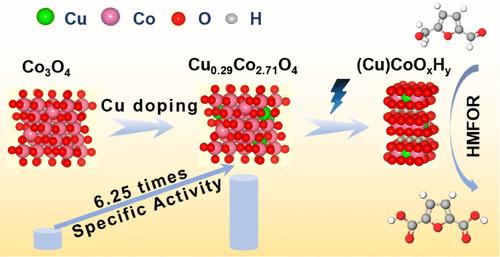
An effective design of a bimetallic cobalt-based spinel oxide catalyst to selectively convert 5-hydroxymethylfurfural (HMF) into 2,5-furandicarboxylic acid (FDCA), replacing the oxygen evolution reaction (OER), demonstrates broad application prospects. However, the oxidation mechanisms differ markedly among various catalysts, and the structural transformations of transition metals within cobalt oxides remain insufficiently understood. Here we synthesized a Cu0.29Co2.71O4 model catalyst using a facile solvothermal method. As the applied potential increased, Co(OH)2 was generated on the surface of Cu0.29Co2.71O4 and subsequently transformed into (Cu)CoOxHy via electrooxidation, followed by a rapid (nonelectrochemical) chemical oxidation reaction with HMF, achieving high selectivity (99.8%) and Faraday efficiency (91.6%) for the production of FDCA. Through comprehensive characterization coupled with electrochemical measurements and theoretical simulations, we found that the incorporation of copper effectively modulates the active sites of the cobalt oxide, which enhances OH– adsorption and improves conductivity, thereby achieving superior HMF oxidation activity. This work provides valuable insights into designing highly active bimetallic spinel oxide electrocatalysts to accelerate the anode oxidation reaction, offering a promising alternative to the OER and promoting efficient biomass conversion.
期刊介绍:
ACS Catalysis is an esteemed journal that publishes original research in the fields of heterogeneous catalysis, molecular catalysis, and biocatalysis. It offers broad coverage across diverse areas such as life sciences, organometallics and synthesis, photochemistry and electrochemistry, drug discovery and synthesis, materials science, environmental protection, polymer discovery and synthesis, and energy and fuels.
The scope of the journal is to showcase innovative work in various aspects of catalysis. This includes new reactions and novel synthetic approaches utilizing known catalysts, the discovery or modification of new catalysts, elucidation of catalytic mechanisms through cutting-edge investigations, practical enhancements of existing processes, as well as conceptual advances in the field. Contributions to ACS Catalysis can encompass both experimental and theoretical research focused on catalytic molecules, macromolecules, and materials that exhibit catalytic turnover.



 京公网安备 11010802042870号
京ICP备2023020795号-1
京公网安备 11010802042870号
京ICP备2023020795号-1

 分享
分享
 求助内容:
求助内容: 应助结果提醒方式:
 扫码关注我们
