Vincent Doublet, Toby D. Doyle, Claire Carvell, Mark J. F. Brown, Lena Wilfert
{"title":"Host ecology and phylogeny shape the temporal dynamics of social bee viromes","authors":"Vincent Doublet, Toby D. Doyle, Claire Carvell, Mark J. F. Brown, Lena Wilfert","doi":"10.1038/s41467-025-57314-7","DOIUrl":null,"url":null,"abstract":"<p>The composition of viral communities (i.e. viromes) can be dynamic and complex. Co-evolution may lead to virome host-specificity. However, eco-evolutionary factors may influence virome dynamics in wild host communities, potentially leading to disease emergence. Social bees are relevant models to address the drivers of virome composition: these important pollinators form multi-species assemblages, with high niche overlap and strong seasonality in their biotic interactions. We applied a microbial community approach to disentangle the role of host phylogeny and host ecology in shaping bee viromes, combining plant-pollinator networks with meta-transcriptomics, and small interfering RNAs as proxies for viral replication in pollinators and pollen. We identified over a hundred insect and plant viral sequences from ca. 4500 insect pollinator samples across three time points in one year. While host genetic distance drives the distribution of bee viruses, we find that plant-pollinator interactions and phenology drive plant virus communities collected by bees. This reveals the opportunities for virus spread in the bee assemblage. However, we show that transmission to multiple hosts is only realized for a fraction of insect viruses, with even fewer found to be actively replicating in multiple species, including the particularly virulent multi-host acute bee paralysis virus.</p>","PeriodicalId":19066,"journal":{"name":"Nature Communications","volume":"49 1","pages":""},"PeriodicalIF":15.7000,"publicationDate":"2025-03-05","publicationTypes":"Journal Article","fieldsOfStudy":null,"isOpenAccess":false,"openAccessPdf":"","citationCount":"0","resultStr":null,"platform":"Semanticscholar","paperid":null,"PeriodicalName":"Nature Communications","FirstCategoryId":"103","ListUrlMain":"https://doi.org/10.1038/s41467-025-57314-7","RegionNum":1,"RegionCategory":"综合性期刊","ArticlePicture":[],"TitleCN":null,"AbstractTextCN":null,"PMCID":null,"EPubDate":"","PubModel":"","JCR":"Q1","JCRName":"MULTIDISCIPLINARY SCIENCES","Score":null,"Total":0}
引用次数: 0
Abstract
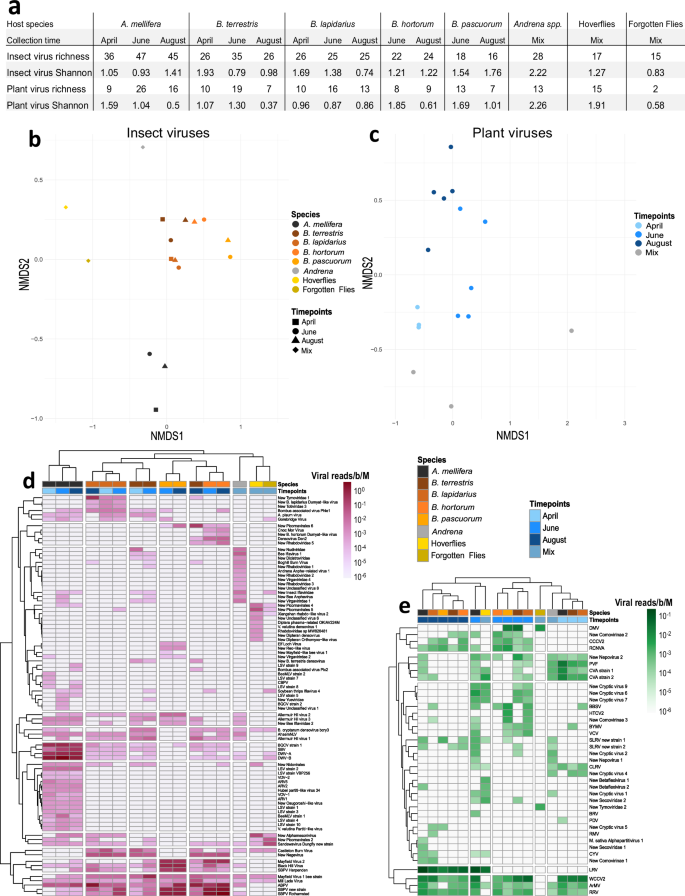
The composition of viral communities (i.e. viromes) can be dynamic and complex. Co-evolution may lead to virome host-specificity. However, eco-evolutionary factors may influence virome dynamics in wild host communities, potentially leading to disease emergence. Social bees are relevant models to address the drivers of virome composition: these important pollinators form multi-species assemblages, with high niche overlap and strong seasonality in their biotic interactions. We applied a microbial community approach to disentangle the role of host phylogeny and host ecology in shaping bee viromes, combining plant-pollinator networks with meta-transcriptomics, and small interfering RNAs as proxies for viral replication in pollinators and pollen. We identified over a hundred insect and plant viral sequences from ca. 4500 insect pollinator samples across three time points in one year. While host genetic distance drives the distribution of bee viruses, we find that plant-pollinator interactions and phenology drive plant virus communities collected by bees. This reveals the opportunities for virus spread in the bee assemblage. However, we show that transmission to multiple hosts is only realized for a fraction of insect viruses, with even fewer found to be actively replicating in multiple species, including the particularly virulent multi-host acute bee paralysis virus.
期刊介绍:
Nature Communications, an open-access journal, publishes high-quality research spanning all areas of the natural sciences. Papers featured in the journal showcase significant advances relevant to specialists in each respective field. With a 2-year impact factor of 16.6 (2022) and a median time of 8 days from submission to the first editorial decision, Nature Communications is committed to rapid dissemination of research findings. As a multidisciplinary journal, it welcomes contributions from biological, health, physical, chemical, Earth, social, mathematical, applied, and engineering sciences, aiming to highlight important breakthroughs within each domain.




 京公网安备 11010802042870号
京ICP备2023020795号-1
京公网安备 11010802042870号
京ICP备2023020795号-1

 分享
分享
 求助内容:
求助内容: 应助结果提醒方式:
 扫码关注我们
