Naoki Shimada, Haruka Uchida, Vasanthi Palanisamy, Vladimir Chernyshev* and Toshiro Fukami*,
{"title":"Multicomponent Solid Forms of Pioglitazone and Their Influence on Drug Dissolution","authors":"Naoki Shimada, Haruka Uchida, Vasanthi Palanisamy, Vladimir Chernyshev* and Toshiro Fukami*, ","doi":"10.1021/acs.cgd.4c01617","DOIUrl":null,"url":null,"abstract":"<p >Pioglitazone (PIO), a type 2 diabetes medication, effectively decreases blood glucose levels. It exhibits poor aqueous solubility and falls in the category of the biopharmaceutics classification system (BCS)-II. To enhance solubility and dissolution characteristics of the lipophilic drug, cocrystallization with organic acids such as 2-naphthalenesulfonoic acid (NSA), oxalic acid (OXA), maleic acid (MLE), and dihydroxy benzoic acid (DHBA) were successfully carried out via the solvent-drop grinding method. The multicomponent solid forms were characterized by powder X-ray diffraction (PXRD), infrared spectroscopy, and thermal analysis. The crystal structures of the PIO–NSA and PIO–MLE solid forms were obtained through Rietveld refinement from the high-resolution PXRD data as their crystallization was challenging. The N–H···N hydrogen-bonded PIO homodimer in the drug is replaced by the O–H···N neutral hydrogen bond in the cocrystal monohydrate (PIO–NSA 1:1:1) and N<sup>+</sup>–H···O<sup>–</sup> ionic interactions in the salt hemihydrate (PIO–MLE 1:1:0.5). Spectroscopic analysis confirmed the formation of 1:1 salts between PIO and OXA/DHBA. However, the structural prediction was compromised due to the nonmonophasic behavior of these salts. Solubility of novel multicomponent solid forms was performed in pH 6.8 phosphate buffer at 37 °C and determined using UV–vis spectroscopy. The PIO–NSA cocrystal hydrate dissolved 7 times compared to PIO, which may be useful for further pharmaceutical application during drug formulation. The solubility data was correlated with the synthon modulation, lower melting point, and coformer solubility.</p>","PeriodicalId":34,"journal":{"name":"Crystal Growth & Design","volume":"25 5","pages":"1514–1525 1514–1525"},"PeriodicalIF":3.4000,"publicationDate":"2025-02-13","publicationTypes":"Journal Article","fieldsOfStudy":null,"isOpenAccess":false,"openAccessPdf":"","citationCount":"0","resultStr":null,"platform":"Semanticscholar","paperid":null,"PeriodicalName":"Crystal Growth & Design","FirstCategoryId":"92","ListUrlMain":"https://pubs.acs.org/doi/10.1021/acs.cgd.4c01617","RegionNum":2,"RegionCategory":"化学","ArticlePicture":[],"TitleCN":null,"AbstractTextCN":null,"PMCID":null,"EPubDate":"","PubModel":"","JCR":"Q2","JCRName":"CHEMISTRY, MULTIDISCIPLINARY","Score":null,"Total":0}
引用次数: 0
Abstract
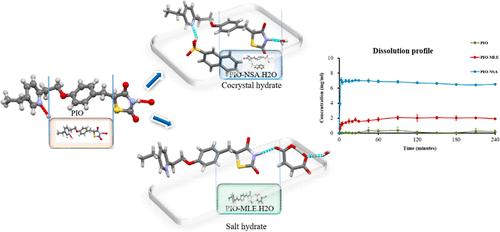
Pioglitazone (PIO), a type 2 diabetes medication, effectively decreases blood glucose levels. It exhibits poor aqueous solubility and falls in the category of the biopharmaceutics classification system (BCS)-II. To enhance solubility and dissolution characteristics of the lipophilic drug, cocrystallization with organic acids such as 2-naphthalenesulfonoic acid (NSA), oxalic acid (OXA), maleic acid (MLE), and dihydroxy benzoic acid (DHBA) were successfully carried out via the solvent-drop grinding method. The multicomponent solid forms were characterized by powder X-ray diffraction (PXRD), infrared spectroscopy, and thermal analysis. The crystal structures of the PIO–NSA and PIO–MLE solid forms were obtained through Rietveld refinement from the high-resolution PXRD data as their crystallization was challenging. The N–H···N hydrogen-bonded PIO homodimer in the drug is replaced by the O–H···N neutral hydrogen bond in the cocrystal monohydrate (PIO–NSA 1:1:1) and N+–H···O– ionic interactions in the salt hemihydrate (PIO–MLE 1:1:0.5). Spectroscopic analysis confirmed the formation of 1:1 salts between PIO and OXA/DHBA. However, the structural prediction was compromised due to the nonmonophasic behavior of these salts. Solubility of novel multicomponent solid forms was performed in pH 6.8 phosphate buffer at 37 °C and determined using UV–vis spectroscopy. The PIO–NSA cocrystal hydrate dissolved 7 times compared to PIO, which may be useful for further pharmaceutical application during drug formulation. The solubility data was correlated with the synthon modulation, lower melting point, and coformer solubility.
期刊介绍:
The aim of Crystal Growth & Design is to stimulate crossfertilization of knowledge among scientists and engineers working in the fields of crystal growth, crystal engineering, and the industrial application of crystalline materials.
Crystal Growth & Design publishes theoretical and experimental studies of the physical, chemical, and biological phenomena and processes related to the design, growth, and application of crystalline materials. Synergistic approaches originating from different disciplines and technologies and integrating the fields of crystal growth, crystal engineering, intermolecular interactions, and industrial application are encouraged.



 京公网安备 11010802042870号
京ICP备2023020795号-1
京公网安备 11010802042870号
京ICP备2023020795号-1

 分享
分享
 求助内容:
求助内容: 应助结果提醒方式:
 扫码关注我们
