Revealing the potential hypoglycaemic, hepatorenal and pancreatic protective effects of sugarcane bagasse extract in fructose/streptozotocin induced diabetic rats
Wei Ning , Xiaozhuang Peng , Xiaomin Zhang , Abdul Basit , Chitchamai Ovatlarnporn , Opeyemi Joshua Olatunji
{"title":"Revealing the potential hypoglycaemic, hepatorenal and pancreatic protective effects of sugarcane bagasse extract in fructose/streptozotocin induced diabetic rats","authors":"Wei Ning , Xiaozhuang Peng , Xiaomin Zhang , Abdul Basit , Chitchamai Ovatlarnporn , Opeyemi Joshua Olatunji","doi":"10.1016/j.jafr.2025.101769","DOIUrl":null,"url":null,"abstract":"<div><div>Sugarcane bagasse (SB) is a byproduct from sugarcane processing, and it constitute a huge amount of waste product which can amount to humongous environmental nuisance. Studies have shown that SB contains ample quantities of polysaccharides, fibers, flavonoids and phenolic acids which can be explored for their added values. This study aimed at investigating the antidiabetic, antioxidant and hypolipidemic activities of sugarcane bagasse extract (SBE), as well as its hepatorenal and pancreatic protective effects in fructose/streptozotocin-induced diabetic rats. Following the induction of diabetes, the rats were divided into five groups as follows: groups 1 and 2 (normal and diabetic control rats, respectively, treated with normal saline), groups 3 and 4 received 250 and 500 mg/kg of SBE, respectively, and group 5 received 200 mg/kg of metformin. Assessment of diabetes was performed by evaluating metabolic parameters (body weight, food and water intake), blood glucose level, glucose tolerance, biochemical and oxidative stress parameters as well as histopathological analysis of the pancreas, kidney and liver tissues. The binding affinities of some of the compounds identified by LCMS were also assessed against antioxidant enzymes including SOD, CAT and GSH. SBE displayed tremendous potentials in managing diabetic symptoms by mitigating hyperglycemia, restoring body weight loss, glucose intolerance, biochemical, and histological changes in Fr/STZ-induced diabetic rats. Furthermore, SBE alleviated oxidative stress by increasing the hepatorenal and pancreatic activities of SOD, CAT and GSH, as well as reducing MDA level in Fr/STZ-induced diabetic rats. The results indicated that luteolin-8-C-rhamnosyl-7-O-rhamnoside showed higher number of groups interacting with residues of these markers, which might be responsible for the high binding affinities of the compound. Overall, these findings suggest that SB has therapeutic potentials against diabetes and diabetes induced multi-organ injury, thus expanding the potential benefits and possible valorization of SB for food and pharmaceutical applications.</div></div>","PeriodicalId":34393,"journal":{"name":"Journal of Agriculture and Food Research","volume":"20 ","pages":"Article 101769"},"PeriodicalIF":6.2000,"publicationDate":"2025-04-01","publicationTypes":"Journal Article","fieldsOfStudy":null,"isOpenAccess":false,"openAccessPdf":"","citationCount":"0","resultStr":null,"platform":"Semanticscholar","paperid":null,"PeriodicalName":"Journal of Agriculture and Food Research","FirstCategoryId":"1085","ListUrlMain":"https://www.sciencedirect.com/science/article/pii/S2666154325001401","RegionNum":0,"RegionCategory":null,"ArticlePicture":[],"TitleCN":null,"AbstractTextCN":null,"PMCID":null,"EPubDate":"2025/2/24 0:00:00","PubModel":"Epub","JCR":"Q1","JCRName":"AGRICULTURE, MULTIDISCIPLINARY","Score":null,"Total":0}
引用次数: 0
Abstract
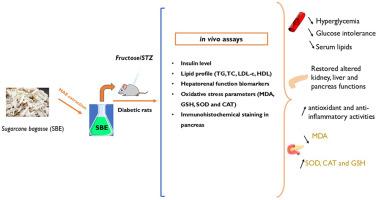
Sugarcane bagasse (SB) is a byproduct from sugarcane processing, and it constitute a huge amount of waste product which can amount to humongous environmental nuisance. Studies have shown that SB contains ample quantities of polysaccharides, fibers, flavonoids and phenolic acids which can be explored for their added values. This study aimed at investigating the antidiabetic, antioxidant and hypolipidemic activities of sugarcane bagasse extract (SBE), as well as its hepatorenal and pancreatic protective effects in fructose/streptozotocin-induced diabetic rats. Following the induction of diabetes, the rats were divided into five groups as follows: groups 1 and 2 (normal and diabetic control rats, respectively, treated with normal saline), groups 3 and 4 received 250 and 500 mg/kg of SBE, respectively, and group 5 received 200 mg/kg of metformin. Assessment of diabetes was performed by evaluating metabolic parameters (body weight, food and water intake), blood glucose level, glucose tolerance, biochemical and oxidative stress parameters as well as histopathological analysis of the pancreas, kidney and liver tissues. The binding affinities of some of the compounds identified by LCMS were also assessed against antioxidant enzymes including SOD, CAT and GSH. SBE displayed tremendous potentials in managing diabetic symptoms by mitigating hyperglycemia, restoring body weight loss, glucose intolerance, biochemical, and histological changes in Fr/STZ-induced diabetic rats. Furthermore, SBE alleviated oxidative stress by increasing the hepatorenal and pancreatic activities of SOD, CAT and GSH, as well as reducing MDA level in Fr/STZ-induced diabetic rats. The results indicated that luteolin-8-C-rhamnosyl-7-O-rhamnoside showed higher number of groups interacting with residues of these markers, which might be responsible for the high binding affinities of the compound. Overall, these findings suggest that SB has therapeutic potentials against diabetes and diabetes induced multi-organ injury, thus expanding the potential benefits and possible valorization of SB for food and pharmaceutical applications.
甘蔗渣是甘蔗加工过程中产生的副产物,其产生的废弃物数量巨大,对环境造成巨大的危害。研究表明,SB含有丰富的多糖、纤维、黄酮类化合物和酚酸,可开发其附加值。本研究旨在探讨甘蔗渣提取物(SBE)对果糖/链脲佐菌素诱导的糖尿病大鼠的抗糖尿病、抗氧化和降血脂活性,以及对肝肾和胰腺的保护作用。糖尿病诱导后,将大鼠分为5组,1组和2组(正常大鼠和糖尿病对照大鼠分别给予生理盐水),3组和4组分别给予250和500 mg/kg的SBE, 5组给予200 mg/kg的二甲双胍。通过评估代谢参数(体重、食物和水的摄入量)、血糖水平、葡萄糖耐量、生化和氧化应激参数以及胰腺、肾脏和肝脏组织的组织病理学分析来评估糖尿病。LCMS鉴定的一些化合物对SOD、CAT和GSH等抗氧化酶的结合亲和力也进行了评估。SBE通过减轻Fr/ stz诱导的糖尿病大鼠的高血糖、恢复体重减轻、葡萄糖耐受不良、生化和组织学变化,在控制糖尿病症状方面显示出巨大的潜力。此外,SBE通过提高Fr/ stz诱导的糖尿病大鼠肝肾和胰腺SOD、CAT和GSH活性,降低MDA水平来减轻氧化应激。结果表明,木犀草素-8- c -鼠李糖-7- o -鼠李糖苷与这些标记的残基相互作用的基团数量较多,这可能是该化合物具有高结合亲和力的原因。总之,这些发现表明SB具有治疗糖尿病和糖尿病引起的多器官损伤的潜力,从而扩大了SB在食品和制药应用中的潜在益处和可能的价值。




 京公网安备 11010802042870号
京ICP备2023020795号-1
京公网安备 11010802042870号
京ICP备2023020795号-1

 分享
分享
 求助内容:
求助内容: 应助结果提醒方式:
 扫码关注我们
