Design, synthesis and biological evaluation of novel hydroxamic acid-derived histone deacetylase inhibitors bearing a 2-oxoindoline scaffold as potential antitumor agents
Tran Thi Lan Huong , Hwa Kyung Kim , Nguyen Duc Thien , Do Thi Mai Dung , Ji Su Kim , Jiyeon Kim , Jong Soon Kang , Dao Thi Kim Oanh , Truong Thanh Tung , Nguyen Quoc Thang , Duong Tien Anh , Sang-Bae Han , Nguyen-Hai Nam
{"title":"Design, synthesis and biological evaluation of novel hydroxamic acid-derived histone deacetylase inhibitors bearing a 2-oxoindoline scaffold as potential antitumor agents","authors":"Tran Thi Lan Huong , Hwa Kyung Kim , Nguyen Duc Thien , Do Thi Mai Dung , Ji Su Kim , Jiyeon Kim , Jong Soon Kang , Dao Thi Kim Oanh , Truong Thanh Tung , Nguyen Quoc Thang , Duong Tien Anh , Sang-Bae Han , Nguyen-Hai Nam","doi":"10.1016/j.bmc.2025.118143","DOIUrl":null,"url":null,"abstract":"<div><div>Histone deacetylases (HDACs) have emerged as compelling targets in developing anticancer therapeutics. This study outlines the development, synthesis, and biological evaluation of novel hydroxamic acid derivatives featuring a 2-oxoindoline scaffold, which exhibit high HDAC inhibitory activity and potential anticancer effects. Three series of <em>N</em>-hydroxycinnamamides, <em>N</em>-hydroxyheptanamides, and <em>N</em>-hydroxybenzamides were synthesized and assessed for their biological activity. The results of the biological activity evaluation indicated that the synthesized derivatives exhibited notable inhibitory effects against SW620 (colon cancer) and HCT116 (human colorectal carcinoma). Compound <em>N</em>-hydroxy-7-(2-oxoindolin-1-yl)heptanamide (<strong>6a</strong>) exhibited remarkable HDAC inhibitory activity, achieving sub-nanomolar potency with an IC<sub>50</sub> value of less than 0.001 µM. While this potent HDAC inhibition suggests strong enzymatic activity, the anticancer activity of <strong>6a</strong> against SW620 and HCT116 was comparable to that of SAHA (IC<sub>50</sub> of 0.101 µM). Analysis of selected compound <strong>6a</strong> also revealed that this compound effectively triggered both early and late stages of apoptosis and caused cell cycle arrest at the G2/M phase in SW620 cells. Finally, docking studies and molecular dynamics study conducted on the HDAC isoforms for series <strong>6a-e</strong> identified key structural features that play a significant role in the inhibitory activity of the synthesized compounds.</div></div>","PeriodicalId":255,"journal":{"name":"Bioorganic & Medicinal Chemistry","volume":"122 ","pages":"Article 118143"},"PeriodicalIF":3.0000,"publicationDate":"2025-05-01","publicationTypes":"Journal Article","fieldsOfStudy":null,"isOpenAccess":false,"openAccessPdf":"","citationCount":"0","resultStr":null,"platform":"Semanticscholar","paperid":null,"PeriodicalName":"Bioorganic & Medicinal Chemistry","FirstCategoryId":"3","ListUrlMain":"https://www.sciencedirect.com/science/article/pii/S0968089625000847","RegionNum":3,"RegionCategory":"医学","ArticlePicture":[],"TitleCN":null,"AbstractTextCN":null,"PMCID":null,"EPubDate":"2025/3/1 0:00:00","PubModel":"Epub","JCR":"Q2","JCRName":"BIOCHEMISTRY & MOLECULAR BIOLOGY","Score":null,"Total":0}
引用次数: 0
Abstract
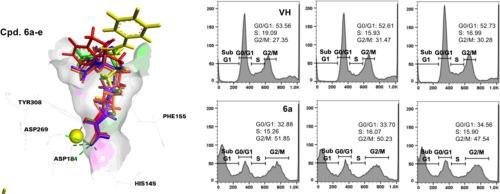
Histone deacetylases (HDACs) have emerged as compelling targets in developing anticancer therapeutics. This study outlines the development, synthesis, and biological evaluation of novel hydroxamic acid derivatives featuring a 2-oxoindoline scaffold, which exhibit high HDAC inhibitory activity and potential anticancer effects. Three series of N-hydroxycinnamamides, N-hydroxyheptanamides, and N-hydroxybenzamides were synthesized and assessed for their biological activity. The results of the biological activity evaluation indicated that the synthesized derivatives exhibited notable inhibitory effects against SW620 (colon cancer) and HCT116 (human colorectal carcinoma). Compound N-hydroxy-7-(2-oxoindolin-1-yl)heptanamide (6a) exhibited remarkable HDAC inhibitory activity, achieving sub-nanomolar potency with an IC50 value of less than 0.001 µM. While this potent HDAC inhibition suggests strong enzymatic activity, the anticancer activity of 6a against SW620 and HCT116 was comparable to that of SAHA (IC50 of 0.101 µM). Analysis of selected compound 6a also revealed that this compound effectively triggered both early and late stages of apoptosis and caused cell cycle arrest at the G2/M phase in SW620 cells. Finally, docking studies and molecular dynamics study conducted on the HDAC isoforms for series 6a-e identified key structural features that play a significant role in the inhibitory activity of the synthesized compounds.
期刊介绍:
Bioorganic & Medicinal Chemistry provides an international forum for the publication of full original research papers and critical reviews on molecular interactions in key biological targets such as receptors, channels, enzymes, nucleotides, lipids and saccharides.
The aim of the journal is to promote a better understanding at the molecular level of life processes, and living organisms, as well as the interaction of these with chemical agents. A special feature will be that colour illustrations will be reproduced at no charge to the author, provided that the Editor agrees that colour is essential to the information content of the illustration in question.



 京公网安备 11010802042870号
京ICP备2023020795号-1
京公网安备 11010802042870号
京ICP备2023020795号-1

 分享
分享
 求助内容:
求助内容: 应助结果提醒方式:
 扫码关注我们
