Harshita Sardana, B. V. N. Phani Kumar and S. Ramakrishnan
{"title":"Tracking solvent-induced conformational collapse of periodically grafted amphiphilic polymers using PFG NMR diffusometry†","authors":"Harshita Sardana, B. V. N. Phani Kumar and S. Ramakrishnan","doi":"10.1039/D5SM00031A","DOIUrl":null,"url":null,"abstract":"<p >Periodically grafted amphiphilic polymers (PGAPs) belong to an interesting class of amphiphilic polymers that carry long hydrophobic alkylene segments along the backbone and periodically located hydrophilic pendant segments, such as polyethylene glycol monomethyl ether (MPEG). In earlier studies, we showed that such PGAPs undergo zigzag folding to segregate the backbone alkylene segments and the pendant MPEG segments; consequently, they organize in the solid state to yield a lamellar morphology with precisely tunable domain sizes. In the present study, two new periodically clickable polyesters were prepared; one bearing dodecyl (C12) segments between adjacent clickable propargyl units and the other carrying longer eicosyl (C20) segments. These were clicked with MPEG-azides of different molecular weights, namely 550, 750 and 2000, to generate a series of PGAPs with varying hydrophilic–lyophilic balance (hlb) and, consequently, different folding propensities. The collapse of these PGAP chains in solution was examined by pulse field gradient nuclear magnetic resonance (PFG NMR) diffusometry studies, in chloroform–methanol mixtures of varying composition; the diffusion constants, estimated from these measurements, underwent a sudden increase at a specific methanol content, which signified the chain–collapse transition. As expected, the collapse occurred at a lower methanol content in the polymers bearing smaller MPEG pendant segments. Additionally, the variation of the relative intensities of the proton peaks belonging to the central hydrophobic segment, that upon collapse becomes more solid-like, also exhibited a sudden drop at roughly the same solvent composition, reconfirming that the collapse occurs to generate a structure with a dense core and solvated shell.</p>","PeriodicalId":103,"journal":{"name":"Soft Matter","volume":" 13","pages":" 2471-2479"},"PeriodicalIF":2.8000,"publicationDate":"2025-02-24","publicationTypes":"Journal Article","fieldsOfStudy":null,"isOpenAccess":false,"openAccessPdf":"","citationCount":"0","resultStr":null,"platform":"Semanticscholar","paperid":null,"PeriodicalName":"Soft Matter","FirstCategoryId":"92","ListUrlMain":"https://pubs.rsc.org/en/content/articlelanding/2025/sm/d5sm00031a","RegionNum":3,"RegionCategory":"化学","ArticlePicture":[],"TitleCN":null,"AbstractTextCN":null,"PMCID":null,"EPubDate":"","PubModel":"","JCR":"Q3","JCRName":"CHEMISTRY, PHYSICAL","Score":null,"Total":0}
引用次数: 0
Abstract
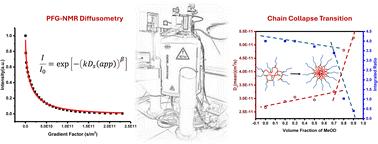
Periodically grafted amphiphilic polymers (PGAPs) belong to an interesting class of amphiphilic polymers that carry long hydrophobic alkylene segments along the backbone and periodically located hydrophilic pendant segments, such as polyethylene glycol monomethyl ether (MPEG). In earlier studies, we showed that such PGAPs undergo zigzag folding to segregate the backbone alkylene segments and the pendant MPEG segments; consequently, they organize in the solid state to yield a lamellar morphology with precisely tunable domain sizes. In the present study, two new periodically clickable polyesters were prepared; one bearing dodecyl (C12) segments between adjacent clickable propargyl units and the other carrying longer eicosyl (C20) segments. These were clicked with MPEG-azides of different molecular weights, namely 550, 750 and 2000, to generate a series of PGAPs with varying hydrophilic–lyophilic balance (hlb) and, consequently, different folding propensities. The collapse of these PGAP chains in solution was examined by pulse field gradient nuclear magnetic resonance (PFG NMR) diffusometry studies, in chloroform–methanol mixtures of varying composition; the diffusion constants, estimated from these measurements, underwent a sudden increase at a specific methanol content, which signified the chain–collapse transition. As expected, the collapse occurred at a lower methanol content in the polymers bearing smaller MPEG pendant segments. Additionally, the variation of the relative intensities of the proton peaks belonging to the central hydrophobic segment, that upon collapse becomes more solid-like, also exhibited a sudden drop at roughly the same solvent composition, reconfirming that the collapse occurs to generate a structure with a dense core and solvated shell.
期刊介绍:
Soft Matter is an international journal published by the Royal Society of Chemistry using Engineering-Materials Science: A Synthesis as its research focus. It publishes original research articles, review articles, and synthesis articles related to this field, reporting the latest discoveries in the relevant theoretical, practical, and applied disciplines in a timely manner, and aims to promote the rapid exchange of scientific information in this subject area. The journal is an open access journal. The journal is an open access journal and has not been placed on the alert list in the last three years.



 京公网安备 11010802042870号
京ICP备2023020795号-1
京公网安备 11010802042870号
京ICP备2023020795号-1

 分享
分享
 求助内容:
求助内容: 应助结果提醒方式:
 扫码关注我们
