{"title":"Concept and Development of Metal-Framework Nucleic Acids","authors":"Li Sun, Prof. Xiangyuan Ouyang","doi":"10.1002/cbic.202401067","DOIUrl":null,"url":null,"abstract":"<p>Based on the Watson-Crick base pairing principle, precisely programmable metal-framework nucleic acids (mFNA) have evolved from one-dimensional to three-dimensional nanoscale structures, a technological advancement attributed to progress in DNA nanotechnology. mFNA are a new type of nanomaterial formed by using framework nucleic acids (FNAs) as precise templates to guide the ordered assembly and self-assembly of metal ions, metal salts (such as calcium phosphate, calcium carbonate, etc.), metal nanoclusters, metal nanoparticles, or metal oxide nanoparticles. Compared to traditional FNAs, mFNA not only inherits the powerful programmed self-assembly capabilities of nucleic acids but also incorporates the unique physicochemical properties of inorganic metal nanomaterials. This intersection of organic and inorganic chemistry presents broad application prospects in fields such as biology, chemistry, materials science, and energy science. This review, based on the principles related to FNAs, introduces the concept of mFNA for the first time, aiming to explore the fundamental connections between nanoscale FNAs and metal materials. Additionally, the article focuses on the construction methods and functional characteristics of mFNA. Finally, the current challenges faced by mFNA are reviewed, and their future development is anticipated, providing detailed information for a comprehensive understanding of the research progress in mFNA.</p>","PeriodicalId":140,"journal":{"name":"ChemBioChem","volume":"26 8","pages":""},"PeriodicalIF":2.8000,"publicationDate":"2025-03-05","publicationTypes":"Journal Article","fieldsOfStudy":null,"isOpenAccess":false,"openAccessPdf":"","citationCount":"0","resultStr":null,"platform":"Semanticscholar","paperid":null,"PeriodicalName":"ChemBioChem","FirstCategoryId":"99","ListUrlMain":"https://chemistry-europe.onlinelibrary.wiley.com/doi/10.1002/cbic.202401067","RegionNum":4,"RegionCategory":"生物学","ArticlePicture":[],"TitleCN":null,"AbstractTextCN":null,"PMCID":null,"EPubDate":"","PubModel":"","JCR":"Q3","JCRName":"BIOCHEMISTRY & MOLECULAR BIOLOGY","Score":null,"Total":0}
引用次数: 0
Abstract
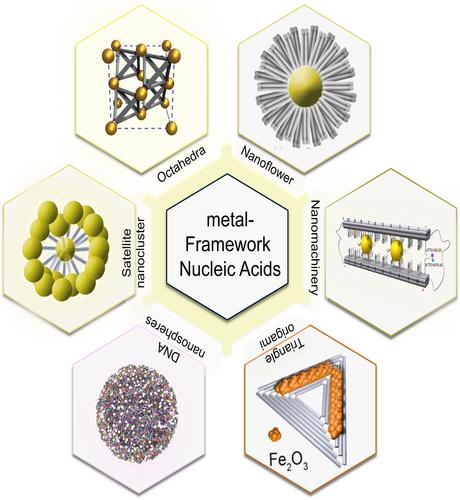
Based on the Watson-Crick base pairing principle, precisely programmable metal-framework nucleic acids (mFNA) have evolved from one-dimensional to three-dimensional nanoscale structures, a technological advancement attributed to progress in DNA nanotechnology. mFNA are a new type of nanomaterial formed by using framework nucleic acids (FNAs) as precise templates to guide the ordered assembly and self-assembly of metal ions, metal salts (such as calcium phosphate, calcium carbonate, etc.), metal nanoclusters, metal nanoparticles, or metal oxide nanoparticles. Compared to traditional FNAs, mFNA not only inherits the powerful programmed self-assembly capabilities of nucleic acids but also incorporates the unique physicochemical properties of inorganic metal nanomaterials. This intersection of organic and inorganic chemistry presents broad application prospects in fields such as biology, chemistry, materials science, and energy science. This review, based on the principles related to FNAs, introduces the concept of mFNA for the first time, aiming to explore the fundamental connections between nanoscale FNAs and metal materials. Additionally, the article focuses on the construction methods and functional characteristics of mFNA. Finally, the current challenges faced by mFNA are reviewed, and their future development is anticipated, providing detailed information for a comprehensive understanding of the research progress in mFNA.
期刊介绍:
ChemBioChem (Impact Factor 2018: 2.641) publishes important breakthroughs across all areas at the interface of chemistry and biology, including the fields of chemical biology, bioorganic chemistry, bioinorganic chemistry, synthetic biology, biocatalysis, bionanotechnology, and biomaterials. It is published on behalf of Chemistry Europe, an association of 16 European chemical societies, and supported by the Asian Chemical Editorial Society (ACES).





 京公网安备 11010802042870号
京ICP备2023020795号-1
京公网安备 11010802042870号
京ICP备2023020795号-1

 分享
分享
 求助内容:
求助内容: 应助结果提醒方式:
 扫码关注我们
