{"title":"Droplet microfluidic method for measurement of ultralow interfacial tension in ternary fluid systems†","authors":"Thai Dinh, Robert Casal and Thomas Cubaud","doi":"10.1039/D4LC01047G","DOIUrl":null,"url":null,"abstract":"<p >We experimentally investigate droplet pattern formation in coaxial microchannels using ternary mixtures of two immiscible fluids and a miscible solvent. The influence of solvent concentration is examined through periodic pattern analysis of droplet flow and functional relationships are developed to determine the initial interfacial tension of dispersions made of aqueous mixtures of solvent and oil at short timescales, <em>i.e.</em>, when solvent diffusion into the continuous phase has a negligible effect on flow morphologies. We examine a wide range of flow rates and delineate vast flow maps of droplet regimes, including dripping and jetting flows, to clarify the hydrodynamic behavior of conjugate fluid mixtures in square microcapillaries. A method based on analysis of droplet size and spacing is implemented to predict the role of the miscible fluid additive concentration in microfluidic multiphase flows of water–isopropanol and ethanol–isopropanol blends in viscous silicone oil. This approach enables measurement of extremely small values of interfacial tension at large solvent concentrations. This work shows a technique for exploring and characterizing numerous ternary flow systems of interest with a variety of organic solvents and oils.</p>","PeriodicalId":85,"journal":{"name":"Lab on a Chip","volume":" 7","pages":" 1823-1830"},"PeriodicalIF":5.4000,"publicationDate":"2025-02-26","publicationTypes":"Journal Article","fieldsOfStudy":null,"isOpenAccess":false,"openAccessPdf":"","citationCount":"0","resultStr":null,"platform":"Semanticscholar","paperid":null,"PeriodicalName":"Lab on a Chip","FirstCategoryId":"5","ListUrlMain":"https://pubs.rsc.org/en/content/articlelanding/2025/lc/d4lc01047g","RegionNum":2,"RegionCategory":"工程技术","ArticlePicture":[],"TitleCN":null,"AbstractTextCN":null,"PMCID":null,"EPubDate":"","PubModel":"","JCR":"Q1","JCRName":"BIOCHEMICAL RESEARCH METHODS","Score":null,"Total":0}
引用次数: 0
Abstract
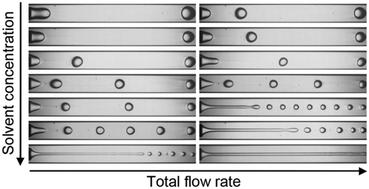
We experimentally investigate droplet pattern formation in coaxial microchannels using ternary mixtures of two immiscible fluids and a miscible solvent. The influence of solvent concentration is examined through periodic pattern analysis of droplet flow and functional relationships are developed to determine the initial interfacial tension of dispersions made of aqueous mixtures of solvent and oil at short timescales, i.e., when solvent diffusion into the continuous phase has a negligible effect on flow morphologies. We examine a wide range of flow rates and delineate vast flow maps of droplet regimes, including dripping and jetting flows, to clarify the hydrodynamic behavior of conjugate fluid mixtures in square microcapillaries. A method based on analysis of droplet size and spacing is implemented to predict the role of the miscible fluid additive concentration in microfluidic multiphase flows of water–isopropanol and ethanol–isopropanol blends in viscous silicone oil. This approach enables measurement of extremely small values of interfacial tension at large solvent concentrations. This work shows a technique for exploring and characterizing numerous ternary flow systems of interest with a variety of organic solvents and oils.
期刊介绍:
Lab on a Chip is the premiere journal that publishes cutting-edge research in the field of miniaturization. By their very nature, microfluidic/nanofluidic/miniaturized systems are at the intersection of disciplines, spanning fundamental research to high-end application, which is reflected by the broad readership of the journal. Lab on a Chip publishes two types of papers on original research: full-length research papers and communications. Papers should demonstrate innovations, which can come from technical advancements or applications addressing pressing needs in globally important areas. The journal also publishes Comments, Reviews, and Perspectives.



 京公网安备 11010802042870号
京ICP备2023020795号-1
京公网安备 11010802042870号
京ICP备2023020795号-1

 分享
分享
 求助内容:
求助内容: 应助结果提醒方式:
 扫码关注我们
