Jun Chen, Chen Tian, Xiao Xiong, Ying Yang, Jing Zhang
{"title":"Extracellular vesicles: new horizons in neurodegeneration.","authors":"Jun Chen, Chen Tian, Xiao Xiong, Ying Yang, Jing Zhang","doi":"10.1016/j.ebiom.2025.105605","DOIUrl":null,"url":null,"abstract":"<p><p>Extracellular vesicles (EVs) are lipid-enclosed nanovesicles secreted by diverse cell types that orchestrate intercellular communication through cargo delivery. Their pivotal roles span from supporting the development of normal central nervous system (CNS) to contributing to the pathogenesis of neurological diseases. Particularly noteworthy is their involvement in the propagation of pathogenic proteins, such as those involved in neurodegenerative disorders, and nucleic acids, closely linking them to disease onset and progression. Moreover, EVs have emerged as promising diagnostic biomarkers for neurological disorders and as tools for disease staging, owing to their ability to traverse the blood-brain barrier and their specific, stable, and accessible properties. This review comprehensively explores the realm of CNS-derived EVs found in peripheral blood, encompassing their detection methods, transport mechanisms, and diverse roles in various neurodegenerative diseases. Furthermore, we evaluate the potentials and limitations of EVs in clinical applications and highlight prospective research directions in this rapidly evolving field.</p>","PeriodicalId":11494,"journal":{"name":"EBioMedicine","volume":"113 ","pages":"105605"},"PeriodicalIF":10.8000,"publicationDate":"2025-03-01","publicationTypes":"Journal Article","fieldsOfStudy":null,"isOpenAccess":false,"openAccessPdf":"https://www.ncbi.nlm.nih.gov/pmc/articles/PMC11925178/pdf/","citationCount":"0","resultStr":null,"platform":"Semanticscholar","paperid":null,"PeriodicalName":"EBioMedicine","FirstCategoryId":"3","ListUrlMain":"https://doi.org/10.1016/j.ebiom.2025.105605","RegionNum":1,"RegionCategory":"医学","ArticlePicture":[],"TitleCN":null,"AbstractTextCN":null,"PMCID":null,"EPubDate":"2025/3/3 0:00:00","PubModel":"Epub","JCR":"Q1","JCRName":"MEDICINE, RESEARCH & EXPERIMENTAL","Score":null,"Total":0}
引用次数: 0
Abstract
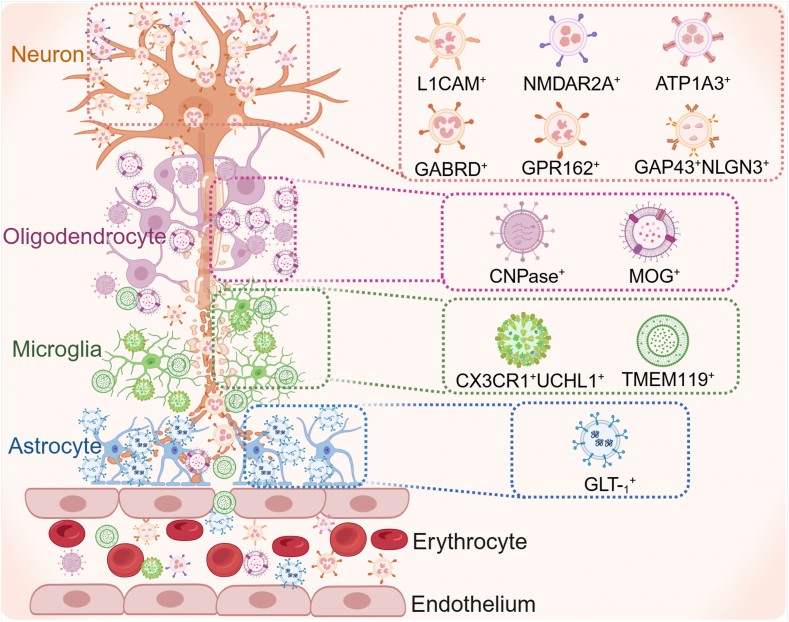
Extracellular vesicles (EVs) are lipid-enclosed nanovesicles secreted by diverse cell types that orchestrate intercellular communication through cargo delivery. Their pivotal roles span from supporting the development of normal central nervous system (CNS) to contributing to the pathogenesis of neurological diseases. Particularly noteworthy is their involvement in the propagation of pathogenic proteins, such as those involved in neurodegenerative disorders, and nucleic acids, closely linking them to disease onset and progression. Moreover, EVs have emerged as promising diagnostic biomarkers for neurological disorders and as tools for disease staging, owing to their ability to traverse the blood-brain barrier and their specific, stable, and accessible properties. This review comprehensively explores the realm of CNS-derived EVs found in peripheral blood, encompassing their detection methods, transport mechanisms, and diverse roles in various neurodegenerative diseases. Furthermore, we evaluate the potentials and limitations of EVs in clinical applications and highlight prospective research directions in this rapidly evolving field.
EBioMedicineBiochemistry, Genetics and Molecular Biology-General Biochemistry,Genetics and Molecular Biology
CiteScore
17.70
自引率
0.90%
发文量
579
审稿时长
5 weeks
期刊介绍:
eBioMedicine is a comprehensive biomedical research journal that covers a wide range of studies that are relevant to human health. Our focus is on original research that explores the fundamental factors influencing human health and disease, including the discovery of new therapeutic targets and treatments, the identification of biomarkers and diagnostic tools, and the investigation and modification of disease pathways and mechanisms. We welcome studies from any biomedical discipline that contribute to our understanding of disease and aim to improve human health.





 京公网安备 11010802042870号
京ICP备2023020795号-1
京公网安备 11010802042870号
京ICP备2023020795号-1

 分享
分享
 求助内容:
求助内容: 应助结果提醒方式:
 扫码关注我们
