Giang Trung Pham MD, BMSc, Rohan Miegel BPhysio, David Ian Watson MBBS, PhD, FRACS, Tim Bright MBBS, MS, FRACS
{"title":"Challenges of a prehabilitation program for oesophageal cancer patients in the Australian setting","authors":"Giang Trung Pham MD, BMSc, Rohan Miegel BPhysio, David Ian Watson MBBS, PhD, FRACS, Tim Bright MBBS, MS, FRACS","doi":"10.1111/ans.70056","DOIUrl":null,"url":null,"abstract":"<p>Patients with oesophageal cancer (OC) considered for surgery typically undergo neoadjuvant therapy (NAT) before oesophagectomy.<span><sup>1</sup></span> While NAT improves cancer survival compared to surgery alone, these regimens can negatively impact patient fitness and subsequent surgical outcomes.<span><sup>2, 3</sup></span> Prehabilitation is a preoperative process that aims to improve the functional capacity of patients with exercise, nutrition and psychological interventions, helping patients endure surgical stress and improve postoperative outcomes.<span><sup>4</sup></span> Studies internationally of prehabilitation in oesophageal cancer patients have yielded positive results.<span><sup>5-9</sup></span> This has encouraged the implementation of prehabilitation programs in Australian hospitals,<span><sup>10</sup></span> including on our unit.</p><p>This article discusses the challenges that may impact the implementation of a prehabilitation program for OC patients in Australia. The data provided below was obtained from a feasibility study conducted at Flinders Medical Centre, South Australia, to measure the impact of prehabilitation on the recovery of patients undergoing oesophagectomy. The study was approved by the Southern Adelaide Clinical Human Research Ethics Committee.</p><p>Oesophageal cancer incidence increases with age.<span><sup>11</sup></span> In our study, 75% of our participants were over the age of 65, and 67% had 2 or more comorbidities. A prehabilitation program was offered once cancer staging was complete and a surgical treatment path was confirmed. To evaluate if our prehabilitation program was able to help patients maintain their physical function and quality of life through NAT, we used patients' weights, the 30-second sit-to-stand test (30STS) and the European Organization for Research and Treatment of Cancer Quality of Life Questionnaire-C30 (EORTC-QLQ-C30). In 12 patients, measurements were obtained at the commencement (baseline), the completion of NAT, and immediately before surgery. We used the Wilcoxon Signed-Rank Test to compare the differences between outcomes at different time points.</p><p>We found that patients participating in prehabilitation maintained their global score through NAT. They had a significant decline in physical functioning (PF), role functioning (RF) and social functioning (SF) scores and substantially higher scores for appetite loss (AP), nausea and vomiting (NV) when measured immediately after completion of NAT (Table 1), consistent with other studies.<span><sup>12-14</sup></span> By the time of surgery, these had resolved with ongoing prehabilitation, and patients reported significant improvements in global score, emotional functioning (EF) and reduced pain compared to their baseline (Table 1). Assessment of physical function confirmed no significant changes in 30STS results through NAT, despite a decrease in the participants' weight after NAT (Fig. 1).</p><p>Twenty-eight percent of Australia's population live in regional and rural areas,<span><sup>15</sup></span> a much higher proportion than those of the United States (20%)<span><sup>16</sup></span> and the United Kingdom (17%),<span><sup>17</sup></span> where prehabilitation programs were first described. In our study, 25% of participants lived more than 60 km away, and the average travel time for participants was 72 min.</p><p>Patients in our study were referred by an Upper GI Cancer Nurse to the hospital dietetics and physiotherapy departments. Patients were contacted and encouraged to attend an initial face-to-face session with their physiotherapist. Where this was not agreeable, a phone or telehealth initial session was conducted. At this session, education and advice were given as well as a home-based exercise program (HEP). Patients were then either booked for biweekly supervised gym sessions, biweekly telehealth supervised sessions or follow-up phone calls every 1 to 2 weeks.</p><p>Despite efforts to encourage participants to join face-to-face sessions, nearly 80% had more sessions via phone than in person. In addition, since most of our participants were older adults and not comfortable with technology, telehealth was not as effective as we expected. This lack of in-person or visual contact impacted tracking patient adherence to both dietetic and exercise prescriptions. Hence, in the Australian context with nearly one-third of the population living in regional areas and facing long travel distances to tertiary medical centres, avoiding variance between the care offered to regional and city patients by providing a prehabilitation program that all patients can adhere to closely is a significant challenge.</p><p>Oesophageal cancer is a relatively low-volume disease which poses a challenge in justifying and sustaining the costs associated with implementing a comprehensive prehabilitation program. While improved outcomes and reduced length of stay can offset this cost, partnering with other tumour streams may make implementation easier to justify.</p><p>Patients going through neoadjuvant therapy can feel overwhelmed with the number of extra appointments they have for their prehabilitation program and the physical requirements set out for them. Longer travel times to attend sessions can compound this. Supervised telehealth sessions can help minimize the logistical barriers and improve accessibility to health professionals when connecting patients to local services. Although there can be technology barriers for older patients, these barriers may be overcome by providing patients with face-to-face education before the commencement of their telehealth sessions.</p><p>Peer support groups can also improve adherence. They create an environment where patients can share their experiences and encourage each other to adhere to the program.<span><sup>18, 19</sup></span> Additionally, as NAT affects patients' social, role and physical functioning, a trimodal program that includes psychological support, nutrition and exercise can help address multiple aspects of patients' well-being and improve their adherence. Finally, patient education from clinicians on the importance and expected benefits of prehabilitation drives participation rate, and focusing on allied health staffing, resources and skills is crucial for implementing these solutions and improving prehabilitation outcomes.</p><p><b>Giang Trung Pham:</b> Conceptualization; data curation; formal analysis; investigation; project administration; resources; software; writing – original draft; writing – review and editing. <b>Rohan Miegel:</b> Conceptualization; data curation; investigation; methodology; project administration; resources; supervision; writing – review and editing. <b>David Ian Watson:</b> Writing – review and editing. <b>Tim Bright:</b> Conceptualization; investigation; methodology; resources; supervision; writing – review and editing.</p>","PeriodicalId":8158,"journal":{"name":"ANZ Journal of Surgery","volume":"95 5","pages":"852-854"},"PeriodicalIF":1.6000,"publicationDate":"2025-03-05","publicationTypes":"Journal Article","fieldsOfStudy":null,"isOpenAccess":false,"openAccessPdf":"https://onlinelibrary.wiley.com/doi/epdf/10.1111/ans.70056","citationCount":"0","resultStr":null,"platform":"Semanticscholar","paperid":null,"PeriodicalName":"ANZ Journal of Surgery","FirstCategoryId":"3","ListUrlMain":"https://onlinelibrary.wiley.com/doi/10.1111/ans.70056","RegionNum":4,"RegionCategory":"医学","ArticlePicture":[],"TitleCN":null,"AbstractTextCN":null,"PMCID":null,"EPubDate":"","PubModel":"","JCR":"Q3","JCRName":"SURGERY","Score":null,"Total":0}
引用次数: 0
Abstract
Patients with oesophageal cancer (OC) considered for surgery typically undergo neoadjuvant therapy (NAT) before oesophagectomy.1 While NAT improves cancer survival compared to surgery alone, these regimens can negatively impact patient fitness and subsequent surgical outcomes.2, 3 Prehabilitation is a preoperative process that aims to improve the functional capacity of patients with exercise, nutrition and psychological interventions, helping patients endure surgical stress and improve postoperative outcomes.4 Studies internationally of prehabilitation in oesophageal cancer patients have yielded positive results.5-9 This has encouraged the implementation of prehabilitation programs in Australian hospitals,10 including on our unit.
This article discusses the challenges that may impact the implementation of a prehabilitation program for OC patients in Australia. The data provided below was obtained from a feasibility study conducted at Flinders Medical Centre, South Australia, to measure the impact of prehabilitation on the recovery of patients undergoing oesophagectomy. The study was approved by the Southern Adelaide Clinical Human Research Ethics Committee.
Oesophageal cancer incidence increases with age.11 In our study, 75% of our participants were over the age of 65, and 67% had 2 or more comorbidities. A prehabilitation program was offered once cancer staging was complete and a surgical treatment path was confirmed. To evaluate if our prehabilitation program was able to help patients maintain their physical function and quality of life through NAT, we used patients' weights, the 30-second sit-to-stand test (30STS) and the European Organization for Research and Treatment of Cancer Quality of Life Questionnaire-C30 (EORTC-QLQ-C30). In 12 patients, measurements were obtained at the commencement (baseline), the completion of NAT, and immediately before surgery. We used the Wilcoxon Signed-Rank Test to compare the differences between outcomes at different time points.
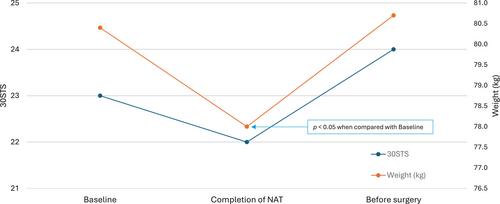
We found that patients participating in prehabilitation maintained their global score through NAT. They had a significant decline in physical functioning (PF), role functioning (RF) and social functioning (SF) scores and substantially higher scores for appetite loss (AP), nausea and vomiting (NV) when measured immediately after completion of NAT (Table 1), consistent with other studies.12-14 By the time of surgery, these had resolved with ongoing prehabilitation, and patients reported significant improvements in global score, emotional functioning (EF) and reduced pain compared to their baseline (Table 1). Assessment of physical function confirmed no significant changes in 30STS results through NAT, despite a decrease in the participants' weight after NAT (Fig. 1).
Twenty-eight percent of Australia's population live in regional and rural areas,15 a much higher proportion than those of the United States (20%)16 and the United Kingdom (17%),17 where prehabilitation programs were first described. In our study, 25% of participants lived more than 60 km away, and the average travel time for participants was 72 min.
Patients in our study were referred by an Upper GI Cancer Nurse to the hospital dietetics and physiotherapy departments. Patients were contacted and encouraged to attend an initial face-to-face session with their physiotherapist. Where this was not agreeable, a phone or telehealth initial session was conducted. At this session, education and advice were given as well as a home-based exercise program (HEP). Patients were then either booked for biweekly supervised gym sessions, biweekly telehealth supervised sessions or follow-up phone calls every 1 to 2 weeks.
Despite efforts to encourage participants to join face-to-face sessions, nearly 80% had more sessions via phone than in person. In addition, since most of our participants were older adults and not comfortable with technology, telehealth was not as effective as we expected. This lack of in-person or visual contact impacted tracking patient adherence to both dietetic and exercise prescriptions. Hence, in the Australian context with nearly one-third of the population living in regional areas and facing long travel distances to tertiary medical centres, avoiding variance between the care offered to regional and city patients by providing a prehabilitation program that all patients can adhere to closely is a significant challenge.
Oesophageal cancer is a relatively low-volume disease which poses a challenge in justifying and sustaining the costs associated with implementing a comprehensive prehabilitation program. While improved outcomes and reduced length of stay can offset this cost, partnering with other tumour streams may make implementation easier to justify.
Patients going through neoadjuvant therapy can feel overwhelmed with the number of extra appointments they have for their prehabilitation program and the physical requirements set out for them. Longer travel times to attend sessions can compound this. Supervised telehealth sessions can help minimize the logistical barriers and improve accessibility to health professionals when connecting patients to local services. Although there can be technology barriers for older patients, these barriers may be overcome by providing patients with face-to-face education before the commencement of their telehealth sessions.
Peer support groups can also improve adherence. They create an environment where patients can share their experiences and encourage each other to adhere to the program.18, 19 Additionally, as NAT affects patients' social, role and physical functioning, a trimodal program that includes psychological support, nutrition and exercise can help address multiple aspects of patients' well-being and improve their adherence. Finally, patient education from clinicians on the importance and expected benefits of prehabilitation drives participation rate, and focusing on allied health staffing, resources and skills is crucial for implementing these solutions and improving prehabilitation outcomes.
Giang Trung Pham: Conceptualization; data curation; formal analysis; investigation; project administration; resources; software; writing – original draft; writing – review and editing. Rohan Miegel: Conceptualization; data curation; investigation; methodology; project administration; resources; supervision; writing – review and editing. David Ian Watson: Writing – review and editing. Tim Bright: Conceptualization; investigation; methodology; resources; supervision; writing – review and editing.
期刊介绍:
ANZ Journal of Surgery is published by Wiley on behalf of the Royal Australasian College of Surgeons to provide a medium for the publication of peer-reviewed original contributions related to clinical practice and/or research in all fields of surgery and related disciplines. It also provides a programme of continuing education for surgeons. All articles are peer-reviewed by at least two researchers expert in the field of the submitted paper.



 京公网安备 11010802042870号
京ICP备2023020795号-1
京公网安备 11010802042870号
京ICP备2023020795号-1

 分享
分享
 求助内容:
求助内容: 应助结果提醒方式:
 扫码关注我们
