Wenshuang Tang, Chao Zhang, Yapeng Qi, Qichen Zhou, Huazhi Li, Xiao-Han Shen, Lan Liu, Weikan Wang, Jian-Ren Liu, Xiaoxia Du
{"title":"Cerebellar microstructural abnormalities in patients with somatic symptom disorders.","authors":"Wenshuang Tang, Chao Zhang, Yapeng Qi, Qichen Zhou, Huazhi Li, Xiao-Han Shen, Lan Liu, Weikan Wang, Jian-Ren Liu, Xiaoxia Du","doi":"10.1186/s12888-025-06642-5","DOIUrl":null,"url":null,"abstract":"<p><strong>Background: </strong>Somatic Symptom Disorder (SSD) is a condition often linked to excessive health anxiety and somatic symptoms. In recent years, studies have found associations between the cerebellum and various mental illnesses, including SSD. However, the microstructure of cerebellar subregions in SSD using diffusion magnetic resonance imaging has not been fully defined.</p><p><strong>Methods: </strong>This is a cross-sectional study, that included 30 SSD patients and 30 age- and gender-matched healthy controls to investigate the microstructure of the cerebellum using diffusion magnetic resonance imaging. SSD diagnosis followed DSM-5 criteria, excluding major psychiatric comorbidities, while healthy controls underwent rigorous screening to exclude psychiatric or neurological histories. Clinical evaluations utilized standardized scales to assess depressive, anxiety, and cognitive symptoms. MRI data were acquired using a 3T Siemens Prisma scanner, including T1-weighted and diffusion-weighted imaging (30 directions, b = 1000/2000 s/mm²). Multi-compartment diffusion magnetic resonance imaging metrics from free water elimination diffusion tensor imaging and neurite orientation dispersion and density imaging were used to observe microstructural changes in the cerebellum's white matter and gray matter subregions in SSD patients.</p><p><strong>Results: </strong>Compared to the control group, patients with SSD exhibited significant alterations in white matter microstructure. These changes were characterized by increased free water-eliminated fractional anisotropy and neurite density index, as well as decreased free water-eliminated mean diffusivity and radial diffusivity. Furthermore, the cerebellum displayed varying microstructural changes across 26 gray matter subregions. These changes included reduced mean diffusivity, free water-eliminated axial diffusivity, and free water-eliminated radial diffusivity, alongside increased neurite density index and orientation dispersion index. Importantly, the study identified significant correlations between these microstructural changes and clinical symptoms. Specifically, Vermis X and the left lobule VIIb showed significant associations with both depression and anxiety scores.</p><p><strong>Conclusions: </strong>The findings suggest greater neurite density and enhanced diffusion restriction in the cerebellum of patients with SSD, which may indicate possible adaptive changes associated with chronic stress.</p>","PeriodicalId":9029,"journal":{"name":"BMC Psychiatry","volume":"25 1","pages":"199"},"PeriodicalIF":3.4000,"publicationDate":"2025-03-04","publicationTypes":"Journal Article","fieldsOfStudy":null,"isOpenAccess":false,"openAccessPdf":"https://www.ncbi.nlm.nih.gov/pmc/articles/PMC11881297/pdf/","citationCount":"0","resultStr":null,"platform":"Semanticscholar","paperid":null,"PeriodicalName":"BMC Psychiatry","FirstCategoryId":"3","ListUrlMain":"https://doi.org/10.1186/s12888-025-06642-5","RegionNum":2,"RegionCategory":"医学","ArticlePicture":[],"TitleCN":null,"AbstractTextCN":null,"PMCID":null,"EPubDate":"","PubModel":"","JCR":"Q2","JCRName":"PSYCHIATRY","Score":null,"Total":0}
引用次数: 0
Abstract
Background: Somatic Symptom Disorder (SSD) is a condition often linked to excessive health anxiety and somatic symptoms. In recent years, studies have found associations between the cerebellum and various mental illnesses, including SSD. However, the microstructure of cerebellar subregions in SSD using diffusion magnetic resonance imaging has not been fully defined.
Methods: This is a cross-sectional study, that included 30 SSD patients and 30 age- and gender-matched healthy controls to investigate the microstructure of the cerebellum using diffusion magnetic resonance imaging. SSD diagnosis followed DSM-5 criteria, excluding major psychiatric comorbidities, while healthy controls underwent rigorous screening to exclude psychiatric or neurological histories. Clinical evaluations utilized standardized scales to assess depressive, anxiety, and cognitive symptoms. MRI data were acquired using a 3T Siemens Prisma scanner, including T1-weighted and diffusion-weighted imaging (30 directions, b = 1000/2000 s/mm²). Multi-compartment diffusion magnetic resonance imaging metrics from free water elimination diffusion tensor imaging and neurite orientation dispersion and density imaging were used to observe microstructural changes in the cerebellum's white matter and gray matter subregions in SSD patients.
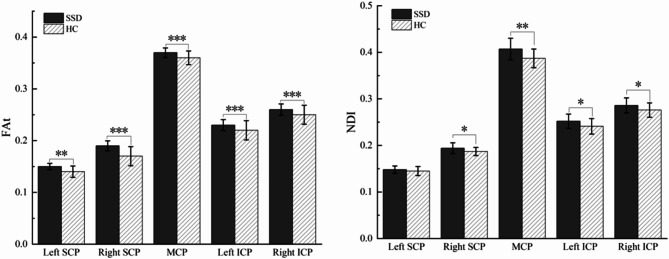
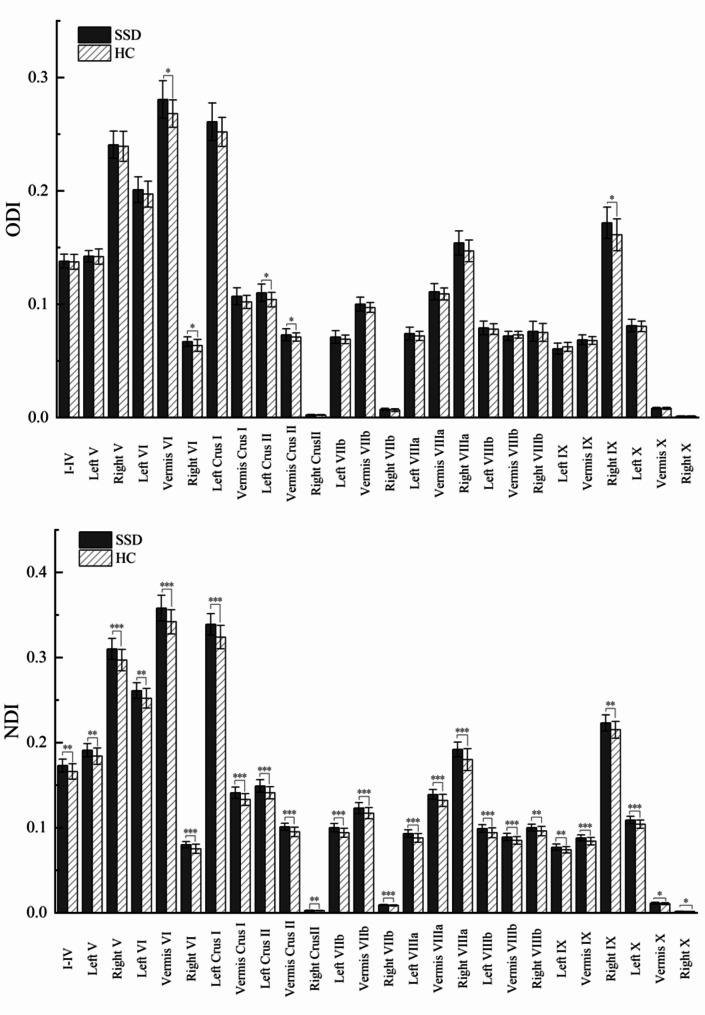
Results: Compared to the control group, patients with SSD exhibited significant alterations in white matter microstructure. These changes were characterized by increased free water-eliminated fractional anisotropy and neurite density index, as well as decreased free water-eliminated mean diffusivity and radial diffusivity. Furthermore, the cerebellum displayed varying microstructural changes across 26 gray matter subregions. These changes included reduced mean diffusivity, free water-eliminated axial diffusivity, and free water-eliminated radial diffusivity, alongside increased neurite density index and orientation dispersion index. Importantly, the study identified significant correlations between these microstructural changes and clinical symptoms. Specifically, Vermis X and the left lobule VIIb showed significant associations with both depression and anxiety scores.
Conclusions: The findings suggest greater neurite density and enhanced diffusion restriction in the cerebellum of patients with SSD, which may indicate possible adaptive changes associated with chronic stress.
期刊介绍:
BMC Psychiatry is an open access, peer-reviewed journal that considers articles on all aspects of the prevention, diagnosis and management of psychiatric disorders, as well as related molecular genetics, pathophysiology, and epidemiology.




 京公网安备 11010802042870号
京ICP备2023020795号-1
京公网安备 11010802042870号
京ICP备2023020795号-1

 分享
分享
 求助内容:
求助内容: 应助结果提醒方式:
 扫码关注我们
