Calvin Chiu, Aminat Tijani, Madeline Griffith, Emily Himes, Sneha Challa, Chioma Okoli, Shakede Dimowo, Ayobambo Jegede, Jenny X Liu
{"title":"How do pro-social tendencies and provider biases affect service delivery? Evidence from the rollout of self-injection of DMPA-SC in Nigeria.","authors":"Calvin Chiu, Aminat Tijani, Madeline Griffith, Emily Himes, Sneha Challa, Chioma Okoli, Shakede Dimowo, Ayobambo Jegede, Jenny X Liu","doi":"10.1186/s12905-025-03613-6","DOIUrl":null,"url":null,"abstract":"<p><strong>Background: </strong>Inconsistent provision of subcutaneous depot medroxyprogesterone acetate (DMPA-SC) for self-injection (SI) undermines efforts to improve women's reproductive health agency and access to self-care. In Nigeria, providers feel pro-social responsibility as frontline health workers to support their clients' wellbeing. However, their pronatalist beliefs censure premarital sexual activity and inhibit access to contraceptives for young, unmarried women. How pro-social tendencies and provider biases interact to affect service delivery is a critical but underexplored question.</p><p><strong>Methods: </strong>We conducted a mixed-methods study comparing stated pro-social tendencies and intentions to dispense DMPA-SC for SI (N = 81 in-depth interviews (IDIs)) with actual dispensing behavior during mystery client (MC) visits (N = 162 post-interaction surveys) across private and public facilities in Lagos, Enugu and Plateau. Qualitative analysis of providers' pro-social tendencies, biases, and reasons for not offering DMPA-SC for SI complemented quantitative analysis exploring the associations between pro-social tendencies and dispensing behavior.</p><p><strong>Results: </strong>Providers showed substantial levels of both pro-social tendencies and bias against young, unmarried women. High levels of stated intentions to dispense in IDIs (91% to older, married women vs 78% to young, unmarried women) did not translate to actual willingness to dispense in MC visits (30% to older, married women vs 27% to young, unmarried women). Young, unmarried actors were twice as likely to perceive differential treatment from providers (33%) relative to older, married women actors (17%). From IDIs, providers expressed biases about the appropriateness of family planning and SI specifically based on a client's age, marital status, parity, and covert use. In some cases, pro-social tendencies reinforced bias when providers sought to uphold social norms as a gatekeeper; in other cases, pro-social tendencies on self-defined client needs helped overcome bias. Providers described other factors that deterred them from dispensing DMPA-SC for SI, including elements of self-care that posed risks to their practice or business.</p><p><strong>Conclusions: </strong>Provider biases may limit provision of DMPA-SC for SI, which could affect contraceptive equity and women's control over their own fertility, especially for younger, unmarried women. Targeted interventions that effectively address provider biases against young, unmarried women, potentially leveraging providers' underlying pro-social tendencies, may help ensure equity in client access to contraceptive self-care.</p>","PeriodicalId":9204,"journal":{"name":"BMC Women's Health","volume":"25 Suppl 1","pages":"97"},"PeriodicalIF":2.7000,"publicationDate":"2025-03-04","publicationTypes":"Journal Article","fieldsOfStudy":null,"isOpenAccess":false,"openAccessPdf":"https://www.ncbi.nlm.nih.gov/pmc/articles/PMC11877756/pdf/","citationCount":"0","resultStr":null,"platform":"Semanticscholar","paperid":null,"PeriodicalName":"BMC Women's Health","FirstCategoryId":"3","ListUrlMain":"https://doi.org/10.1186/s12905-025-03613-6","RegionNum":3,"RegionCategory":"医学","ArticlePicture":[],"TitleCN":null,"AbstractTextCN":null,"PMCID":null,"EPubDate":"","PubModel":"","JCR":"Q2","JCRName":"OBSTETRICS & GYNECOLOGY","Score":null,"Total":0}
引用次数: 0
Abstract
Background: Inconsistent provision of subcutaneous depot medroxyprogesterone acetate (DMPA-SC) for self-injection (SI) undermines efforts to improve women's reproductive health agency and access to self-care. In Nigeria, providers feel pro-social responsibility as frontline health workers to support their clients' wellbeing. However, their pronatalist beliefs censure premarital sexual activity and inhibit access to contraceptives for young, unmarried women. How pro-social tendencies and provider biases interact to affect service delivery is a critical but underexplored question.
Methods: We conducted a mixed-methods study comparing stated pro-social tendencies and intentions to dispense DMPA-SC for SI (N = 81 in-depth interviews (IDIs)) with actual dispensing behavior during mystery client (MC) visits (N = 162 post-interaction surveys) across private and public facilities in Lagos, Enugu and Plateau. Qualitative analysis of providers' pro-social tendencies, biases, and reasons for not offering DMPA-SC for SI complemented quantitative analysis exploring the associations between pro-social tendencies and dispensing behavior.
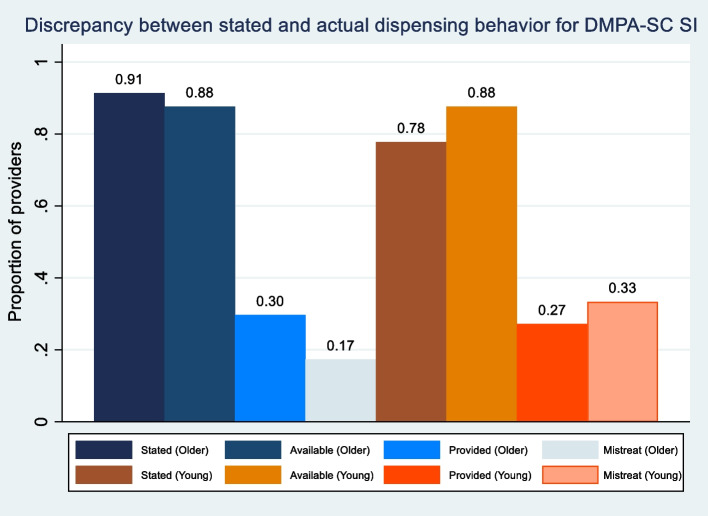
Results: Providers showed substantial levels of both pro-social tendencies and bias against young, unmarried women. High levels of stated intentions to dispense in IDIs (91% to older, married women vs 78% to young, unmarried women) did not translate to actual willingness to dispense in MC visits (30% to older, married women vs 27% to young, unmarried women). Young, unmarried actors were twice as likely to perceive differential treatment from providers (33%) relative to older, married women actors (17%). From IDIs, providers expressed biases about the appropriateness of family planning and SI specifically based on a client's age, marital status, parity, and covert use. In some cases, pro-social tendencies reinforced bias when providers sought to uphold social norms as a gatekeeper; in other cases, pro-social tendencies on self-defined client needs helped overcome bias. Providers described other factors that deterred them from dispensing DMPA-SC for SI, including elements of self-care that posed risks to their practice or business.
Conclusions: Provider biases may limit provision of DMPA-SC for SI, which could affect contraceptive equity and women's control over their own fertility, especially for younger, unmarried women. Targeted interventions that effectively address provider biases against young, unmarried women, potentially leveraging providers' underlying pro-social tendencies, may help ensure equity in client access to contraceptive self-care.
期刊介绍:
BMC Women''s Health is an open access, peer-reviewed journal that considers articles on all aspects of the health and wellbeing of adolescent girls and women, with a particular focus on the physical, mental, and emotional health of women in developed and developing nations. The journal welcomes submissions on women''s public health issues, health behaviours, breast cancer, gynecological diseases, mental health and health promotion.



 京公网安备 11010802042870号
京ICP备2023020795号-1
京公网安备 11010802042870号
京ICP备2023020795号-1

 分享
分享
 求助内容:
求助内容: 应助结果提醒方式:
 扫码关注我们
