{"title":"How does pole length affect lower back muscle activity at different inclines and skiing intensities during double poling?","authors":"Marie Lund Ohlsson, Marcus Nilsson, Mikael Swarén","doi":"10.3389/fspor.2025.1438386","DOIUrl":null,"url":null,"abstract":"<p><strong>Purpose: </strong>This study aimed to investigate how pole length, incline, and skiing intensity affect lower back muscle activation in elite cross-country skiers. This addressing a critical gap in understanding the biomechanical demands and risk of low back pain of double poling (DP).</p><p><strong>Method: </strong>Eleven elite cross-country skiers performed skiing trials on a treadmill, varying in incline (flat vs. 6°), intensity (two self-selected speeds, training speed and racing speed), and pole lengths. Muscle activity was measured by surface electromyography on the erector spinae thoracic and lumbar muscles, on the left and right side. A motion capture system was used for kinematic analysis of the lower back-pole moment arm and the hip angle during the DP cycle.</p><p><strong>Results: </strong>Compared to men, female skiers had a significantly higher (<i>p</i> < 0.001), overall muscle activation for the m. erector spinae lumbar on both the left and right side (26% of MVC vs. 15% of MVC, and 28% of MVC vs. 22% of MVC, for the left and right side, respectively). No correlations were found, neither between muscle activation to the lower back-pole moment arm, or to the hip angle.</p><p><strong>Conclusion: </strong>The findings suggest that female skiers experience significantly higher lumbar erector spinae activation during DP, potentially indicating greater susceptibility to back-related issues. The results also highlight the need to tailor training and right adapted equipment to mitigate lower back stress, especially in flat terrain high-intensity conditions. The asymmetrical muscle activity and gender differences underscores the need for further investigation into biomechanical factors influencing back muscle engagement in cross-country skiing.</p>","PeriodicalId":12716,"journal":{"name":"Frontiers in Sports and Active Living","volume":"7 ","pages":"1438386"},"PeriodicalIF":2.6000,"publicationDate":"2025-02-18","publicationTypes":"Journal Article","fieldsOfStudy":null,"isOpenAccess":false,"openAccessPdf":"https://www.ncbi.nlm.nih.gov/pmc/articles/PMC11876168/pdf/","citationCount":"0","resultStr":null,"platform":"Semanticscholar","paperid":null,"PeriodicalName":"Frontiers in Sports and Active Living","FirstCategoryId":"1085","ListUrlMain":"https://doi.org/10.3389/fspor.2025.1438386","RegionNum":0,"RegionCategory":null,"ArticlePicture":[],"TitleCN":null,"AbstractTextCN":null,"PMCID":null,"EPubDate":"2025/1/1 0:00:00","PubModel":"eCollection","JCR":"Q2","JCRName":"SPORT SCIENCES","Score":null,"Total":0}
引用次数: 0
Abstract
Purpose: This study aimed to investigate how pole length, incline, and skiing intensity affect lower back muscle activation in elite cross-country skiers. This addressing a critical gap in understanding the biomechanical demands and risk of low back pain of double poling (DP).
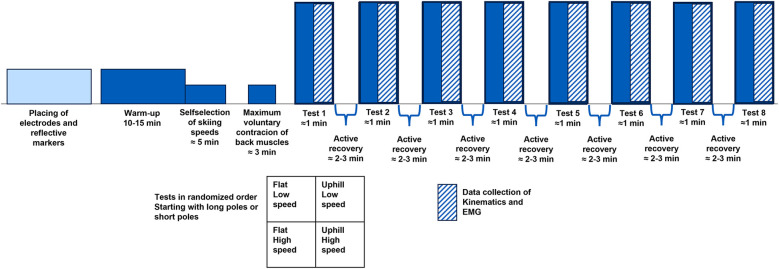
Method: Eleven elite cross-country skiers performed skiing trials on a treadmill, varying in incline (flat vs. 6°), intensity (two self-selected speeds, training speed and racing speed), and pole lengths. Muscle activity was measured by surface electromyography on the erector spinae thoracic and lumbar muscles, on the left and right side. A motion capture system was used for kinematic analysis of the lower back-pole moment arm and the hip angle during the DP cycle.
Results: Compared to men, female skiers had a significantly higher (p < 0.001), overall muscle activation for the m. erector spinae lumbar on both the left and right side (26% of MVC vs. 15% of MVC, and 28% of MVC vs. 22% of MVC, for the left and right side, respectively). No correlations were found, neither between muscle activation to the lower back-pole moment arm, or to the hip angle.
Conclusion: The findings suggest that female skiers experience significantly higher lumbar erector spinae activation during DP, potentially indicating greater susceptibility to back-related issues. The results also highlight the need to tailor training and right adapted equipment to mitigate lower back stress, especially in flat terrain high-intensity conditions. The asymmetrical muscle activity and gender differences underscores the need for further investigation into biomechanical factors influencing back muscle engagement in cross-country skiing.






 京公网安备 11010802042870号
京ICP备2023020795号-1
京公网安备 11010802042870号
京ICP备2023020795号-1

 分享
分享
 求助内容:
求助内容: 应助结果提醒方式:
 扫码关注我们
