{"title":"Clinical application of targeted next-generation sequencing in pneumonia diagnosis among cancer patients.","authors":"Ke Yang, Jiuzhou Zhao, Tingjie Wang, Zhizhong Wang, Rui Sun, Dejian Gu, Hao Liu, Weizhen Wang, Cuiyun Zhang, Chengzhi Zhao, Yongjun Guo, Jie Ma, Bing Wei","doi":"10.3389/fcimb.2025.1497198","DOIUrl":null,"url":null,"abstract":"<p><strong>Background: </strong>Cancer patients are highly susceptible to infections due to their immunocompromised state from both the malignancy and intensive treatments. Accurate and timely identification of causative pathogens is crucial for effective management and treatment. Targeted next-generation sequencing (tNGS) has become an important tool in clinical infectious disease diagnosis because of its broad microbial detection range and acceptable cost. However, there is currently a lack of systematic research to evaluate the diagnostic value of this method in cancer patients.</p><p><strong>Methods: </strong>To evaluate the diagnostic value of tNGS for cancer patients with pneumonia, a retrospective analysis was conducted on 148 patients with suspected pneumonia who were treated at the Henan Cancer Hospital. The tNGS results were compared with conventional microbiological tests (CMT) and clinical diagnoses based on symptoms and imaging studies to assess the diagnostic performance of tNGS in cancer patients with pneumonia.</p><p><strong>Results: </strong>Among these 148 patients, 130 were ultimately diagnosed with pneumonia. tNGS demonstrated significantly higher sensitivity (84.62% vs. 56.92%) and diagnostic accuracy (85.81% vs. 62.16%) compared to the CMT method. The tNGS method identified more pathogens than CMT method (87.50% vs 57.14%), regardless of whether they were bacteria, fungi, or viruses, primarily due to its broader pathogen detection range and higher sensitivity compared to the CMT method. tNGS had significantly higher diagnostic accuracy for <i>Pneumocystis jirovecii</i> and <i>Legionella pneumophil</i>a than the CMT method, but for most pathogens, tNGS showed higher sensitivity but with a correspondingly lower specificity compared to CMT.</p><p><strong>Conclusion: </strong>tNGS demonstrates higher sensitivity and a broader pathogen detection spectrum compared to CMT, making it a valuable diagnostic tool for managing pneumonia in cancer patients.</p>","PeriodicalId":12458,"journal":{"name":"Frontiers in Cellular and Infection Microbiology","volume":"15 ","pages":"1497198"},"PeriodicalIF":4.8000,"publicationDate":"2025-02-18","publicationTypes":"Journal Article","fieldsOfStudy":null,"isOpenAccess":false,"openAccessPdf":"https://www.ncbi.nlm.nih.gov/pmc/articles/PMC11876428/pdf/","citationCount":"0","resultStr":null,"platform":"Semanticscholar","paperid":null,"PeriodicalName":"Frontiers in Cellular and Infection Microbiology","FirstCategoryId":"3","ListUrlMain":"https://doi.org/10.3389/fcimb.2025.1497198","RegionNum":2,"RegionCategory":"医学","ArticlePicture":[],"TitleCN":null,"AbstractTextCN":null,"PMCID":null,"EPubDate":"2025/1/1 0:00:00","PubModel":"eCollection","JCR":"Q2","JCRName":"IMMUNOLOGY","Score":null,"Total":0}
引用次数: 0
Abstract
Background: Cancer patients are highly susceptible to infections due to their immunocompromised state from both the malignancy and intensive treatments. Accurate and timely identification of causative pathogens is crucial for effective management and treatment. Targeted next-generation sequencing (tNGS) has become an important tool in clinical infectious disease diagnosis because of its broad microbial detection range and acceptable cost. However, there is currently a lack of systematic research to evaluate the diagnostic value of this method in cancer patients.
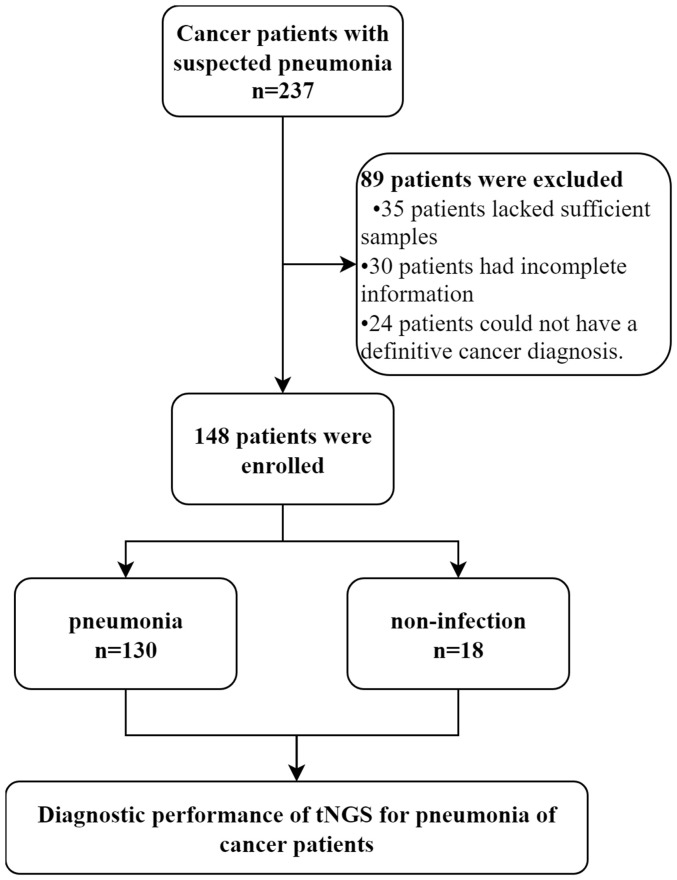
Methods: To evaluate the diagnostic value of tNGS for cancer patients with pneumonia, a retrospective analysis was conducted on 148 patients with suspected pneumonia who were treated at the Henan Cancer Hospital. The tNGS results were compared with conventional microbiological tests (CMT) and clinical diagnoses based on symptoms and imaging studies to assess the diagnostic performance of tNGS in cancer patients with pneumonia.
Results: Among these 148 patients, 130 were ultimately diagnosed with pneumonia. tNGS demonstrated significantly higher sensitivity (84.62% vs. 56.92%) and diagnostic accuracy (85.81% vs. 62.16%) compared to the CMT method. The tNGS method identified more pathogens than CMT method (87.50% vs 57.14%), regardless of whether they were bacteria, fungi, or viruses, primarily due to its broader pathogen detection range and higher sensitivity compared to the CMT method. tNGS had significantly higher diagnostic accuracy for Pneumocystis jirovecii and Legionella pneumophila than the CMT method, but for most pathogens, tNGS showed higher sensitivity but with a correspondingly lower specificity compared to CMT.
Conclusion: tNGS demonstrates higher sensitivity and a broader pathogen detection spectrum compared to CMT, making it a valuable diagnostic tool for managing pneumonia in cancer patients.
背景:肿瘤患者由于恶性肿瘤和强化治疗导致免疫功能低下,极易发生感染。准确和及时地识别致病病原体对于有效的管理和治疗至关重要。靶向新一代测序(tNGS)因其广泛的微生物检测范围和可接受的成本,已成为临床传染病诊断的重要工具。然而,目前还缺乏系统的研究来评估该方法对癌症患者的诊断价值。方法:对河南省肿瘤医院收治的148例疑似肺炎患者进行回顾性分析,以评价tNGS对肿瘤合并肺炎的诊断价值。将tNGS结果与常规微生物试验(CMT)和基于症状和影像学检查的临床诊断进行比较,以评估tNGS对癌症合并肺炎患者的诊断效果。结果:148例患者中,130例最终诊断为肺炎。与CMT相比,tNGS的敏感性(84.62% vs. 56.92%)和诊断准确性(85.81% vs. 62.16%)显著提高。无论是细菌、真菌还是病毒,tNGS方法都比CMT方法鉴定出更多的病原体(87.50% vs 57.14%),这主要是由于tNGS方法的病原体检测范围比CMT方法更广,灵敏度更高。与CMT相比,tNGS对耶氏肺囊虫和嗜肺军团菌的诊断准确率明显高于CMT,但对大多数病原体,tNGS的敏感性较高,但特异性相应较低。结论:与CMT相比,tNGS具有更高的灵敏度和更广泛的病原体检测谱,是治疗癌症患者肺炎的有价值的诊断工具。
期刊介绍:
Frontiers in Cellular and Infection Microbiology is a leading specialty journal, publishing rigorously peer-reviewed research across all pathogenic microorganisms and their interaction with their hosts. Chief Editor Yousef Abu Kwaik, University of Louisville is supported by an outstanding Editorial Board of international experts. This multidisciplinary open-access journal is at the forefront of disseminating and communicating scientific knowledge and impactful discoveries to researchers, academics, clinicians and the public worldwide.
Frontiers in Cellular and Infection Microbiology includes research on bacteria, fungi, parasites, viruses, endosymbionts, prions and all microbial pathogens as well as the microbiota and its effect on health and disease in various hosts. The research approaches include molecular microbiology, cellular microbiology, gene regulation, proteomics, signal transduction, pathogenic evolution, genomics, structural biology, and virulence factors as well as model hosts. Areas of research to counteract infectious agents by the host include the host innate and adaptive immune responses as well as metabolic restrictions to various pathogenic microorganisms, vaccine design and development against various pathogenic microorganisms, and the mechanisms of antibiotic resistance and its countermeasures.





 京公网安备 11010802042870号
京ICP备2023020795号-1
京公网安备 11010802042870号
京ICP备2023020795号-1

 分享
分享
 求助内容:
求助内容: 应助结果提醒方式:
 扫码关注我们
