Adwait Pradhan , Fengyuan Yang , Kapish Karan , Thomas Durig , Quyen Schwing , Brian Haight , Mark Costello , Mark Anderson , Feng Zhang
{"title":"Material-sparing degradation-kinetics model for thermolabile drug stability assessment during twin-screw melt granulation – Insights with gabapentin","authors":"Adwait Pradhan , Fengyuan Yang , Kapish Karan , Thomas Durig , Quyen Schwing , Brian Haight , Mark Costello , Mark Anderson , Feng Zhang","doi":"10.1016/j.ijpharm.2025.125421","DOIUrl":null,"url":null,"abstract":"<div><div>Twin-Screw Melt Granulation (TSMG) has emerged as a viable manufacturing process for continuous granulation due to short residence time (<1 min) while maintaining drug crystallinity. However, TSMG relies on heat and shear, making it challenging to process thermolabile drugs like gabapentin (GABA). The absence of a material-sparing model to evaluate TSMG feasibility for such drugs has limited adoption. This study aims to develop an empirical model based on the degradation kinetics of thermolabile drugs. In this work, GABA-HPC (Hydroxypropylcellulose) model system with gabalactam (GABA-L) as degradant was selected. In-process sampling using screw pullout indicated GABA degradation followed different rates in pre-granulation (before kneading zone) and granulation sections(kneading zone to discharge) due to the granule growth and attrition downstream of kneading zone. Leveraging DSC and ball-milling to simulate the stresses encountered during TSMG, a model was developed linking the GABA degradation kinetics of milled and unmilled blends to granule temperature and residence time, providing a comprehensive approach for calculating GABA-L. One key finding was that only 10–30 % GABA-L degraded in pre-granulation while majority of degradation occurred in the granulation section despite its shorter residence time (30–35 % of total) highlighting the importance of a deeper mechanistic understanding of TSMG. The combined model encapsulating both sections showed promise as predicted %GABA-L correlated well with actual %GABA-L after TSMG (R2 = 0.927) for various granulation runs conducted with 30° and 60° kneading block configurations. This work represents one of the first attempts at developing a material-sparing model for feasibility evaluation studies for TSMG of thermolabile drugs.</div></div>","PeriodicalId":14187,"journal":{"name":"International Journal of Pharmaceutics","volume":"674 ","pages":"Article 125421"},"PeriodicalIF":5.2000,"publicationDate":"2025-03-02","publicationTypes":"Journal Article","fieldsOfStudy":null,"isOpenAccess":false,"openAccessPdf":"","citationCount":"0","resultStr":null,"platform":"Semanticscholar","paperid":null,"PeriodicalName":"International Journal of Pharmaceutics","FirstCategoryId":"3","ListUrlMain":"https://www.sciencedirect.com/science/article/pii/S0378517325002571","RegionNum":2,"RegionCategory":"医学","ArticlePicture":[],"TitleCN":null,"AbstractTextCN":null,"PMCID":null,"EPubDate":"","PubModel":"","JCR":"Q1","JCRName":"PHARMACOLOGY & PHARMACY","Score":null,"Total":0}
引用次数: 0
Abstract
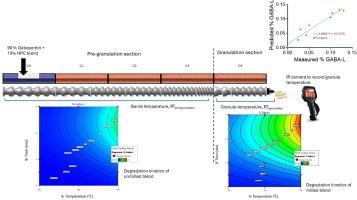
Twin-Screw Melt Granulation (TSMG) has emerged as a viable manufacturing process for continuous granulation due to short residence time (<1 min) while maintaining drug crystallinity. However, TSMG relies on heat and shear, making it challenging to process thermolabile drugs like gabapentin (GABA). The absence of a material-sparing model to evaluate TSMG feasibility for such drugs has limited adoption. This study aims to develop an empirical model based on the degradation kinetics of thermolabile drugs. In this work, GABA-HPC (Hydroxypropylcellulose) model system with gabalactam (GABA-L) as degradant was selected. In-process sampling using screw pullout indicated GABA degradation followed different rates in pre-granulation (before kneading zone) and granulation sections(kneading zone to discharge) due to the granule growth and attrition downstream of kneading zone. Leveraging DSC and ball-milling to simulate the stresses encountered during TSMG, a model was developed linking the GABA degradation kinetics of milled and unmilled blends to granule temperature and residence time, providing a comprehensive approach for calculating GABA-L. One key finding was that only 10–30 % GABA-L degraded in pre-granulation while majority of degradation occurred in the granulation section despite its shorter residence time (30–35 % of total) highlighting the importance of a deeper mechanistic understanding of TSMG. The combined model encapsulating both sections showed promise as predicted %GABA-L correlated well with actual %GABA-L after TSMG (R2 = 0.927) for various granulation runs conducted with 30° and 60° kneading block configurations. This work represents one of the first attempts at developing a material-sparing model for feasibility evaluation studies for TSMG of thermolabile drugs.
期刊介绍:
The International Journal of Pharmaceutics is the third most cited journal in the "Pharmacy & Pharmacology" category out of 366 journals, being the true home for pharmaceutical scientists concerned with the physical, chemical and biological properties of devices and delivery systems for drugs, vaccines and biologicals, including their design, manufacture and evaluation. This includes evaluation of the properties of drugs, excipients such as surfactants and polymers and novel materials. The journal has special sections on pharmaceutical nanotechnology and personalized medicines, and publishes research papers, reviews, commentaries and letters to the editor as well as special issues.



 京公网安备 11010802042870号
京ICP备2023020795号-1
京公网安备 11010802042870号
京ICP备2023020795号-1

 分享
分享
 求助内容:
求助内容: 应助结果提醒方式:
 扫码关注我们
