Integrating network pharmacology and experimental validation to explore the potential mechanism by which resveratrol acts on osimertinib resistance in lung cancer.
{"title":"Integrating network pharmacology and experimental validation to explore the potential mechanism by which resveratrol acts on osimertinib resistance in lung cancer.","authors":"Xin Yu, Yuan Yao, Haiwen Zhou, Jintao Zhu, Nini Zhang, Shuliu Sang, Hailun Zhou","doi":"10.3892/ol.2025.14938","DOIUrl":null,"url":null,"abstract":"<p><p>Globally, osimertinib resistance has been a long-term challenge. Resveratrol, a naturally occurring polyphenolic compound found in various plants, has the potential to modulate multidrug resistance mechanisms. However, the specific role of resveratrol in delaying osimertinib resistance in lung cancer is still unclear. The present study aimed to investigate the therapeutic effects and underlying mechanisms of resveratrol in delaying osimertinib resistance. Accordingly, the corresponding targets of resveratrol were screened through the Traditional Chinese Medicine Systems Pharmacology database. Similarly, the corresponding targets for osimertinib resistance were mined from the GeneCards database. A protein-protein interaction network was subsequently constructed to pinpoint key hub genes that resveratrol may target to delay resistance. Molecular docking analysis was then employed to assess the binding energy between the predicted key targets and resveratrol. Finally, <i>in vitro</i> experiments were performed to validate the results. Ultimately, 13 potential therapeutic targets of resveratrol related to delaying osimertinib resistance were identified. Kyoto Encyclopedia of Genes and Genomes analysis suggested that the effects of resveratrol may be associated with the apoptotic pathway. Molecular docking revealed that resveratrol has good binding affinities with MCL1 and BCL2L11. <i>In vitro</i> experiments confirmed that resveratrol inhibited the proliferation of osimertinib-resistant cells and upregulated the expression of BCL2L11. In conclusion, resveratrol may promote apoptosis by targeting BCL2L11 to delay osimertinib resistance.</p>","PeriodicalId":19503,"journal":{"name":"Oncology Letters","volume":"29 4","pages":"192"},"PeriodicalIF":2.2000,"publicationDate":"2025-02-20","publicationTypes":"Journal Article","fieldsOfStudy":null,"isOpenAccess":false,"openAccessPdf":"https://www.ncbi.nlm.nih.gov/pmc/articles/PMC11877012/pdf/","citationCount":"0","resultStr":null,"platform":"Semanticscholar","paperid":null,"PeriodicalName":"Oncology Letters","FirstCategoryId":"3","ListUrlMain":"https://doi.org/10.3892/ol.2025.14938","RegionNum":4,"RegionCategory":"医学","ArticlePicture":[],"TitleCN":null,"AbstractTextCN":null,"PMCID":null,"EPubDate":"2025/4/1 0:00:00","PubModel":"eCollection","JCR":"Q3","JCRName":"ONCOLOGY","Score":null,"Total":0}
引用次数: 0
Abstract
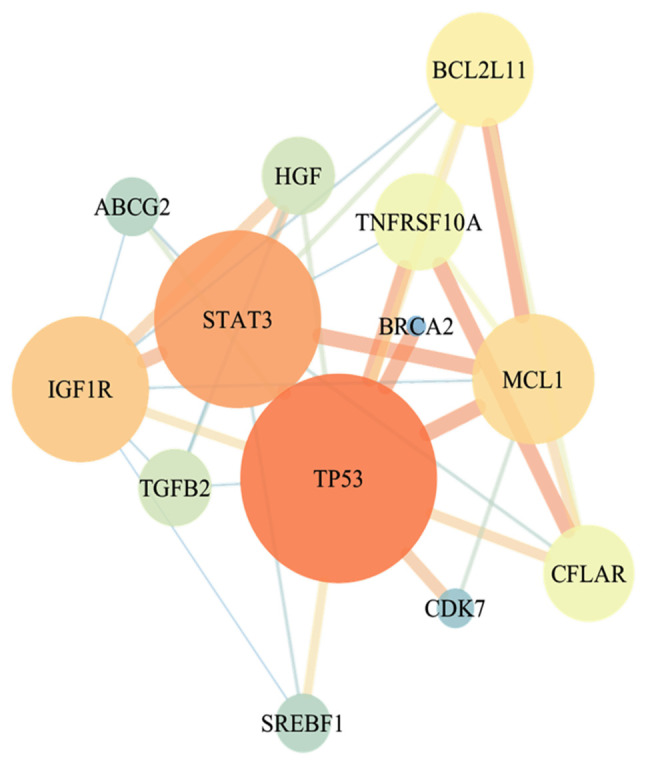
Globally, osimertinib resistance has been a long-term challenge. Resveratrol, a naturally occurring polyphenolic compound found in various plants, has the potential to modulate multidrug resistance mechanisms. However, the specific role of resveratrol in delaying osimertinib resistance in lung cancer is still unclear. The present study aimed to investigate the therapeutic effects and underlying mechanisms of resveratrol in delaying osimertinib resistance. Accordingly, the corresponding targets of resveratrol were screened through the Traditional Chinese Medicine Systems Pharmacology database. Similarly, the corresponding targets for osimertinib resistance were mined from the GeneCards database. A protein-protein interaction network was subsequently constructed to pinpoint key hub genes that resveratrol may target to delay resistance. Molecular docking analysis was then employed to assess the binding energy between the predicted key targets and resveratrol. Finally, in vitro experiments were performed to validate the results. Ultimately, 13 potential therapeutic targets of resveratrol related to delaying osimertinib resistance were identified. Kyoto Encyclopedia of Genes and Genomes analysis suggested that the effects of resveratrol may be associated with the apoptotic pathway. Molecular docking revealed that resveratrol has good binding affinities with MCL1 and BCL2L11. In vitro experiments confirmed that resveratrol inhibited the proliferation of osimertinib-resistant cells and upregulated the expression of BCL2L11. In conclusion, resveratrol may promote apoptosis by targeting BCL2L11 to delay osimertinib resistance.
期刊介绍:
Oncology Letters is a monthly, peer-reviewed journal, available in print and online, that focuses on all aspects of clinical oncology, as well as in vitro and in vivo experimental model systems relevant to the mechanisms of disease.
The principal aim of Oncology Letters is to provide the prompt publication of original studies of high quality that pertain to clinical oncology, chemotherapy, oncogenes, carcinogenesis, metastasis, epidemiology and viral oncology in the form of original research, reviews and case reports.





 京公网安备 11010802042870号
京ICP备2023020795号-1
京公网安备 11010802042870号
京ICP备2023020795号-1

 分享
分享
 求助内容:
求助内容: 应助结果提醒方式:
 扫码关注我们
