Chao Wang, Jeevan Sreerama, Benjamin Nham, Nicole Reid, Nese Ozalp, James O Thomas, Cecilia Cappelen-Smith, Zeljka Calic, Andrew P Bradshaw, Sally M Rosengren, Gülden Akdal, G Michael Halmagyi, Deborah A Black, David Burke, Mukesh Prasad, Gnana K Bharathy, Miriam S Welgampola
{"title":"Separation of stroke from vestibular neuritis using the video head impulse test: machine learning models versus expert clinicians.","authors":"Chao Wang, Jeevan Sreerama, Benjamin Nham, Nicole Reid, Nese Ozalp, James O Thomas, Cecilia Cappelen-Smith, Zeljka Calic, Andrew P Bradshaw, Sally M Rosengren, Gülden Akdal, G Michael Halmagyi, Deborah A Black, David Burke, Mukesh Prasad, Gnana K Bharathy, Miriam S Welgampola","doi":"10.1007/s00415-025-12918-3","DOIUrl":null,"url":null,"abstract":"<p><strong>Background: </strong>Acute vestibular syndrome usually represents either vestibular neuritis (VN), an innocuous viral illness, or posterior circulation stroke (PCS), a potentially life-threatening event. The video head impulse test (VHIT) is a quantitative measure of the vestibulo-ocular reflex that can distinguish between these two diagnoses. It can be rapidly performed at the bedside by any trained healthcare professional but requires interpretation by an expert clinician. We developed machine learning models to differentiate between PCS and VN using only the VHIT.</p><p><strong>Methods: </strong>We trained machine learning classification models using unedited head- and eye-velocity data from acute VHIT performed in an Emergency Room on patients presenting with acute vestibular syndrome and whose final diagnosis was VN or PCS. The models were validated using an independent test dataset collected at a second institution. We compared the performance of the models against expert clinicians as well as a widely used VHIT metric: the gain cutoff value.</p><p><strong>Results: </strong>The training and test datasets comprised 252 and 49 patients, respectively. In the test dataset, the best machine learning model identified VN with 87.8% (95% CI 77.6%-95.9%) accuracy. Model performance was not significantly different (p = 0.56) from that of blinded expert clinicians who achieved 85.7% accuracy (75.5%-93.9%) and was superior (p = 0.01) to that of the optimal gain cutoff value (75.5% accuracy (63.8%-85.7%)).</p><p><strong>Conclusion: </strong>Machine learning models can effectively differentiate PCS from VN using only VHIT data, with comparable accuracy to expert clinicians. They hold promise as a tool to assist Emergency Room clinicians evaluating patients with acute vestibular syndrome.</p>","PeriodicalId":16558,"journal":{"name":"Journal of Neurology","volume":"272 3","pages":"248"},"PeriodicalIF":4.6000,"publicationDate":"2025-03-05","publicationTypes":"Journal Article","fieldsOfStudy":null,"isOpenAccess":false,"openAccessPdf":"https://www.ncbi.nlm.nih.gov/pmc/articles/PMC11882619/pdf/","citationCount":"0","resultStr":null,"platform":"Semanticscholar","paperid":null,"PeriodicalName":"Journal of Neurology","FirstCategoryId":"3","ListUrlMain":"https://doi.org/10.1007/s00415-025-12918-3","RegionNum":2,"RegionCategory":"医学","ArticlePicture":[],"TitleCN":null,"AbstractTextCN":null,"PMCID":null,"EPubDate":"","PubModel":"","JCR":"Q1","JCRName":"CLINICAL NEUROLOGY","Score":null,"Total":0}
引用次数: 0
Abstract
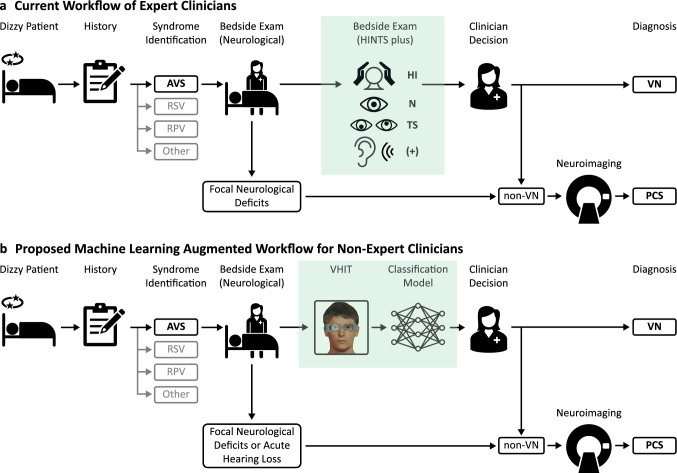
Background: Acute vestibular syndrome usually represents either vestibular neuritis (VN), an innocuous viral illness, or posterior circulation stroke (PCS), a potentially life-threatening event. The video head impulse test (VHIT) is a quantitative measure of the vestibulo-ocular reflex that can distinguish between these two diagnoses. It can be rapidly performed at the bedside by any trained healthcare professional but requires interpretation by an expert clinician. We developed machine learning models to differentiate between PCS and VN using only the VHIT.
Methods: We trained machine learning classification models using unedited head- and eye-velocity data from acute VHIT performed in an Emergency Room on patients presenting with acute vestibular syndrome and whose final diagnosis was VN or PCS. The models were validated using an independent test dataset collected at a second institution. We compared the performance of the models against expert clinicians as well as a widely used VHIT metric: the gain cutoff value.
Results: The training and test datasets comprised 252 and 49 patients, respectively. In the test dataset, the best machine learning model identified VN with 87.8% (95% CI 77.6%-95.9%) accuracy. Model performance was not significantly different (p = 0.56) from that of blinded expert clinicians who achieved 85.7% accuracy (75.5%-93.9%) and was superior (p = 0.01) to that of the optimal gain cutoff value (75.5% accuracy (63.8%-85.7%)).
Conclusion: Machine learning models can effectively differentiate PCS from VN using only VHIT data, with comparable accuracy to expert clinicians. They hold promise as a tool to assist Emergency Room clinicians evaluating patients with acute vestibular syndrome.
期刊介绍:
The Journal of Neurology is an international peer-reviewed journal which provides a source for publishing original communications and reviews on clinical neurology covering the whole field.
In addition, Letters to the Editors serve as a forum for clinical cases and the exchange of ideas which highlight important new findings. A section on Neurological progress serves to summarise the major findings in certain fields of neurology. Commentaries on new developments in clinical neuroscience, which may be commissioned or submitted, are published as editorials.
Every neurologist interested in the current diagnosis and treatment of neurological disorders needs access to the information contained in this valuable journal.





 京公网安备 11010802042870号
京ICP备2023020795号-1
京公网安备 11010802042870号
京ICP备2023020795号-1

 分享
分享
 求助内容:
求助内容: 应助结果提醒方式:
 扫码关注我们
