Nima Naseh, Tânia F. Vaz, Hugo Ferreira, Nuno Canto Moreira, Lena Hellström-Westas, Fredrik Ahlsson, Johan Ågren
{"title":"Impact of early nutrition on brain development and neurocognitive outcomes in very preterm infants","authors":"Nima Naseh, Tânia F. Vaz, Hugo Ferreira, Nuno Canto Moreira, Lena Hellström-Westas, Fredrik Ahlsson, Johan Ågren","doi":"10.1038/s41390-025-03964-8","DOIUrl":null,"url":null,"abstract":"Malnutrition of preterm infants may negatively affect brain growth and later neurocognitive function. We aimed to investigate the association between very preterm infants’ macronutrient intakes, and brain MRI at term and neurodevelopment at 2 years. Single-center, retrospective cohort including extremely (22–27w) and very (28–31w) preterm infants born 2011–2014. The intakes of fluid, protein, carbohydrate, fat, and total calories during days 0–28 together with body weights were assessed in relation to brain MRI (morphology, volumetry, diffusion-weighted imaging) at term, and cognition (BSID-III) at 2 years, using adjusted multivariable regression analyses. Seventy-two infants were included. A lower (p < 0.001) caloric intake in extremely preterm (n = 26) than in very preterm (n = 46) infants did not translate to any differences in brain volumes. While bivariate correlations (p < 0.01) were found between the enteral intakes of all macronutrients, and white matter volume and apparent diffusion coefficients, none of the correlations remained significant after adjusting for covariates in the multivariable analysis. Similarly, no associations between nutrient intakes and cognitive development remained after covariate adjustment. In a cohort of preterm infants receiving macronutrient intakes meeting current recommendations, individual variations in nutrition did not influence brain growth or neurodevelopment.","PeriodicalId":19829,"journal":{"name":"Pediatric Research","volume":"98 2","pages":"593-598"},"PeriodicalIF":3.1000,"publicationDate":"2025-03-04","publicationTypes":"Journal Article","fieldsOfStudy":null,"isOpenAccess":false,"openAccessPdf":"https://www.nature.comhttps://www.nature.com/articles/s41390-025-03964-8.pdf","citationCount":"0","resultStr":null,"platform":"Semanticscholar","paperid":null,"PeriodicalName":"Pediatric Research","FirstCategoryId":"3","ListUrlMain":"https://www.nature.com/articles/s41390-025-03964-8","RegionNum":3,"RegionCategory":"医学","ArticlePicture":[],"TitleCN":null,"AbstractTextCN":null,"PMCID":null,"EPubDate":"","PubModel":"","JCR":"Q1","JCRName":"PEDIATRICS","Score":null,"Total":0}
引用次数: 0
Abstract
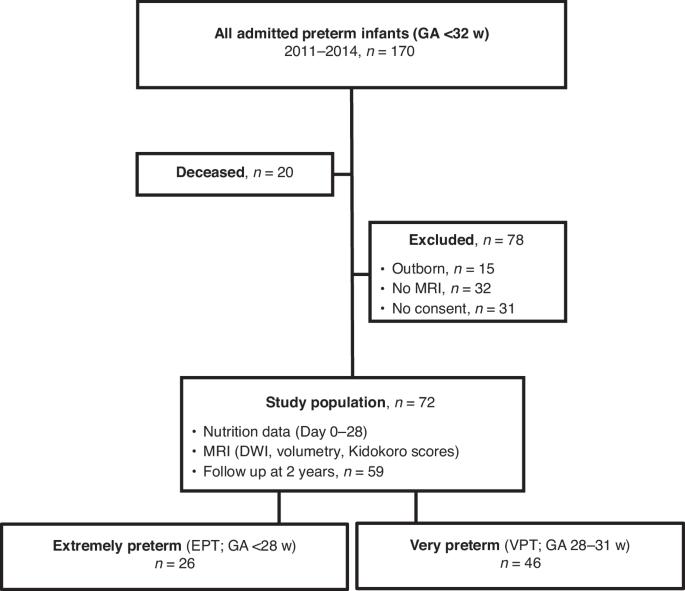
Malnutrition of preterm infants may negatively affect brain growth and later neurocognitive function. We aimed to investigate the association between very preterm infants’ macronutrient intakes, and brain MRI at term and neurodevelopment at 2 years. Single-center, retrospective cohort including extremely (22–27w) and very (28–31w) preterm infants born 2011–2014. The intakes of fluid, protein, carbohydrate, fat, and total calories during days 0–28 together with body weights were assessed in relation to brain MRI (morphology, volumetry, diffusion-weighted imaging) at term, and cognition (BSID-III) at 2 years, using adjusted multivariable regression analyses. Seventy-two infants were included. A lower (p < 0.001) caloric intake in extremely preterm (n = 26) than in very preterm (n = 46) infants did not translate to any differences in brain volumes. While bivariate correlations (p < 0.01) were found between the enteral intakes of all macronutrients, and white matter volume and apparent diffusion coefficients, none of the correlations remained significant after adjusting for covariates in the multivariable analysis. Similarly, no associations between nutrient intakes and cognitive development remained after covariate adjustment. In a cohort of preterm infants receiving macronutrient intakes meeting current recommendations, individual variations in nutrition did not influence brain growth or neurodevelopment.
期刊介绍:
Pediatric Research publishes original papers, invited reviews, and commentaries on the etiologies of children''s diseases and
disorders of development, extending from molecular biology to epidemiology. Use of model organisms and in vitro techniques
relevant to developmental biology and medicine are acceptable, as are translational human studies



 京公网安备 11010802042870号
京ICP备2023020795号-1
京公网安备 11010802042870号
京ICP备2023020795号-1

 分享
分享
 求助内容:
求助内容: 应助结果提醒方式:
 扫码关注我们
