Jinwei Zhu, Ziming Liu, Chunbo Lou, Quan Chen, Haiyan Liu
{"title":"Decoding and reengineering the promoter specificity of T7-like RNA polymerases based on phage genome sequences.","authors":"Jinwei Zhu, Ziming Liu, Chunbo Lou, Quan Chen, Haiyan Liu","doi":"10.1093/nar/gkaf140","DOIUrl":null,"url":null,"abstract":"<p><p>The single subunit RNA polymerases (ssRNAPs) of bacteriophages are highly interesting targets for the prediction and engineering of specific protein-DNA interactions. Despite extensive existing studies focusing on particular ssRNAPs such as the T7 RNAP, few rules governing the protein-DNA sequence covariations across diverse ssRNAPs and their cognate promoters are clearly known. Here, aiming to reveal such rules, we comprehensively mined promoters of various categories of ssRNAPs from phage genomes. For T7-like RNAPs, direct coupling analyses of the predicted set of RNAP-promoter pairs revealed that the interaction specificity was dominantly encoded by the amino acid and nucleotide residues at only a few key positions. The covariations between the amino acid and the nucleotide residues at these positions were summarized into a sparsely connected network. Using experimentally verified connections in this network, we designed a set of orthogonal T7 RNAP-promoter variants that showed more stringent orthogonality than previously reported sets. We further designed and experimentally verified variants with novel interactions. These results provided guidance for engineering novel RNAP-promoter pairs for synthetic biology or other applications. Our study also demonstrated the use of comprehensive genome mining in combination with sequence covariation analysis in the prediction and engineering of specific protein-DNA interactions.</p>","PeriodicalId":19471,"journal":{"name":"Nucleic Acids Research","volume":"53 5","pages":""},"PeriodicalIF":13.1000,"publicationDate":"2025-02-27","publicationTypes":"Journal Article","fieldsOfStudy":null,"isOpenAccess":false,"openAccessPdf":"https://www.ncbi.nlm.nih.gov/pmc/articles/PMC11880802/pdf/","citationCount":"0","resultStr":null,"platform":"Semanticscholar","paperid":null,"PeriodicalName":"Nucleic Acids Research","FirstCategoryId":"99","ListUrlMain":"https://doi.org/10.1093/nar/gkaf140","RegionNum":2,"RegionCategory":"生物学","ArticlePicture":[],"TitleCN":null,"AbstractTextCN":null,"PMCID":null,"EPubDate":"","PubModel":"","JCR":"Q1","JCRName":"BIOCHEMISTRY & MOLECULAR BIOLOGY","Score":null,"Total":0}
引用次数: 0
Abstract
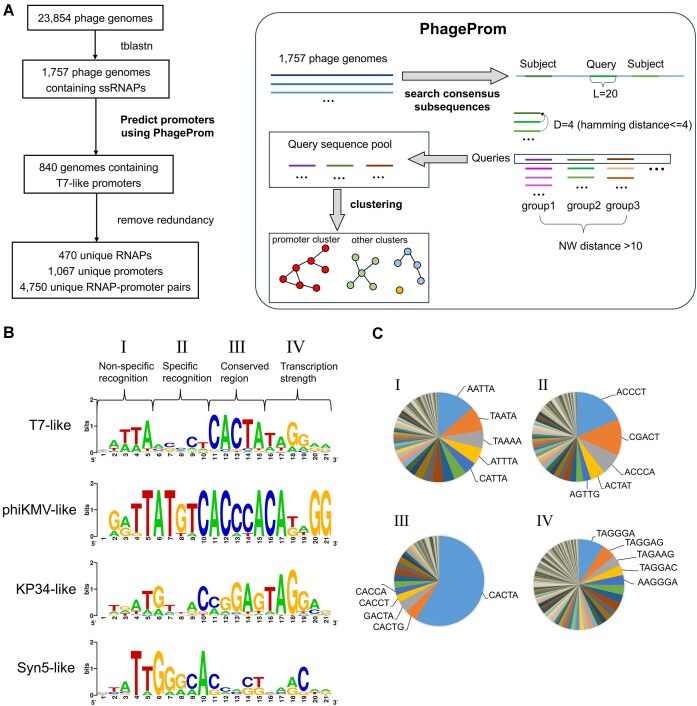
The single subunit RNA polymerases (ssRNAPs) of bacteriophages are highly interesting targets for the prediction and engineering of specific protein-DNA interactions. Despite extensive existing studies focusing on particular ssRNAPs such as the T7 RNAP, few rules governing the protein-DNA sequence covariations across diverse ssRNAPs and their cognate promoters are clearly known. Here, aiming to reveal such rules, we comprehensively mined promoters of various categories of ssRNAPs from phage genomes. For T7-like RNAPs, direct coupling analyses of the predicted set of RNAP-promoter pairs revealed that the interaction specificity was dominantly encoded by the amino acid and nucleotide residues at only a few key positions. The covariations between the amino acid and the nucleotide residues at these positions were summarized into a sparsely connected network. Using experimentally verified connections in this network, we designed a set of orthogonal T7 RNAP-promoter variants that showed more stringent orthogonality than previously reported sets. We further designed and experimentally verified variants with novel interactions. These results provided guidance for engineering novel RNAP-promoter pairs for synthetic biology or other applications. Our study also demonstrated the use of comprehensive genome mining in combination with sequence covariation analysis in the prediction and engineering of specific protein-DNA interactions.
期刊介绍:
Nucleic Acids Research (NAR) is a scientific journal that publishes research on various aspects of nucleic acids and proteins involved in nucleic acid metabolism and interactions. It covers areas such as chemistry and synthetic biology, computational biology, gene regulation, chromatin and epigenetics, genome integrity, repair and replication, genomics, molecular biology, nucleic acid enzymes, RNA, and structural biology. The journal also includes a Survey and Summary section for brief reviews. Additionally, each year, the first issue is dedicated to biological databases, and an issue in July focuses on web-based software resources for the biological community. Nucleic Acids Research is indexed by several services including Abstracts on Hygiene and Communicable Diseases, Animal Breeding Abstracts, Agricultural Engineering Abstracts, Agbiotech News and Information, BIOSIS Previews, CAB Abstracts, and EMBASE.





 京公网安备 11010802042870号
京ICP备2023020795号-1
京公网安备 11010802042870号
京ICP备2023020795号-1

 分享
分享
 求助内容:
求助内容: 应助结果提醒方式:
 扫码关注我们
